

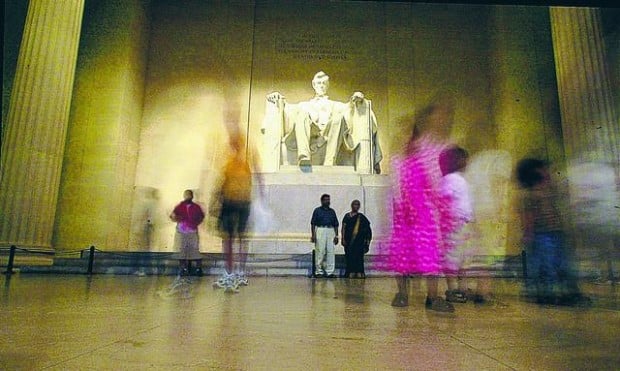
WASHINGTON — Two hundred years after the birth of Abraham Lincoln, we still seek him in words and in action, in lessons from his life, in reminders of his legend — and in pilgrimages to the temple built in his honor.
We are drawn to the Lincoln Memorial in so many ways.
Protesters stand among hundreds of thousands as civil rights are invoked, or peace demanded; the great, godlike head looks on from above as if nodding in approval. Barack Obama makes a surprise appearance just days before taking office, communing with the statue as if to offer a blessing to a much-invoked predecessor and somehow be blessed in return.
Ordinary visitors stop by on a rainy winter's night, as fog and bluish clouds suspend like a canopy over the National Mall: a student from South Africa; a chemical engineer from Amsterdam; a group of American teachers in training, wondering how they might relate to the most human and most mythic of presidents.
People are also reading…
"It does have that deified aspect," said 26-year-old Tim Laughlin, who as a native of Gettysburg, Pa., has lived with Lincoln history for much of his life. "And that's a fine line, because you don't want to look at him as a perfect person, but at the same time you want students to recognize why leaders like Lincoln matter to us."
We measure presidents by how they represent ourselves, and how we wish to be. Lincoln, the rail-splitter raised to destiny by war and to near-divinity by assassination, embodies both. More than George Washington or Thomas Jefferson, Lincoln is our sage and aspiration, the ordinary and unexpected man of greatness, the victor and martyr of the great American narrative, the Civil War.
The Lincoln Memorial, like the Greek temple it was modeled upon, presides stoically above the clashes and climate of worldly affairs. "Quiet — and yet a voice forever," poet Langston Hughes once wrote in tribute to the stern, marbled colossus, 19 feet tall.
It is a first stop for many who visit Washington, an unofficial mecca for organized dissent and as much a minting of the Lincoln image as his profile on the penny.
"It's a wonderful monument. It's overwhelming, magnificent, beautiful. It's deeply, deeply moving," said historian David Herbert Donald, whose "Lincoln" is widely regarded as the best of the endless Lincoln biographies. "It's a symbol of nonpartisan unity, of what the country is capable of at its best."
These feelings are renewed daily at the memorial, with its towering pillars and imposing steps marked by signposts requesting, plainly, "No sliding down banisters." And then, a final warning: "QUIET — RESPECT PLEASE."
Decades ago, around the time the memorial was dedicated, H.L. Mencken mocked "the growth of the Lincoln legend" and the transformation of flesh into plaster. Mencken and other skeptics have labeled Lincoln a racist, an imperialist, a dictator and a buffoon.
But the legend of Lincoln has held, and even grown, if only because we have thought so much harder about him.
"Lincoln's accomplishments and a century and a half of mythologizing have had Lincoln's image so capacious that you can find anything there," said historian Henry Louis Gates, editor of "Lincoln on Race and Slavery" and producer of a new PBS documentary on Lincoln. "Any constituency looks in the mirror and sees Lincoln staring back at them."
The first of the Lincoln mythologers was Abraham Lincoln, born Feb. 12, 1809, in what was indeed a log cabin in Hodgenville, Ky. He was poor, but not humble. His ambition, wrote law partner William Herndon, was "a little engine that knew no rest." However self-deprecating his personality, he didn't need war, the presidency or elective office of any kind to imagine belonging to the ages.
In his lifetime, Lincoln was regarded as very much a man, sometimes less. He was called "the ape baboon of the prairie," a "coarse, vulgar joker," and the "craftiest and most dishonest politician that ever disgraced" public office. His assassin, John Wilkes Booth, was far from the only man who thought Lincoln was a tyrant.
But even contemporaries found qualities fit for a future legend: rustic carriage and righteous sobriety, good-natured wit and poetic wisdom, humanity plain and haunting. Walt Whitman saw a "deep latent sadness in his expression." Nathaniel Hawthorne was struck by his "sallow, queer, sagacious visage, with the homely human sympathies that warmed it."
Sainthood began with Lincoln's murder and evolved over the decades following, in apocryphal stories from ex-slaves of Lincoln visitations, in speeches that referred to him as a Christlike soldier for freedom.
For politicians, Lincoln is a most sacred text — canonical, yet adaptable. No one can say, and thus anyone can, how he would have responded to the Vietnam War, the rise of the Soviet Union, or even global warming and the capital-gains tax.
Presidents of both parties have honored him, and in doing so, honored themselves. Republican Theodore Roosevelt, as much a man of flesh as Lincoln was of bone, praised Lincoln for the "courage and willingness to self-sacrifice" that Roosevelt believed he, too, possessed. Democrat Woodrow Wilson, among the most idealistic and self-righteous of leaders, identified in Lincoln a "very holy and very terrible isolation."
Through the decades, the memorial has been claimed, and reinvented, by Vietnam protesters, religious conservatives and advocates for gay rights.
With the election of Obama, the memorial — and Lincoln — again becomes a symbol of change.


