

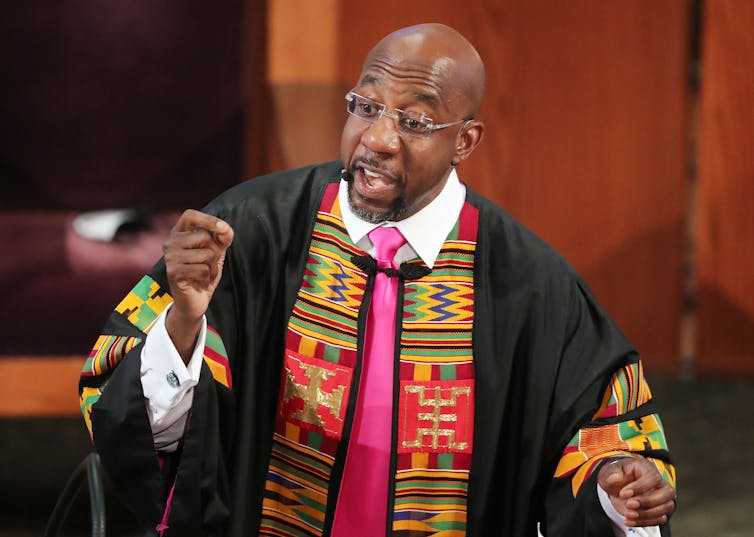
Rev. Raphael G. Warnock delivers a eulogy at Ebenezer Baptist Church.
Raphael Warnock, by winning Georgia’s Senate election against U.S. Sen. Kelly Loeffler, will join Republican Sen. James Lankford as one of two ordained ministers in the Senate chamber. Only about 2% of members of the U.S. House of Representatives are ordained ministers.
People are also reading…
Their numbers are scarce despite the fact that members of the clergy often possess speaking skills, have an impulse to serve and boast strong ties to their communities — all qualities that are useful in politics. Furthermore, Americans are among the most religious people in the Western world.
So why do so few clergy serve in Congress? And what kind of effect might this have on the priorities and policies that emerge from Washington, D.C.?
Lawyers, business people lead the pack
In the “Congress and the Presidency” course that I teach, I discuss the prior professional careers of members of Congress and the way those backgrounds can influence lawmaking.
Almost half of U.S. senators worked as attorneys prior to their political careers, and 147 current members of the U.S. House of Representatives have law degrees. Other than politics, law is the most common former profession of Democrats in Congress, while business is the most common former profession of Republicans.
Lawyers in Congress can write legislation using language that can guide administrative agencies and judges, with an eye toward shielding laws from potential legal challenges. The downside of this practice is that legislative text can be weighed down in legal jargon that only other lawyers can understand.
Meanwhile, the growing ranks of Republican members of Congress with business backgrounds reflect the party’s ideological opposition to government regulation of the private sector.
Each party’s recent presidents reflect their orientation: The last three Republican presidents — Donald Trump, George W. Bush and George H.W. Bush — all worked in business prior to entering politics. Once Joe Biden becomes president, he’ll join Democratic predecessors Barack Obama and Bill Clinton as having graduated from law school.
From the outside looking in
Members of the clergy, however, are far down the list of congressional occupations — behind agriculture, engineering, journalism, labor, medicine, real estate and the military.
Only one former U.S. president, James Garfield, has ties to a previous life at the pulpit — and even those are tenuous. While he’s sometimes described as an ordained minister with the Disciples of Christ — and he did preach to congregations as a young man — there don’t appear to be any clear ordination records. His primary professions before entering politics were as a Civil War general, teacher and attorney.
It’s possible that the lack of clergy members in Congress may bring less attention to spiritual issues in Washington. Morality may be deemed less important, while crafting public policies that help the less fortunate get short shrift.
At the same time, the clergy has long played an active role in American politics outside of elective office, usually working to influence policy and politicians.
Prominent evangelical preachers Jerry Falwell Jr., Franklin Graham, James Dobson and Kenneth Copeland all spoke out in favor of Donald Trump’s reelection.
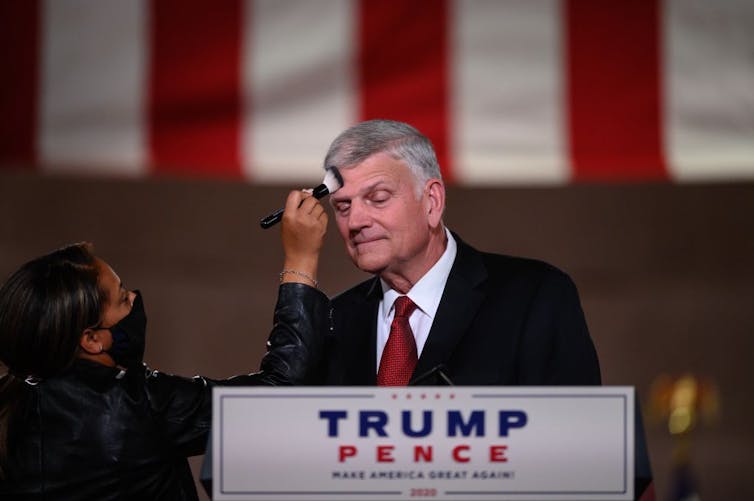
Evangelist Franklin Graham has been a vocal supporter of President Trump.
Reverend Jesse Jackson and Rev. Al Sharpton have each run for the Democratic nomination for president, while Rev. William Barber has garnered attention in recent years for leading “Moral Mondays” protests to advocate for civil rights and progressive causes in Raleigh, North Carolina.
Legal and papal pushback
In the past, there have been legal and doctrinal restrictions on clergy members serving in government.
Up until the 1970s, several states had constitutional restrictions against clergy members serving in the state legislatures, which often serve as a stepping stone for candidates to run for national office.
But in an 8-0 decision, the U.S. Supreme Court ruled in 1978 that such state restrictions violated the free exercise clause of the First Amendment of the U.S. Constitution. The decision allowed Rev. Paul McDaniel, a Baptist minister, to run to be a delegate to a Tennessee state constitutional convention.
Church policy can also discourage clergy running for office. Two Catholic priests who had served in the House of Representatives ended their candidacies in 1980 when Pope John Paul II declared that he would begin strictly enforcing a canon law that priests should not serve in public office.
One of them was Father Robert Drinan, who had served five terms as a U.S. representative from Massachusetts. Drinan was known nationally as a prominent opponent of the Vietnam War, and he had introduced the first impeachment resolution against President Richard Nixon. Drinan’s support of abortion rights was especially controversial among Catholic church leaders.
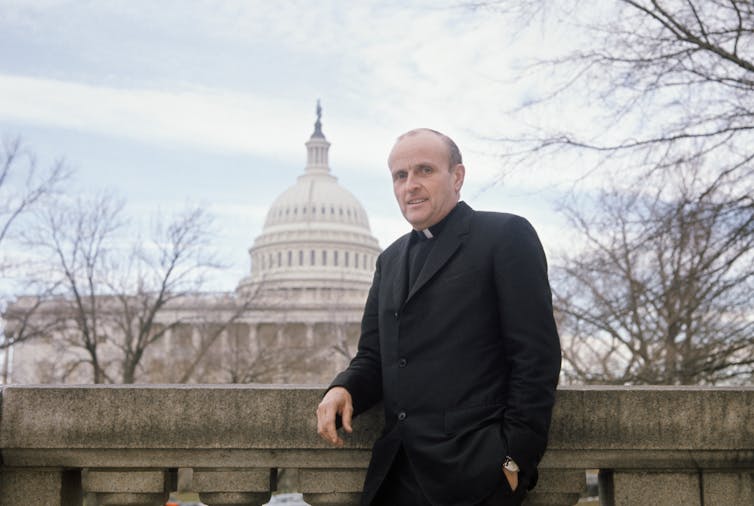
After Pope John Paul II demanded all priests withdraw from electoral politics, Rep. Robert Drinan decided not to seek reelection.
Separation of church and state a core value
Another reason for low numbers of clergy in national elected office may be tied to the country’s longstanding tradition of separating religion from government. In 1802, President Thomas Jefferson famously wrote that the language of the First Amendment to the U.S. Constitution indicated “a wall of separation between Church & State.”
Religion and government are more closely intertwined in many other Western countries. For example, in the United Kingdom, 26 bishops who are leaders in the Church of England are members of the House of Lords.
While most Americans remain religious, the fundamental belief that religion and politics should operate in separate spheres remains strong in the United States. A 2019 Pew Research Forum survey found that 63% of Americans thought that houses of worship should stay out of politics, while 76% of Americans agreed that houses of worship should not openly support political candidates.
Finally, clergy may be at a financial disadvantage when seeking a national political office. The majority of members of Congress last year were millionaires.
With the possible exception of some megachurch leaders, most members of the clergy do not enter their profession for financial reasons, and you won’t see many with the means to self-finance their campaigns.
Could Rev. Warnock’s victory signal a new trend? The U.S. House of Representatives currently has more ordained ministers than at any other time since occupational statistics began to be compiled in Congress in the 1950s. It’ll be the first time in at least 55 years that the U.S. Senate has had two ordained ministers serving at the same time.
In the midst of a recession, a global pandemic, political polarization and climate change, perhaps more voters are looking for spiritual and moral leadership in Washington, D.C.
This article is republished from The Conversation under a Creative Commons license. Read the original article.

6 takeaways from the Georgia runoff elections
6 TAKEAWAYS FROM THE GEORGIA ELECTIONS

Emily Murdock votes in Georgia's U.S. Senate runoff election in Evans, Ga., Tuesday morning, Jan. 5, 2021. Republican Sen. Kelly Loeffler and David Perdue are being challenged by Democrats Jon Ossoff and Raphael Warnock in Tuesday's runoff. (Michael Holahan/The Augusta Chronicle via AP)
The Georgia runoffs that determined control of the U.S. Senate also offered the first clues about the direction of American politics after the turbulent presidency of Donald Trump.
Republicans David Perdue and Sen. Kelly Loeffler are trying to hold off strong challenges from their respective Democratic opponents, Jon Ossoff and Raphael Warnock, in a race where half a billion dollars was spent to shape the outcome.
Here are some early takeaways.
TRUMP'S FALSE CLAIMS FIND FAVOR WITH GOP VOTERS

Sen. Kelly Loeffler, R-Ga., speaks as President Donald Trump listens during a campaign rally in support of Senate candidates Sen. Kelly Loeffler, R-Ga., and David Perdue in Dalton, Ga., Monday, Jan. 4, 2021. (AP Photo/Brynn Anderson)
Trump may have lost the presidency but his campaign to undermine the legitimacy of the election clearly succeeded with Republican voters in Georgia.
About three-quarters of voters who backed Perdue and Loeffler told the AP VoteCast survey that Biden was not legitimately elected in November. AP VoteCast interviewed more than 3,600 voters to measure the electorate's views on a range of topics.
Roughly 9 in 10 of the Republicans' backers said they lacked confidence that votes in November's presidential contest were accurately counted. Half said they have no confidence at all in the vote count. That's roughly five times as many Republicans who said in November they had no confidence that votes would be counted accurately.
That sentiment clearly tracks Trump's false rhetoric about election fraud, a claim that has been rejected by Attorney General William Barr, dozens of federal courts and several prominent Republican senators.
TRUMP STILL A TURNOUT DRIVER -- FOR BOTH SIDES

U.S. Secretary of Agriculture Sonny Perdue, right, and the first cousin of David Perdue embraces a supporter during a Republican election-night watch party, Tuesday, Jan. 5, 2021, in Atlanta. (AP Photo/John Bazemore)
Even though it carried risk, Perdue, who is trying to win a second term after his first one expired Sunday, and Loeffler, an appointed senator trying to win her first election, tethered themselves to Trump every step of the campaign.
Early returns and turnout projections show why.
Democrats were even running stronger in the early voting than they did in November, and that had Republicans nervous. Those worries followed weeks of Trump railing that Biden stole the election, spurring GOP fears that he'd drive some of his loyalists to skip the runoff out of protest while also repelling moderate and GOP-leaning independents in urban and suburban areas.
GOP strategists felt better Tuesday as they watched steady turnout in conservative counties where early voting had lagged the fall pace considerably. Republicans also reported strong turnout in the outer ring of metro Atlanta, counties where Republicans still have troves of votes.
But, as it goes in the era of Trump, Democratic turnout appeared to stay strong as well. Officials in Fulton County, the most populous in the state and home to Atlanta, said Election Day turnout there exceeded what it was in November.
TEAM SPIRIT

Democratic U.S. Senate challenger Jon Ossoff waves after speaking to the media at Dunbar Neighborhood Center during Georgia's Senate runoff elections, Tuesday, Jan. 5, 2021, in Atlanta. (AP Photo/Branden Camp)
The four candidates ran essentially as two teams, a reflection of the national stakes. But there was always the possibility of a split result — most likely driven by a slice of voters who might vote in just one of the two races.
Indeed, as early returns piled up Tuesday night, Warnock consistently had several thousand more votes than Ossoff. The early vote showed a strong Black turnout; Warnock would be Georgia's first Black senator in history.
Republicans needed just one Georgia win for a majority in Washington. Democrats needed both seats.
DEMOCRATS HIGH-TOUCH GROUND GAME

Voters socially distance while waiting in line to cast their votes in the state's runoff election inside the gymnasium at Social Circle Middle School, Tuesday, Jan. 5, 2021, in Social Circle, Ga. Republican Sen. Kelly Loeffler and David Perdue are being challenged by Democrats Jon Ossoff and Raphael Warnock in Tuesday's runoff. (Curtis Compton/Atlanta Journal-Constitution via AP)
Democrats seem to have had a broader reach than Republicans in contacting voters. About 6 in 10 voters say they were contacted on behalf of Democratic candidates, compared with about half for Republican candidates.
Democrats' ground game may have helped them turn out voters. Overall, about 4 in 10 said they were contacted and responded with a pledge or commitment to vote. These voters were more likely to favor Ossoff and Warnock than Perdue and Loeffler.
NEW RESIDENTS CHANGING POLITICS

Election workers check-in, sort, and signature verify absentee ballots for the state's U.S. Senate runoff election at the Beauty P. Baldwin Voter Registrations and Elections Building on Tuesday night, Jan. 5, 2021, in Lawrenceville, Ga. (Curtis Compton/Atlanta Journal-Constitution via AP)
AP VoteCast showed signs that newcomers to Georgia were more Democratic than longtime residents of the state. Those who have lived in the state for longer than 20 years leaned Republican, while those who have moved more recently favored Democrats.


