PHILADELPHIA — As political gridlock puts the government at risk of defaulting, President Joe Biden on Thursday made an opening bid with a budget plan that would cut deficits by $2.9 trillion over the next decade — a proposal Republicans already intend to reject.
It’s part of the president’s broader attempt to call out House Republicans who are demanding severe cuts to spending in return for lifting the government’s legal borrowing limit. The GOP has no counteroffer so far, other than a flat “no” to a Biden blueprint with tax increases on the wealthy that could form the policy backbone of Biden’s yet-to-be-declared campaign for reelection in 2024.
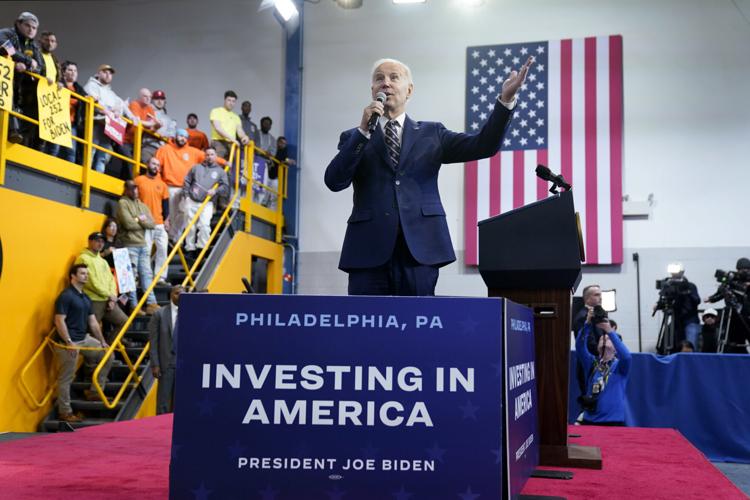
Striding around a stage at a union training center in Philadelphia, Biden spoke about his plan for the government’s finances and how his values contrast with Republican priorities.
“I just laid out the bulk of my budget,” Biden said. “Republicans in Congress should do the same thing. Then we can sit down and see where we disagree.”
People are also reading…
Yet the president doubted GOP lawmakers could make their numbers match their calls for a balanced budget and he suggested efforts to do so could come at the expense of middle-class families.
“How are they going to make the math work?” Biden said. “What are they going to cut?”

President Joe Biden speaks Thursday about his 2024 budget proposal at the Finishing Trades Institute in Philadelphia.
As proposed, Biden’s package of tax and spending priorities is unlikely to pass the GOP-run House or the Senate, where Democrats hold a slim edge.
House Speaker Kevin McCarthy, R-Calif., said the president’s proposed deficit reduction was inadequate. “It just seems like it’s going to create the biggest government in history. I don’t think that’s what we need at this time,” he said.
Biden’s 10-year budget largely revolves around taxing the wealthy to help fund programs for the middle class, older adults and families. It would raise $4.7 trillion from higher taxes, with an additional $800 billion in savings from changes to programs.
The tax increases include a reversal of the 2017 tax cuts made by President Donald Trump on people earning more than $400,000 a year.
Biden floated a new 25% minimum tax on households worth $100 million or more. Also, the tax that companies pay on stock buybacks would rise fourfold and those earning more than $400,000 would pay an additional Medicare tax that would help to keep the program solvent beyond the year 2050. Medicare could negotiate on the prices of more prescription drugs, helping to save the government money.
Accompanying that would be $2.6 trillion worth of new spending, including the restoration of the expanded child tax credit that would give families as much as $3,600 per child, compared with the current level of $2,000. That credit would be “fully refundable,” which means households could receive all of that sum even if they don’t owe any taxes. The budget proposal would impose a $35-a-month cap on insulin prices, matching a change Biden already put in place for Medicare recipients.
At a time of increased tensions with Russia and China, the budget shows a decline in military spending as a share of the U.S. economy over the next decade. But federal spending would be equal to roughly one-quarter of economic output as the spending on Social Security and Medicare climbs, essentially keeping the government the same size as it is currently.
The budget would seek to close the “carried interest” loophole that allows wealthy hedge fund managers and others to pay their taxes at a lower rate, and prevent billionaires from being able to set aside large amounts of their holdings in tax-favored retirement accounts. The plan also projects saving $24 billion over 10 years by removing a tax subsidy for cryptocurrency transactions.

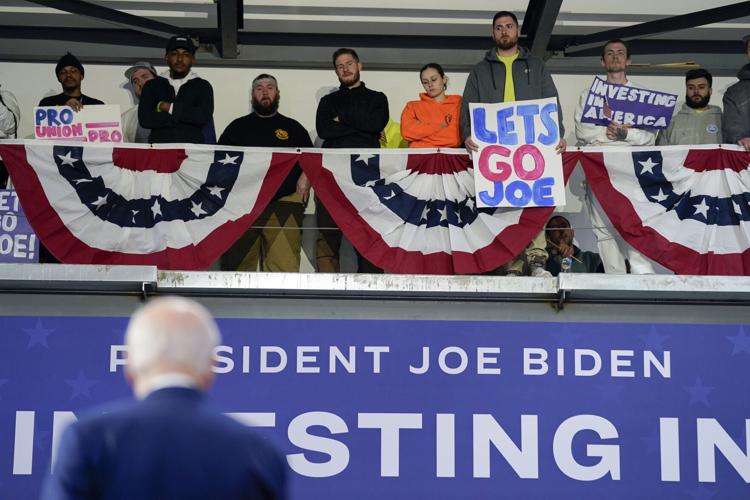
Attendees listen as President Joe Biden speaks Thursday about his 2024 budget proposal at the Finishing Trades Institute in Philadelphia.
By refusing to raise taxes or cut Social Security and Medicare spending, GOP lawmakers face some harsh math that makes it hard to reduce deficits without risking a voter backlash. McCarthy said his plan’s release was pushed back because Biden’s proposal was only now coming out.
With the economy already in a fragile state because of high inflation, if Biden and Congress cannot agree to raise the statutory debt cap of $31.4 trillion by this summer, the government could default on payments and perhaps send the country into a recession.
The budget also shows the shadow of Trump’s legacy, as provisions in his 2017 tax cuts will expire after 2025. Biden wants to eliminate elements of that overhaul, arguing that lower taxes failed to produce the growth Trump promised. But Biden’s budget does not address tax cuts that benefited households making less than $400,000: Their expiration could amount to a tax increase that would violate a pledge by Biden to only raise taxes on the wealthy.
The cost of extending the tax breaks for people making less than $400,000 would be $1.5 trillion, according to Kyle Pomerleau, a senior fellow at the center-right American Enterprise Institute. That would halve the deficit savings being promoted by Biden, but Pomerleau cautioned his estimates might be high because the president’s plan includes the cost of the expanded child tax credit.
In February, the nonpartisan Congressional Budget Office estimated that the national debt held by the public will grow by more than $20 trillion over the next decade.
Here's a breakdown of what's in President Biden's proposed budget
Intro

President Joe Biden released his annual budget Thursday, outlining his policy priorities for the year ahead.
Make no mistake, the proposed budget has no chance of making it through the Republican-controlled House. But Biden's plan could frame upcoming political battles on Capitol Hill, where the GOP has yet to unveil its own spending plan.
Biden's budget comes out after the US hit the debt ceiling, a cap set by Congress, earlier this year. The Treasury Department is now taking extraordinary measures to allow the government to keep paying its bills. But the country could start to default on its obligations over the summer if Congress doesn't address the debt ceiling before then. Republicans are calling for some spending cuts in exchange for voting to raise the cap, while the White House does not want to negotiate on resolving the debt limit drama.
Place a minimum tax on billionaires

Place a minimum tax on billionaires: The budget includes a 25% minimum tax on all the income of the wealthiest .01% of Americans, including their appreciated assets. It would hit those with a net worth of more than $100 million. Prior efforts to add this type of tax were not successful.
Increase the corporate tax rate

Increase the corporate tax rate: Biden wants to increase the corporate tax rate to 28%, up from the 21% rate set by the GOP tax cut package in 2017. The budget would also reduce incentives for multinational businesses to book profits in low-tax jurisdictions and raise the tax rate on their foreign earnings to 21% from 10.5%. And it would hike the stock buybacks tax enacted last year to 4%, from 1%.
Repealing Trump's tax cuts for the wealthy

Repealing Trump's tax cuts for the wealthy: Biden's budget would scrap some tax cuts for certain individuals that were put in place by the Republican's 2017 tax law.
Biden's plan would raise the top tax rate to 39.6% from 37%. This would impact single filers making more than $400,000 a year and married couples making more than $450,000 per year, according to the administration.
It also proposes taxing capital gains at the same rate as wage income for those earning more than $1 million, as well as closing the carried interest loophole that allows investment managers to treat much of their compensation as capital gains -- thus lowering their tax rate.
The Biden administration has previously had trouble getting support for these provisions from some Democrats.
Restore the enhanced child tax credit

Restore the enhanced child tax credit: The budget calls for reviving the expanded child tax credit, which was in place for 2021. It would beef up the credit to $3,600 per child for those under age 6 and $3,000 for older children. It would permanently make the credit fully refundable so more low-income families would qualify.
Improve Medicare's finances

Improve Medicare's finances: Biden wants to shore up Medicare's hospital insurance trust fund, known as Part A, by raising taxes on those earning more than $400,000 a year and by allowing Medicare to negotiate prices for even more drugs.
Medicare, which covers more than 65 million senior citizens and people with disabilities, will only be able to fully pay scheduled benefits until 2028, according to the most recent forecast by its trustees. Biden's proposal would extend Medicare's solvency by 25 years or more, according to the White House.
The plan would increase the net investment income tax rate on earned and unearned income above $400,000 to 5%, up from 3.8%. Also, it would be levied on the owners of certain pass-through firms who include business income on their personal tax returns and aren't currently subject to the tax.
In addition, the measure would dedicate the revenue from the tax, which was created by the Affordable Care Act, to Medicare's hospital insurance trust fund.
Also, the proposal would build on the Inflation Reduction Act, which congressional Democrats passed last summer, by allowing Medicare to negotiate the prices of more drugs and bringing drugs into negotiation sooner after they launch. And it would extend the law's requirement that drug companies pay rebates to Medicare if they increase prices faster than inflation to commercial health insurance.
$35 insulin for all Americans

$35 insulin for all Americans: The budget also calls for capping the price of insulin at $35 a month for everyone. The Inflation Reduction Act limited the price of each insulin prescription to $35 a month for Medicare beneficiaries as of this year.
Democrats had hoped to extend the provision to those with private insurance as part of last year's package, but congressional Republicans blocked the measure.
Reduce prescription drug costs for seniors

Reduce prescription drug costs for seniors: The budget proposes to limit Medicare beneficiaries' out-of-pocket costs for generic drugs used for certain chronic conditions to no more than $2. Seniors' costs would also drop if Medicare expanded its drug price negotiations.
Make enhanced Obamacare subsidies permanent

Make enhanced Obamacare subsidies permanent: Biden wants to continue the more generous Affordable Care Act subsidies, which are set to expire after 2025. The temporary enhancement has beefed up the premium subsidy and allowed more middle-class folks to qualify. The proposal would also provide Medicaid-like coverage to those in states that have not expanded the public health insurance program for low-income Americans.
Increase food security

Increase food security: The budget would provide more than $15 billion to allow more states and schools to provide free school meals to an additional 9 million children.
Reduce maternal mortality

Reduce maternal mortality: Biden would provide $471 million to reduce maternal mortality rates and expand maternal health initiatives in rural communities. It would also require all states to provide continuous Medicaid postpartum coverage for 12 months, instead of 60 days.
Lower Medicaid spending

Lower Medicaid spending: The budget would require private insurance companies that provide Medicaid coverage to pay back some money when they charge the program far more than they actually spend on patient care. And it would give the Department of Health and Human Services the authority to negotiate additional, supplemental Medicaid drug rebates on behalf of states.
Make college more affordable

Make college more affordable: The spending plan calls for a $500 increase to the maximum Pell grant, which is awarded to roughly 7 million college students from the lowest-income families annually. Currently, the maximum Pell grant is $7,395 for the 2023-2024 school year. Congress has increased the maximum amount by $900 over the past two years, but the grant historically covered a larger share of the cost of college than it does now.
Biden's budget would also provide $500 million for a new grant program to help make two years of community college free.
Universal preschool and affordable child care

Universal preschool and affordable child care: The budget would provide funding for a new federal-state partnership program that would provide universal, free preschool. The spending plan would also increase funding for existing federal early care and education programs.
Provide paid family and medical leave

Provide paid family and medical leave: Biden's budget would establish a national paid family and medical leave program. It would provide 12 weeks of leave for eligible employees to take time off to care for and bond with a new child, care for a seriously ill loved one, heal from their own serious illness, address circumstances arising from a loved one's military deployment, or find safety from domestic violence, sexual assault or stalking, according to the administration.
Congress provided for some paid sick leave during the Covid-19 pandemic, but lawmakers let the benefit expire in 2021.
Address climate change

Address climate change: The spending plan calls for billions of dollars of investment to help address climate change.
For example, money would go toward creating clean-energy jobs and cutting energy bills for families, funding climate research and helping communities become strengthen their infrastructure to withstand floods, wildfires, storms and drought brought on by climate change.
The investments would also help achieve Biden's goal to cut greenhouse gas emissions by 50%-52% by 2030.
What can be done to save Social Security and Medicare? | The Ethical Life podcast