

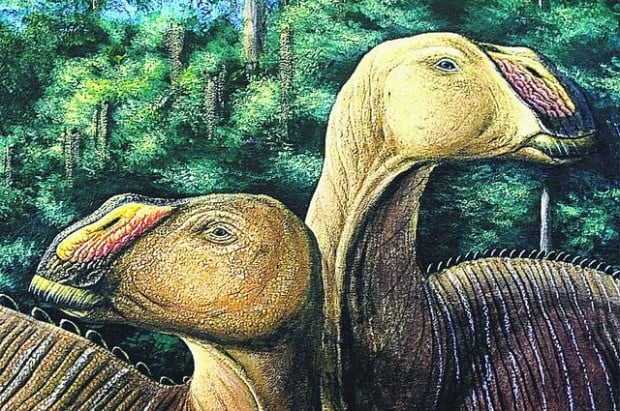
SALT LAKE CITY — The world, it seems, was its salad bar. Scientists are amazed at the chomping ability of a newly described duck-billed dinosaur.
The herbivore's powerful jaw, more than 800 teeth and compact skull meant that no leaf, branch or bush would have been safe, they say.
"It really is like the Arnold Schwarzenegger of dinosaurs — it's all pumped up," said Scott Sampson, curator of the Utah Museum of Natural History.
The newly named Gryposaurus monumentensis, or hook-beaked lizard from the monument, was discovered near the Arizona line in the Grand Staircase-Escalante National Monument in 2002 by a volunteer at the site.
Details about the 75 million-year-old dinosaur, including its name, were published in the Oct. 3 edition of Zoological Journal of the Linnean Society.
People are also reading…
Duck-billed dinosaurs were previously known to have been among the most imposing herbivores, with hundreds of teeth and a body that could knock down trees.
Gryposaurus monumentensis, at least 30 feet long and 10 feet tall with a robust jaw and thick bones, was like a duck-billed dinosaur on steroids, said paleontologist Terry Gates.
"It's basically the Cretaceous version of a weed whacker," he said. "You have a very formidable herbivore."
Utah a dinosaur haven
Although paleontologists said Wednesday that the dinosaur could eat just about any plant it wanted, scientists still aren't sure what it dined on.
Southern Utah is now a rocky desert with few trees, but 75 million years ago it was a dinosaur haven that looked something like Louisiana today, Gates said.
"It's very humid and wet, with lots of ponds and lots of rivers and creeks flowing through it. It was very lush," he said.
The discovery of new species will help scientists understand more about what the Earth was like millions of years ago, he said.
Sampson said duck-billed dinosaurs once lived throughout northwestern North America.
The newly discovered version has a smaller skull that allowed it to apply more force to what it was eating.
"By shortening the skull, you can get more power per bite. The shrinking of the skull and the robustness of the jaw and snout all lead me to think this guy was made to eat," Gates said.
Scientists also aren't sure if the new dinosaur was a loner or traveled in herds for protection against predators because so few skeletal remains have been found.
It's one of several questions scientists are hoping to answer, along with how and why different species of the duck-billed dinosaur developed.


