

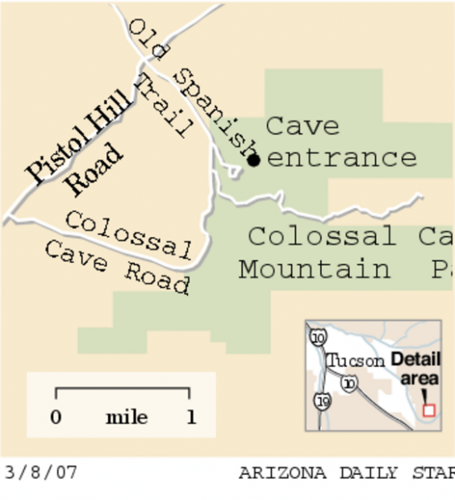
Pima County directed construction of a new statewide trail through Colossal Cave Mountain Park that comes within a stone's throw of an endangered bat species' roosting and feeding area, apparently without taking the same precautions expected of builders.
The lesser long-nosed bat, listed as an endangered species in 1988, sometimes uses caves in the park during its migration from maternity roosts in other parts of Arizona to Mexico, according to published studies of the nectar-feeding mammal's behavior.
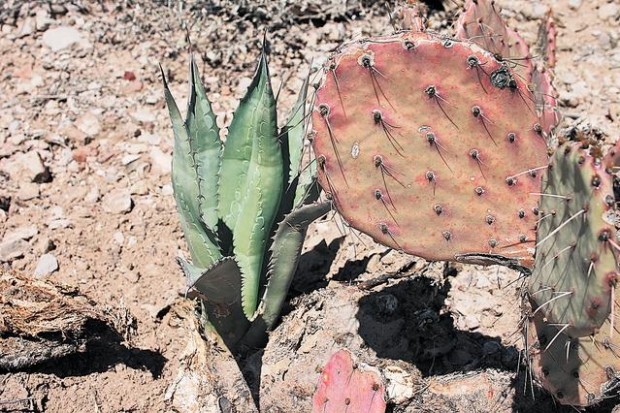
In some places the new trail — for hikers, mountain bikers and horses — was carved out of desert hillside within sight of some cave entrances and within arm's length of Palmer agave, considered a key food source for the endangered bats.
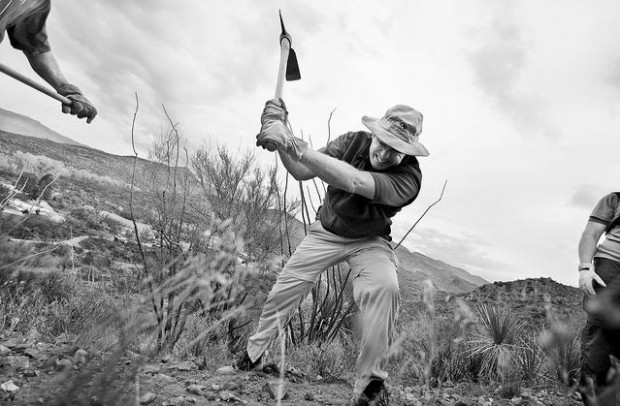
In some cases, volunteers ripped out Palmer agave, according to the volunteer coordinator for the project.
People are also reading…
"I just kind of put it where they (Pima County Natural Resources, Parks & Recreation Department staffers) told me," said Mark Flint, of Sonoran Desert Mountain Bicyclists. The club provided a significant portion of the labor.
Flint said he was present for every volunteer trail-building work session during the two years it took to carve out the three- to four-mile section through the county park.
He said neither he nor volunteers had any intention of damaging bat habitat and that workers transplanted some of the plants that were dug up to clear the trail — but not all.
"There were some agaves we either took out or didn't transplant," said Flint.
Flint said the Palmer agaves were not marked as plants to protect, and he cited numerous detours by trail builders as proof that they would have made the added effort to avoid those plants, had they known.
The entire trail within Colossal Cave Mountain Park appears to be in an area labeled significant habitat on the county's own habitat map for the lesser long-nosed bat (formerly known as Sanborn's long-nosed bat).
"That's a real good example of a problem that's really easy to avoid, because bats roost in specific places and they have specific food needs, and that area's really well-known," said Kieran Suckling of the Center for Biological Diversity.
"It doesn't take a rocket scientist to say, 'If we move the trail 200 yards up the road, it'll be fine,' " Suckling said.
When unsure, Suckling said, private or public developers should consult with Fish & Wildlife and get a concurrence letter. "Fish & Wildlife says, 'It looks OK to us, so we're going to concur with you.' "
He said that informal procedure is used by developers on projects that are in or near potential endangered-species habitat to protect the builder, as well as the endangered species.
Scott Richardson, the local U.S. Fish & Wildlife Service biologist who works on permitted land uses in suspected endangered-species habitat, said he was not contacted by anyone from the county about routing of the Arizona Trail within Colossal Cave Mountain Park.
"Historically, Colossal Cave itself was used as a maternity roost," Richardson said, making it reasonable for anyone building nearby to consider the possibility of seasonal use by the lesser long-nosed bat.
"There are a lot of smaller caves that have had some use by lesser long-nosed" bats, Richardson said.
Richardson said although a distance of one-quarter mile is used as a rule of thumb for avoiding endangered habitat, it's not a firm rule. In some cases, he said, activity may be acceptable even closer than one-quarter mile, and in others one-half mile might not be enough.
Most developers are so concerned of running afoul of endangered-species protection that they err on the side of caution, said Douglas Warren of Darling Environmental & Survey Ltd., a Tucson firm that works for developers and builders with concerns about work on potentially sensitive habitat.
He said builders and developers want to get the approval from government agencies to cover them in the event an endangered species shows up.
"If I was building in the area where there were caves and the lesser long-nosed bats," Warren said, "I'd have to get clearance from the Fish & Wildlife Service. They're willing to work with you. They'll say, 'If you're there, you'll have to look out for this or that.'
"I've always found them to be cooperative," Warren said. "I haven't always agreed with them, but …"
The Colossal Cave Mountain Park section of the trail, built over the last two years and just completed in late January, was constructed by volunteers, but Flint said the crews followed routes staked out by county officials.
"If there's sensitive plant species (there) I assume we would have been advised," Flint said. "We had to move the trail around old mines because they were historical," said Flint, referring to laborious changes in the route ordered by county staffers so the trail didn't encroach on sensitive archaeological or biological areas.
"I did the survey with the archaeological guy," said Flint. "Right on the spot we'd move the flags to his satisfaction. I wasn't out there with the biological guy."
Some of the Pima County Natural Resources, Parks and Recreation Department staffers most directly involved in the planning and layout of the Colossal Cave Mountain Park section of the trail could not be reached for comment on the environmental-impact efforts and considerations.
Rafael Payan, the department's director, said he did not know the specifics of habitat considerations in plotting the trail, but that it was done to minimize impact.
"We developed (the Arizona Trail) in those areas where there were already campgrounds and some access to the trail."
Kerry Baldwin, manager of the department's Natural Resources Division, said it was his understanding that there was a biological-impact study done by a consultant several years ago, before the trail was started.
"The general alignments were anticipated at that time," Baldwin said. But he said he didn't have the consultant's report readily available.
Baldwin said some of the trail was on existing paths in the park. "So we weren't creating all new trail," Baldwin said.
Flint questioned whether trail use would have much impact on the bats. Although the trail is open 24 hours a day, he said the majority of use would be during daylight and that the bats are nocturnal.
"I have seen a lot of bogus claims of impacts of trails," Flint said.
"The other thing I think is really important for people to remember is that it's a management tool to direct (hikers, bikers and riders) to keep them away from critical habitat. If you don't … you'll have people just wandering off," Flint said, blazing their own trails.
Lesser long-nosed bat
• The lesser long-nosed bat was listed as an endangered species on Halloween 1988.
• It is one of two nectar-feeding bats found in Arizona; the rest are insect feeders. Arizona has 28 bat species, second only to Texas.
• The bat ranges from as far south as Central America. Southern Arizona is the northernmost reach of its range and it is one of only four tropical bats found in the U.S.
• They feed on the nectar of saguaro and organ pipe cacti and agave.
• They are threatened by habitat and food- source disturbance, including the harvesting of agave in Mexico for the making of tequila.
• The bats are thought to be responsible for mysterious overnight raids that drain Tucson-area hummingbird feeders.
SOURCE: Center for Biological Diversity


