

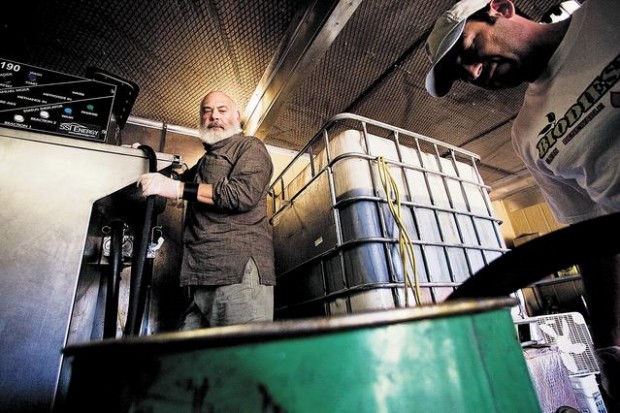
X9 RANCH — Andy Weil's got a still in his backyard, out here in the Rincon Valley.
And, if he can make his plans work, he'd like to share his home brew with the rest of us.
Dr. Andrew Weil — the world-famous physician who works to heal our bodies as naturally as possible — is now doing his part to try to heal a polluted planet.
Admitting he once thought the idea far-fetched, Weil today brews biodiesel fuel in his own garage — dubbed the "Bio-Depot" — and runs several of his ranch vehicles cleanly and cheaply on it.
At 75 cents a gallon. Using vegetable oil that Tucson restaurants throw out.
While the rest of us belch toxic crap out of our cars at three-plus dollars a gallon, Weil can hardly believe how well this bio thing really works. So well that he wants to form a co-op and offer this golden moonshine to any and all takers in Tucson.
People are also reading…
"I've always written and taught that it's very difficult to be healthy in an unhealthy world," said Weil, explaining why he's gone into the backyard brewing business.
A pioneer at combining mainstream medicine with alternative therapies, Weil founded the integrative medicine program at the University of Arizona and has written numerous best-sellers on the topic.
"We have to be very immediately concerned about finding solutions for the toxic effects the combustion engine has on human health," he said.
For starters, he notes that biodiesel fuel cuts asthma-causing particulates and carbon monoxide in vehicle exhaust by nearly 50 percent, releases far fewer cancer-causing compounds into the air, and cuts down on ozone and smog now choking us and our planet.
"This affects all of the issues — our dependence on Middle East oil, the root problem in the world today," he said. "If we break that dependence, the whole issue would disappear, and these regimes would collapse.
"And you're no longer throwing carbons into the atmosphere like you do when you burn gasoline or petro diesel. That's a huge advantage."
Even so, people still guffaw when he tells them what he's up to in his garage and what he pumps into his car now, he said.
Weil himself was skeptical when he first heard about the biodiesel idea — at a forum at actress Daryl Hannah's place in Colorado some eight years ago.
"I thought it was a curiosity," he said. "I didn't pay much attention to it.
"But after 9/11, as the oil crisis in the Middle East got worse, it became clear we need to break our dependence on foreign oil. That's when we got serious."
Enter X9 neighbor André Fasciola — who fortuitously happens to be studying organic chemistry at UA — and the curious idea was up and running.
Working with Weil, Fasciola took up the challenge of deciphering the nuts and bolts of making biodiesel, as well as ways to get its key ingredient, waste vegetable oil.
"I didn't know anything about biodiesel, except that it smells like french fries," Fasciola said. " It took about a year to pull the whole operation together. But it's working great now."
The first thing these two did, in anticipation of this venture, was buy diesel-engine cars, which proved to be more than a little frustrating. They're not all that easy to find, though things are slowly improving.
"The diesel engine is much more efficient than the gasoline engine, so it makes you angry, how few choices we have for these cars in the U.S.," Weil said, noting that diesel engines dominate in Latin America, and are headed that way in Europe.
"Also, diesel is a crude product compared to gasoline, so it should cost a lot less. But not here," he said.
Weil finally settled on a high-end Volkswagen model, while Fasciola drives a diesel Ford pickup. Weil pointed out that VW diesel Jettas are now available for less than $20,000.
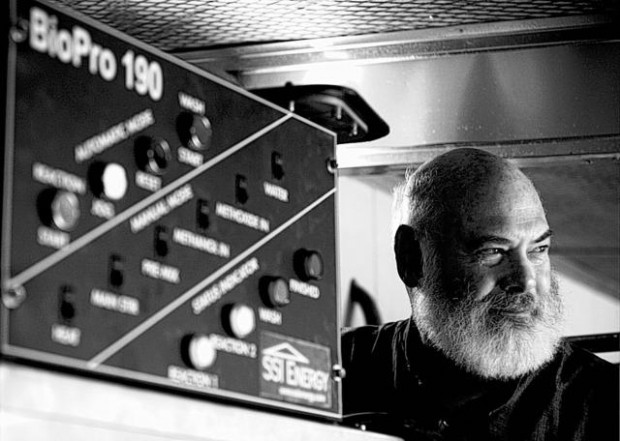
Next, they bought a unit to process the biodiesel — a Rube-Goldberg-like contraption called BioPro that fits in the garage. Made by a California company specializing in small-scale bio-processors, the unit cost $7,000 and makes about 40 gallons of biodiesel in 48 hours.
Simpler backyard processors can cost as little as a few hundred dollars. You can get by using an old water heater to do the job, or you can just pump straight, unprocessed vegetable oil into a diesel engine, and forget the processor entirely.
"But we don't recommend that," Weil said. Processing units make a higher-quality fuel out of the used vegetable oil, making it safer for the engine.
"Even so, the first time I pumped it into the VW, I was pretty nervous," he said. He used only a 5 percent blend at first (95 percent petrodiesel), but gradually bit the entire bio bullet and has run his car on 100 percent for the past year.
"There's been absolutely no change in the car's performance or mileage," he said. "And it burns cleaner, it's nontoxic and it smells good. You can drink the stuff."
True enough, but biodiesel isn't perfect, as Weil and other advocates acknowledge. Emissions of one type of noxious gas, nitrogen oxides, actually go up when it's used, and additives to deal with that need to be developed.
Also, long-term studies are needed to verify that even the purer forms of biodiesel — such as that used by Weil — don't hurt engine durability and fuel system parts, says the National Renewable Energy Laboratory.
The kind of sophisticated unit Weil has likely would work best for a neighborhood group, so a number of people can share the upfront costs, he said.
Several such biodiesel "co-ops" are known to be operating among friends around the city. Two places in town sell biodiesel commercially at the pump, though at much higher prices than the 75 cents a gallon it costs to make it at home.
Another reason to go into this as a group is the legwork it takes to get the vegetable oil.
"You kind of have to beat the streets at first, to set up your contacts with the restaurants," said Fasciola, who gets waste oil from the UA Student Union and several Tucson restaurants.
"Sometimes you get 200 gallons in a trip, sometimes you get five," he said. "But if you get a group of like-minded people together to share this chore, it's definitely doable."
In the coming months, Fasciola is looking to expand the Weil operation and set up a co-op, inviting members to pay an annual fee and volunteer for the oil pickups, then pump the biodiesel as needed.
"So many people want change on this issue, on the problems our oil dependence is causing. This is very empowering, and we'd like to share what we've learned with anyone who'd like to do it."
"There's been absolutely no change in the car's performance or mileage. And it burns cleaner, it's nontoxic and it smells good. You can drink the stuff."
Dr. Andrew Weil, who now operates biodiesel plant


