

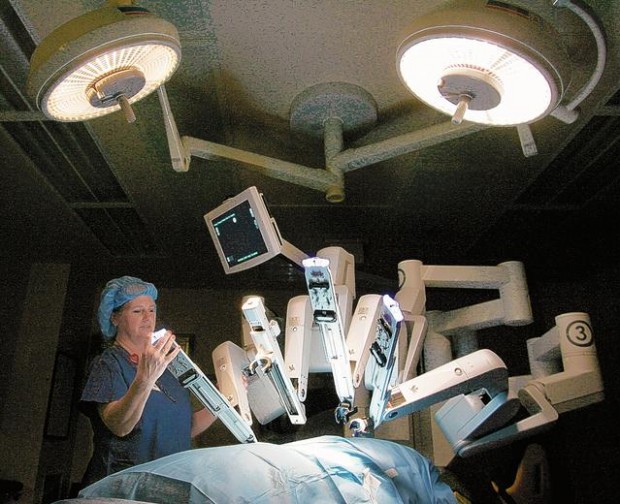
One by one, the surgical robots are marching into Tucson, now working at three hospitals, taking over the job of a surgeon's skilled hands.
As they do, Tucson gradually is joining what may be one of the most remarkable revolutions in medical history, with 'bots invading our operating rooms — now cutting into our abdomens with their alien, metal "fingers" and soon to take aim at our hearts.
"This is vastly different and vastly superior to traditional surgery," said Dr. Kalpesh Patel, a Tucson urologist who now uses a surgical robot at St. Mary's Hospital to remove cancerous prostate glands.
"This instrument works like your own wrist, but miniaturized. It can rotate to give a full range of very precise, concise movement — we call it 'degrees of freedom' in the surgical field.
"It took me three cases to realize the benefits to the patient are amazing. I have become a convert."
People are also reading…
Having a robot perform your surgery doesn't mean the machine operates on its own. Rather, the robot is a high-tech extension of the surgeon's own hands, which maneuver the robotic arms, pincers and instruments from a nearby console. The robot is at the operating table with the patient. The surgeon is not.
The robot Patel maneuvers — formally known as the da Vinci Surgical System — is the second in Tucson. It follows Tucson's pioneer da Vinci robot, bought by the University of Arizona and installed at University Physicians Healthcare Hospital at Kino Campus in May 2005.
There, the $1.5 million device so far has performed about 100 surgeries — mostly prostate removals, but also gynecologic operations such as hysterectomies, and now procedures to correct acid reflux.
The second da Vinci, being rotated between St. Mary's and St. Joseph's hospitals — both owned by Carondelet Health Network — geared up this fall, and now has performed about 27 surgeries, all of them to remove diseased prostates.
That extremely delicate surgery — with major risks involving incontinence and sexual dysfunction — was the first approved by the U.S. Food and Drug Administration for the surgical robot, in 2000.
Since then, the technology slowly has spread throughout the United States, as doctors and patients work to overcome a natural aversion to yielding this life-and-death human skill to a machine.
"I had one patient frankly tell me no — he'd rather have his surgery done the way it's been done for 50 years," Patel said.
"And that's fine — it is totally the patient's choice, the patient's decision. Traditional open prostate surgery is still the gold standard, and robotic surgery is cutting-edge new. We do what the patient feels comfortable with."
But most patients given the option of having a robot slice and dice into their bellies have gone for it, enticed in part by the ultimate in state-of-the-art surgical gadgetry.
They do have to think about it a bit, however.
"When I realized how new it was here, yes, I felt a little concern I was one of the first, that I might be a guinea pig for this," said Tucson attorney Roger Frazier, who put his body in the robot's "hands" in mid-November.
"There is a learning curve for surgeons using the robot, and that learning curve is real — some say it takes 10 to 20 cases to become fully competent with it," said Frazier, who researched the concept extensively before making his decision.
In the end, Frazier chose the robot — actually the robot operated by Patel — to remove his prostate because he wanted the tiny incisions, faster healing and shorter recovery promised by robotic surgery.
He got it. With four dime-sized incisions in his abdomen, he was up and walking on his own the day after the Nov. 14 surgery, and returned to work a week later.
Standard "open" abdominal surgery — with bigger incisions, more bleeding and pain — often require four to six weeks of recovery.
But still unknown is whether robotic surgery can improve on the twin fears linked to prostate removal — the loss of urinary and sexual function.
Sparing the vital nerves that control these functions depends heavily on the skill and experience of the surgeon and the anatomy of the patient, experts say. At this point, that appears to hold true whether the doctor is performing hands-on or robotic surgery.
"For urinary control, we are getting very good results with open surgery, and robotic appears to do the same," said Dr. Sanjay Ramakumar, a Tucson urologist who pioneered robotic and hands-on minimally invasive prostate surgery at the UA, and now is moving into private practice.
"For sexual function, robotics possibly does better, but that is highly dependent on how good the patient's function was before the surgery," he said, crediting the robot's full-motion instruments and three-dimensional camera for its potential.
However, large-scale scientific studies have not yet been done to prove which surgical method is superior at cutting out the cancer and at sparing the nerves.
"The bottom line is that if you have a good, experienced, meticulous surgeon using the robotic system, it's a win-win," Ramakumar said. "You get all the advantages, for the surgeon and the patient.
"But the surgeon's skill is vital, no matter how you do it."
For that reason, George Kalil — Tucson's primo Wildcat basketball fan and beverage-industry mogul — flew to the City of Hope in Los Angeles to get his prostate removed by robot in November. Able to afford it, he simply wanted to go where they have done this new thing longer than almost anywhere else.
"I've never been one to say you have to go out of town to get the best treatment," he said, speaking from his Seattle hotel room Thursday, just before the Wildcats' blockbuster win against Washington.
"But I'm overweight, I'm 68, I have diabetes, so I had to take all the precautions and go where they've been doing this consistently for some years."
Using the word "slick" to describe how fast and easy his recovery was, Kalil said he was back in his usual courtside spot in three days. That was exactly what he wanted from the robot.
However, several of Tucson's top urologists are not yet ready to endorse this use of robotics, though fully trained to do it.
"The fact is, nobody knows which method is better — we just don't have convincing data yet," said Dr. Paul Yurkanin. "Urologists recommend these procedures without definitively proven outcomes, and that's partly due to the aggressive marketing by the companies that make the robots."
Those concerns come even as some medical centers already are using the technology to do mini-incision heart surgeries that once required splitting the chest and cracking the ribs to get at that organ.
Yurkanin's partner, urologist Dr. Bruce Dalkin, is especially concerned about some reports showing unacceptably high rates of unexcised cancer using robotic systems compared with hands-on prostate surgery.
For now, Yurkanin explains the risks and benefits to patients, but is not recommending robotic surgery over other surgical methods.
"I want to see how it plays out in the near future before I do," he said.


