

As a little girl on the New Mexico Zuni Reservation, Zellisha Quam played doctor with her stuffed animals, bandaging up their fur and using a staticky television set as her X-ray machine.
But for years, the dream of becoming a health professional stopped at make-believe.
"I guess I thought that becoming a doctor or dentist was too big of a dream for me. I mean, does that really happen on the reservation?" she said. "There was no one there that could be a mentor to me."
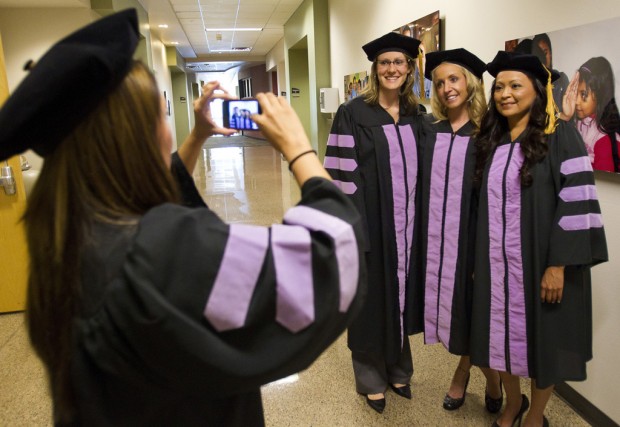
It wasn't until she met a Native American dentist years later that Quam starting considering the career path for herself. On Friday, June 8, she became one of six American Indians to graduate from the Arizona School of Dentistry and Oral Health at A.T. Still University in Mesa.
The group of Native Americans - defined in this case as enrolled members of federally recognized tribes - is believed to be the largest to graduate from any U.S. dental school at one time.
People are also reading…
"I believe this is probably going to be a high-water mark for some time," said George Blue Spruce, associate dean at the dental school and co-founder of the Society of American Indian Dentists. "I could talk for hours on all the challenges that stop American Indians from making it into the health professions, all the way from lack of family support or tribal support to financial issues."
Saint Regis Mohawk and graduate Dariene Lazore agreed that "living on a reservation isn't easy."
Kids there can "feel like they have no hope or future," she said.
That mindset, coupled with the fact that reservation residents can be nervous or hesitant about seeing doctors who are not Native American, is part of the reason the school has made a point of reaching out to prospective Native American students all over the country, according to dean Jack Dillenberg.
"Last year, there were only eight American Indian (dental-school) applicants in the U.S., and four came here," he said. "We know how important this is, and we're committed to not only recruiting but retaining these students."
In addition to encouraging participation in on-campus activities and groups, the dental school urges students to attend Native American professional conferences so they can "rub elbows with people they aspire to be like" and stay motivated instead of feeling isolated, Blue Spruce said.
Students also can qualify for a scholarship in exchange for a post-graduate commitment to serve the Native American community for a set period of time.
Though not everyone in the group participated in the scholarship program, all six graduates plan to work with Native American populations, on reservations or at clinics affiliated with the national Indian Health Service.
"I have four years to pay back, but I was already planning on working with the IHS," said Cheryle Singer, a Navajo from northeastern Arizona. Singer said she hopes to help eliminate language barriers and ease the anxiety some reservation residents feel at the dentist's office.
"A lot of times you hear back on the reservation things like, 'They send (non-Native American) doctors out here just to practice on us,'" Singer said. "And there are a lot of elderly people there who aren't bilingual, so being able to talk to them in their own language gives them a sense of comfort."
Quam hopes to show patients it's possible to achieve what she has. "If I had not seen my first Native American doctor, it wouldn't have catapulted me into this career," she said, "so I think it's important for younger generations to see a Native American dentist and hopefully get inspired to the same."


