

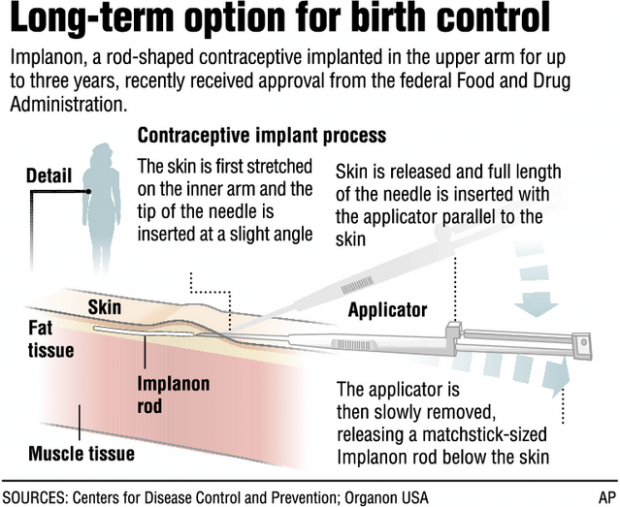
WASHINGTON — Choosing a method of birth control is a decision women can make daily, weekly or monthly. Starting this summer, add "once every three years" to the list.
That's how long the latest birth-control option should last. Called Implanon, it's a slender implantable rod that releases a pregnancy-preventing hormone into the body. It's billed as a long-term solution to birth control.
Implanon sales will begin in August or later, after doctors receive mandatory company training on how to implant it, according to manufacturer Organon USA Inc. The company announced Tuesday that federal regulators had approved it.
Once implanted, the matchstick-size rod should provide longer protection than any other hormonal contraceptives sold here, including the pill, patch, shot and vaginal ring.
It will be the only implant available on the U.S. market, the first since Norplant. Wyeth Pharmaceuticals stopped selling Norplant in 2000.
People are also reading…
Unlike Norplant and its six tiny rods, Implanon includes a single rod, just 1.5 inches long. Once injected under the skin of the upper arm, Implanon provides 99 percent contraceptive protection for up to three years.
Norplant worked for up to seven years, or four years more than Implanon. It also spawned lawsuits by women injured while having its six rods removed or disturbed by side effects. Another implant, a two-rod product called Jadelle, received Food and Drug Administration approval in 1996 but has never been sold in this country.
Implanon has been sold in more than 30 countries since 1998. More than 2.5 million women have used it, according to Organon.
That track record, along with the implant's single-rod design and the training doctors must receive before they can prescribe it to women, should prevent a repeat of the Norplant experience, said Dr. Scott Monroe, acting director of FDA's Division of Reproductive and Urologic Products.
The rod is inserted by a doctor in a quick surgical procedure that requires only a local anesthetic. It must be removed after three years, although it can be taken out at any time before then, according to the company, a unit of Netherlands-based Akzo Nobel NV.
Implanon releases a low, steady dose of progestin to prevent pregnancy. It may not work as well in women more than 30 percent heavier than their ideal weight, Monroe said.
The implant also can cause irregular bleeding and spotting. For some, it can eliminate monthly periods altogether.
Progestin is a synthetic hormone that's similar to the progesterone made in the ovaries.


