

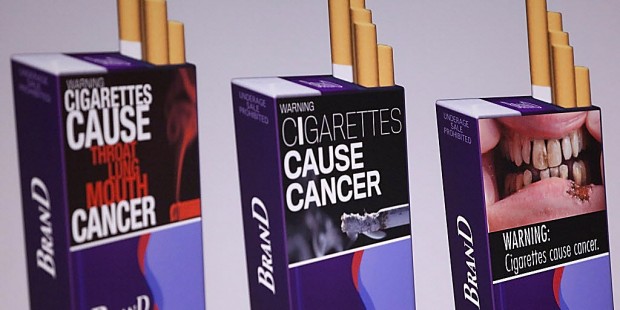
LOS ANGELES - In the first major change to cigarette packaging in a quarter-century, the Food and Drug Administration said Wednesday that it will require graphic warning labels that cover half a package's front and rear and the top 20 percent of all cigarette ads.
The labels will feature either drawings or photos illustrating graphically the dangers associated with smoking and will be accompanied by text stating that smoking is addictive or that it kills.
The pictures feature such things as a diseased lung, a corpse and a man smoking a cigarette through a tracheotomy tube. They are not quite as grim as some used in other countries, but regulators hope they will be sufficiently frightening to keep young people from beginning to smoke and to strengthen the will of those who are attempting to quit.
"We want to make sure every person who picks up a pack of cigarettes knows exactly what the risk is they are taking," Health and Human Services Secretary Kathleen Sebelius said at a news conference.
People are also reading…
"These are great. I am pleasantly shocked that HHS is doing this," said Stanton A. Glantz, a tobacco-control expert at the University of California-San Francisco, echoing the response of most observers. "There is no question but that strong graphic warning labels work," and that they influence kids in particular, he said. "Right now, we have the weakest warning labels in the world. Now we will be right up there tied for the strongest."
But John F. Banzhaf III, a professor of public-interest law at George Washington University and executive director of Action on Smoking and Health, said he was "quite disappointed" in the changes.
"Of all the things that they could do, HHS has done nothing more than exactly what Congress told them to do and not one iota more," he said.
Banzhaf also noted that Canada has had strong package warnings since 2000 and that "other jurisdictions have stronger warnings, more graphic pictures."
The FDA is currently looking at 36 different potential labels. The agency will select nine of them by June 22, and cigarette manufacturers must begin putting them on packages and advertising by Sept. 22. By Oct. 22, manufacturers will no longer be able to distribute cigarettes that do not bear the new warnings.
Federal agencies have been concerned that smoking rates, which declined from about 42 percent in 1965 to just under 21 percent in 2004, have remained flat since then.
"That's bad news," Sebelius said. "Every day, 4,000 young people try cigarettes for the first time and 1,000 continue to smoke."
Tobacco use causes at least 18 different cancers, not just lung cancer, according to the American Association for Cancer Research. Smoking also plays a major role in the onset of cardiovascular disease.
An estimated 450,000 Americans die prematurely as a result of smoking-related disease every year, and 8 million suffer chronic diseases at a cost to the economy of nearly $200 billion annually. Most of those deaths and diseases are preventable.
On the Web
The FDA is considering 36 different potential labels. They can be viewed at: www.fda.gov/cigarettewarnings


