

This is an article about something you probably shouldn’t do.
This installment of “Pandemic Lessons” focuses on how to travel with relative safety during the time of Covid-19. There are ways to do it – if you must – but multiple top experts interviewed for this story said the same thing:
They are doing the holidays by Zoom – and you probably should, too.
“It really is the safest thing to do, and the most responsible thing to do,” said Dr. Angela Rasmussen, a Columbia University virologist. “I’d rather give up one year of getting together with the whole family in exchange for years of holidays.”
That’s not necessarily because travel itself is dangerous. We know enough coronavirus science to gauge the relative risks of flying and driving, both of which can be done with a reasonable degree of safety. The science says that.
People are also reading…
But the science also says this: Where you’re going, who you’re seeing and what you’re doing matters a lot. You’re potentially safer on a plane, seated adjacent to a stranger, than having a warm, laugh-filled Thanksgiving dinner in your sister’s dining room.
How can you possibly be safer among strangers on a plane than at a family dinner?
The plane is controlled. Family dinners are not – unless every person at the gathering has been following full Covid-prevention protocols for weeks leading up to the gathering.
Planes are sanitized and – nowadays – frequently uncrowded. But most importantly, people are required to wear masks and “the air turnover is phenomenal,” said Dr. Thomas Russo, chief of infectious disease at the University at Buffalo’s Jacobs School of Medicine & Biomedical Sciences. Airplane ventilation systems send air from the ceiling to floor, usually bringing in half of the air from outside and recirculating the other half through high-efficiency filtration systems.
“The air quality is as good or better than most surgical operating rooms,” said Russo, noting the real issue on an airplane is other people: “If they’re not wearing their masks or wearing them improperly, and they are infected, they could potentially put you at risk.”
That’s the key point: If somebody is infected and unmasked, they are dangerous. They are dangerous on a plane, and dangerous at a holiday dinner. They are dangerous whether they’re a stranger, a friend, or a relative.
Isn’t “dangerous” a harsh thing to call your family?
Yes, but Covid-19 is harsh – and the numbers are getting hotter. Consider the immediate Buffalo area: In the week leading up to Halloween, just under 3% of Covid-19 tests in Erie County were positive. In the week afterward, that number catapulted to more than 5% – and climbing. The rolling seven-day average of positive tests by Nov. 12 exceeded 7%.
What does that mean?
The scariest thing about Halloween wasn’t the masks people wore. It’s the masks they DIDN’T wear when getting together.
Thanksgiving could become a horror holiday, too. According to a real-time, county-by-county Covid-19 risk assessment map created by researchers at Georgia Tech, if you gathered with 10 people in Erie County this past weekend, there was a 14% to 26% chance that at least one person would arrive infected. Raise that group size to 25 people, and the odds spiked to 28% on the conservative side, and 49% on the high. As the numbers go up, so will those odds.
Traveling elsewhere won’t necessarily make it better. Although Western New York’s Covid-positive rates are among the worst in New York, we’re actually still better than much of the country. For example, a 10-person gathering in the Chicago area carries a risk of 31%-53% that at least one person is infected. A party of the same size in Wausau, Wis., comes with up to an 8-in-10 chance that someone is infected. In rural and sparsely populated areas of North Dakota and Montana, among other hot spots, the odds creep close to 100%
The risk levels in four of the five bordering states where New Yorkers can travel without facing quarantining restrictions are alarming in spots, too, running as high as 33% for 10-person gatherings in parts of Connecticut, 45% in portions of rural Pennsylvania, 31% in Massachusetts and 34% in areas of New Jersey.
Can’t you just take temperatures and screen for symptoms?
That’s not enough.
People are asymptomatic for about 60% of the time they are infectious, said Dr. George Rutherford, a leading epidemiologist at the University of California, San Francisco. That means you could feel fine, yet still get people sick.
In a September interview with The News, Dr. Joseph Khabbaza, a pulmonologist at the Cleveland Clinic, said, “Our strongest weapon against Covid is avoiding it all together.”
With our Covid-19 numbers rising fast, that’s getting harder to do – in town and on the road.
If you are going to travel, what are the best ways to do it safely?
Driving is safest, if you can do it with people from your own household. (If not, wear masks in the car and crack open windows for ventilation.) Minimize proximity to others by paying at the pump at gas stations, getting take-out or drive-through meals or packing food.
Motels are often a good option for overnight stays, said UB’s Russo, because they “have minimal interaction.” Most motel stays involve a quick front desk check-in and then driving up to your room, where the door is on the outside.
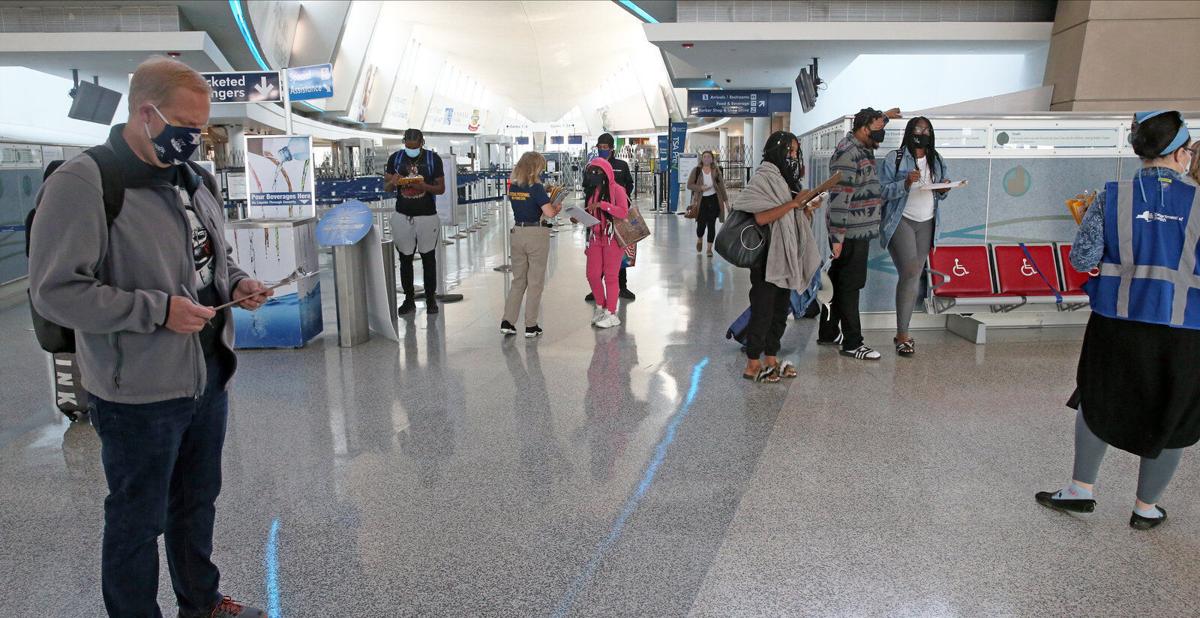
If you have to fly, wear a mask “door to door,” advises Rasmussen, the virologist at Columbia University, who has plenty of experience flying while commuting to New York from her home in Washington state. “Wear that mask at the airport the whole time,” she said, noting that other parts of air travel – crowding in the waiting area or baggage claim, for example – create vulnerabilities.
Buses and trains are “potentially riskier because the ventilation isn’t as good,” Russo said, which becomes a bigger risk if someone isn’t wearing a mask properly, or at all.
On an airplane – or by extension, a train or a bus – stick to your seat and don’t linger by the bathroom or other areas. It’s helpful, too, if you can book a flight or ride that is less crowded. There are studies of Covid-19, flu and other respiratory viruses that “have shown that transmission is really limited to the row that you’re in, and the row right in front of you and right behind you,” Rasmussen said. “It's not like if you're in the last row of the plane, you're going to get infected from somebody at the front of the plane. But the more people that are in any environment, the greater the risk is of exposure.”
Quarantine before and after – or if you have people coming to you, insist they do the same. To ensure that you are safe for others, Russo suggests “rigorously” quarantining for 14 days before travel, and getting a Covid-19 test on day 12, a timeframe that would likely still flag a developing infection even if you are asymptomatic. (That said, in Western New York right now it is difficult to get a test if you aren’t exhibiting symptoms.) But this isn’t foolproof. It works only if everyone is quarantining with equal rigor – and even then, an infection could theoretically slide by. “If you're going to cross social bubbles, you're going to generate a risk,” Russo said. “Though you could try to mitigate this risk, you’re not going to be able to get that risk to zero.”
Note: Do you have a topic or question you’d like to see explored in an upcoming installment of “Pandemic Lessons”? Send it to Tim O’Shei at toshei@buffnews.com or via Twitter (@timoshei).


