ANNA, Ill. — The disturbing 911 call began with sounds of a struggle, then a voice that sounded like a child’s cried out, “Let me go.” When the police dispatcher in the rural southern Illinois community announced herself, no one responded.
She heard other voices, laughing and taunting, then a female voice said, “You want me to break your other finger?”
There was shouting, and someone crying “Let me go” at least a dozen more times.
At one point the victim — who was later identified as a 22-year-old resident of the Choate Mental Health and Developmental Center — said “I don’t like you.”
“I don’t give a shit,” a woman responded.
Almost five minutes passed on the June 2020 call before the dispatcher got the attention of someone on the other end of the line. Then the connection went dead.
People are also reading…
With the audio recording in hand, the Illinois State Police launched an investigation. They learned that the call was made as Choate employees attempted to restrain a patient: A smart watch jostled in the struggle had accidentally dialed emergency services. They discovered that the voice heard pleading for help belonged to Alijah Luellen, who has Prader-Willi syndrome, a genetic condition that can cause severe childhood obesity, intellectual disability and behavioral problems. They also discovered that the other voices belonged to the employees paid to care for him.
Nonetheless, such incriminating evidence was not enough to hold anyone accountable.
The transcript is from Illinois investigators.
Such failures of accountability at Choate, which is run by the Illinois Department of Human Services, do not begin or end with the 911 call. Reporting by Lee Enterprises Midwest, Capitol News Illinois and ProPublica reveals a culture of cover-ups that makes it harder to reform the 270-bed developmental center for people with intellectual and developmental disabilities and mental illnesses. In dozens of cases, records show that Choate employees have lied to state police and to investigators with IDHS’ Office of the Inspector General; walked out of interviews, plotted to cover up or obfuscate alleged abuse and neglect; and failed to follow policies intended to protect the integrity of investigations.
The findings follow stories by the three news organizations last month that exposed abuses patients have suffered at Choate. In response to those articles, Illinois Gov. J.B. Pritzker issued a warning to state workers: Put an end to “awful” abuses or the state may be forced to shut the facility down.
During an unrelated news conference, Gov. J.B. Pritzker responded to questions about conditions at Choate Mental Health and Developmental Center in Anna.
IDHS did not dispute any of the news organizations’ findings, and it said in a statement that the agency requires employees to cooperate with OIG investigations and trains them on the need to be truthful with both the OIG and state police. Similarly, IDHS trains staff on preventing and reporting abuse and neglect on at least a yearly basis.
But as the 911 incident reveals, cleaning up the facility’s practices may not be easy.
When police questioned several of the employees on shift that night, they all told the investigators that they believed it had been a routine restraint, something they did to Luellen several times a week. One worker also said the order for strapping Luellen to his bed was made after the patient was “verbally uncooperative” and reached for the shirt of an employee who told him he couldn’t stay up and watch TV after 10 p.m., according to the police report.

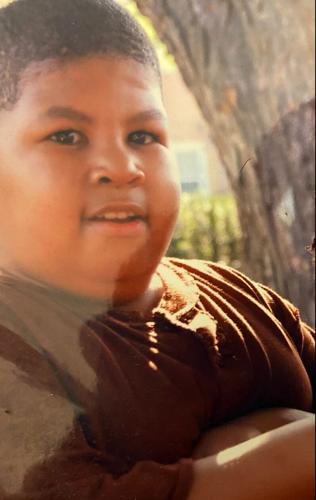
Alijah Luellen as a child.
Records show he remained in restraints for two hours. During a medical examination after the incident, a doctor found tenderness in his finger and bruises on his upper body.
The investigators played the audio recording of the 911 call to each employee and wrote down their reactions. According to notes from their interviews, one worker acted nervous and told them all the shouting was making her anxious; another told them he wished that they didn’t have the audio because it “sounds bad.”
Yet they all claimed they couldn’t recognize the voice of the worker who threatened the patient on the 911 call.
In addition, two employees cut their interviews with investigators short and walked out. (Law enforcement cannot compel employees to answer questions, according to state police; IDHS said that employees’ participation in criminal investigations is not mandated as a condition of employment.) Another employee, in internal paperwork, initially stated he assisted in the restraint. He later told police he had falsified the paperwork and wasn’t actually in the room, according to the police report.
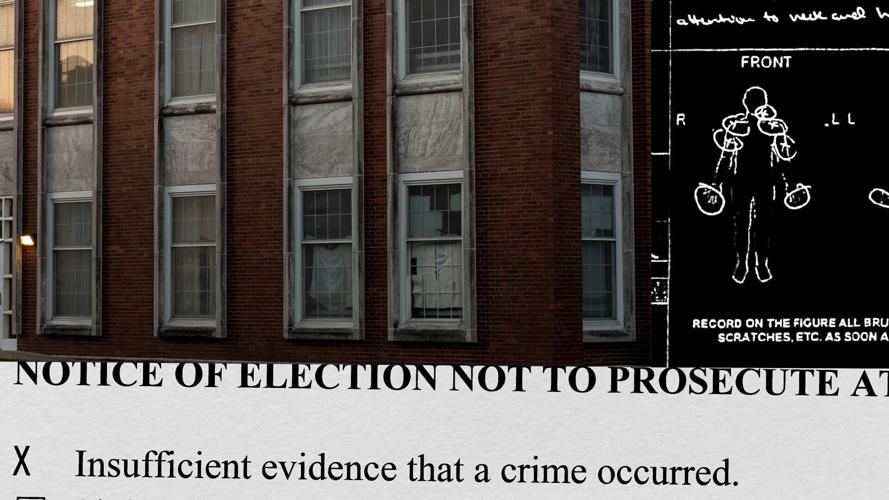
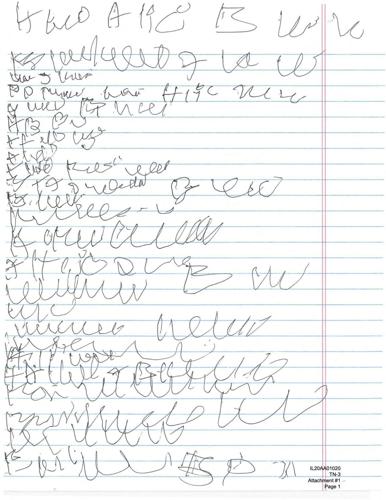
The victim’s statement also wasn’t helpful in making the case: Because of Luellen’s severe speech impediment, state police investigators asked him to write down the initials of anyone who hurt him. He returned to them a page of illegible scribbles.

The page that Alijah Luellen gave to state police when they asked him to write down the initials of the people who hurt him.
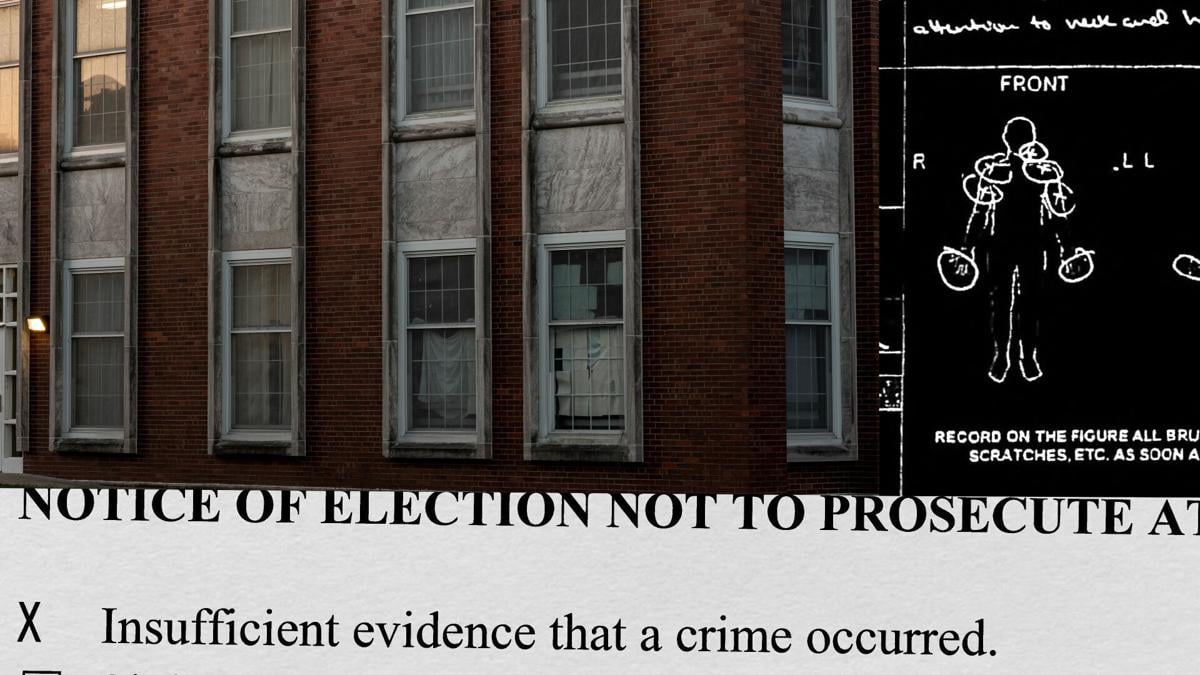
This June, two years after the incident, the Union County prosecutor declined to bring charges, citing insufficient evidence. State police interviewed six mental health technicians and one nurse who were working on the unit that night. Two of the mental health techs who participated in restraining Luellen were trainees; one was fired and the other resigned. Two permanent employees have been on paid administrative leave since the incident. None of the permanent employees were fired. The nurse who ordered the restraints left Choate in December 2021 and accepted a new job with the Illinois Department of Veterans’ Affairs.
Reporters obtained a copy of the 911 call by making a Freedom of Information Act request to Union County and provided the agency a copy of the recording and questions about their handling of the case. But when asked about the recording, the agency spokesperson said senior officials had not listened to the 911 call and that it couldn’t be released to them because it was part of an ongoing OIG review. That review could lead to discipline against employees.
Benita Hunter, Luellen’s aunt and legal guardian, also received the recording from reporters; hearing it for the first time left her stunned and heartbroken.
“They’re supposed to be there to support and help the clients that they have coming in,” Hunter said. “Alijah, he wouldn’t be able to explain everything because of his developmental delays, and they know that. He cannot defend himself and speak against them.”
Elusive justice
While audio evidence of abuse is rare, the actions taken by Choate staff in the aftermath of the investigation were not.
The OIG cited Choate employees in more than four dozen cases between 2015 and 2021 for lying or providing false statements to OIG investigators; for failing to report an allegation within four hours of its discovery, as is required by law; and for other failures to follow department policy concerning the reporting and investigation of abuse and neglect, according to an analysis of OIG records by the news organizations.
Of the 1,180 allegations of abuse and neglect made during that time frame, OIG ruled that only a tiny fraction were substantiated — meaning that it found credible evidence to support the allegation. But records and interviews make clear that investigatory missteps and lack of employee cooperation can quickly derail an investigation.
Stacey Aschemann of Equip for Equality, a disability rights legal aid organization that officially monitors the facility for the state, said, “We commonly observe that no staff saw or heard anything, which is unlikely.”
She added, “We have reason to believe that there are multiple cases that would have been substantiated if additional evidence had been available.”
In an interview, Union County State’s Attorney Tyler Tripp said he was disturbed by the 911 recording in which Luellen was threatened. He was also troubled by the fact that he couldn’t make a case. He kept it open for two years, he said, hoping someone would come forward with more information.
It’s not the only case in which he has encountered stonewalling that has made prosecution difficult.
“In these types of situations, a select group of bad actors coordinate in anticipation of an investigation to get their stories straight, to obscure evidence and to frustrate the investigation,” Tripp said.
He said investigations are typically stymied if patient testimony is not corroborated by employee witnesses. In addition, he said, some patients aren’t even able to tell police what happened. Nearly 15% of residents at Choate have a developmental disability that is diagnosed as severe or profound, and about 10% are nonverbal.
Another case from the same year that has languished on Tripp’s desk involves a resident who alleges a Choate employee wrapped a towel around the patient’s neck until he passed out, according to two people who are intimately familiar with the investigation but not authorized to comment on it. A different staffer discovered the patient unconscious with a red mark on his neck.
The accused employee denied the accusation and refused an interview by police. Other employees claimed they didn’t know what happened.
Tripp has yet to make a decision on whether he will press charges, and he declined to comment on the details of the case. He said that in general, when he delays a decision, it’s because an investigation has brought forth some evidence but not as much as is needed to successfully prosecute a case.
Though uncooperative facility staff had long frustrated state police investigations, administrators became the target of an investigation in January 2020. It started when two employees reported that they witnessed a colleague, Kevin Jackson, remove his belt and repeatedly use it to whip a female patient. The employees, who worked in a neighboring building, reported that they saw the assault through the victim’s bedroom window.
After an OIG investigator notified state police of the allegation against Jackson, assistant administrators Teresa Smith and Gary Goins looked at the investigatory file and then sent a psychologist to speak with the patient while the police were still on their way, according to then-security chief Barry Smoot, in his testimony before a Union County grand jury. After the police arrived, the victim said that someone other than Jackson had hit her.
Longstanding OIG policy had prohibited administrative involvement in abuse and neglect investigations to avoid conflicts of interest. According to Smoot, facility director Bryant Davis also accessed the file, along with Smith, on a different occasion. And state police Sgt. Rick White testified before a Union County grand jury that the administrators’ interventions were unusual and threatened to derail the investigation, court records show.
Jackson, the mental health tech, pleaded not guilty to a felony battery charge and his case is pending. The administrators were also initially charged with felony official misconduct; the state’s attorney withdrew those charges but left open the possibility of filing new ones.
Senior department officials have defended the actions of the Choate administrators. Attempts to reach the administrators for comment, including facility director Davis, were not successful. Jackson declined to comment.
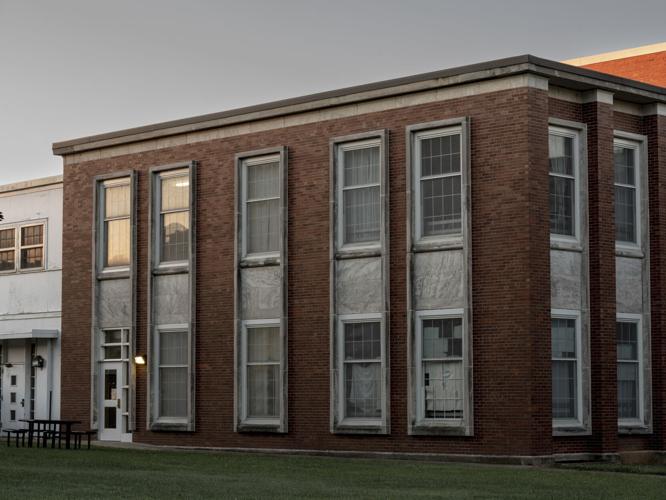
State Sen. Terri Bryant, a Republican from Murphysboro whose district includes Choate, said she was alarmed by the department’s handling of this case. Shortly after the reported assault, Bryant said, she received a call from a worker informing her that employees had placed paper over the windows on the unit where the incident occurred.
Bryant said she went to see it for herself, then called an IDHS administrator in Springfield to inquire about it. He called the facility and was told the paper had been taken down. He relayed that information to Bryant. But Bryant said she was sitting outside the building when he called her back and could see from her car that it was still up. In August, 20 months after the assault, the paper was still there.
An IDHS spokesperson said, “At times, paper was on windows because the window fixtures were on order. The paper would have been for privacy in resident bedrooms.”

Windows are covered with paper at Choate Mental Health and Developmental Center.
Few consequences
Serious consequences in cases of abuse and misconduct are rare. The Illinois State Police opened at least 40 investigations at Choate over the past decade. Of those, 28, including Luellen’s case, did not result in any criminal charges, with the Union County prosecutor most frequently citing insufficient evidence as the reason for not moving forward. The other 12 investigations resulted in felony charges against 26 employees, with most pleading guilty to misdemeanor charges or having their cases dismissed entirely. (A few are pending.) Only one employee was convicted of a felony — for hiding evidence, rather than for the underlying abuse. To date, no one has served prison time.
Beyond the lack of criminal sanctions, employees are also rarely fired for misconduct, including actions that obstruct investigations. According to a review of records where OIG cited Choate for problems, by far the most common response to the deficiencies cited was a recommendation for “retraining.” The response was included in cases where OIG cited employees for lying or otherwise impeding an investigation. One former official at Choate said the department’s retraining amounted to providing employees with a policy document and having them sign a form saying that they’d read it.
In one 2016 case, Choate planned a training for the entire staff that addresses “late reporting of abuse/neglect, staff members encouraging, bribing or coercing individuals regarding OIG investigations and obstruction with an ongoing OIG investigation,” IDHS records show. The department redacted details about what prompted the retraining.
In 25 cases, the department acknowledged a need to retrain workers in how to treat Choate’s clients with “dignity and respect.” IDHS’ policy for employees demands that they do not engage in dehumanizing practices, such as cursing, yelling, mocking or other cruel treatment.
Though the details of incidents were redacted in most of these cases, employees have been cited by OIG in recent years for using racist, homophobic and derogatory language toward people with disabilities, including calling them “retards.”
Code of silence
C. Thomas Cook, who has worked with people with developmental disabilities for more than 50 years across four Midwestern states, including Illinois, said that it’s not uncommon for employees in large facilities like Choate to close ranks and protect one another in the face of abuse allegations.
When the code of silence is deeply entrenched, Cook said, it takes far more than retraining to change the culture. Things like cameras and monitors can help, Cook said, but employees also need to know that they will face strict sanctions, including criminal charges and dismissals, if they cover for abusive colleagues.
“There are ways to disrupt that code of silence,” Cook said. “It’s the responsibility of the people who run the programs to do it.”
It's especially problematic, he said, in communities where the employees are part of a tightly knit population with a common interest in protecting each other.
That characterization could perfectly describe the facility in rural Anna, a town with a population of about 4,200. Reporters identified numerous instances in which investigations involved two or more suspects who were relatives, friends or in romantic relationships with one another, according to the police records.
In one case, a Choate social worker offered to help police interview patients during an abuse investigation, but then police discovered she was the girlfriend of the technician who was the target of the investigation. Two recently charged employees are relatives of the current acting security chief, whose job is on the front line of investigations. He declined to comment. This August, a senior IDHS official grew concerned enough about the familial relationships between security officers and the employees they were investigating that he sent an email to select staff reminding them of the need to recuse themselves to avoid even the appearance of a conflict of interest, emails obtained by reporters showed.
When a facility is critical to a struggling local economy, Cook said, that can compound the incentives to cover up misconduct. Choate serves the poorest part of the state, and the facility has been Union County’s largest employer for decades. A former administrator once told The Southern Illinoisan that if Choate wasn’t there, “Anna would dry up and probably blow away.” The facility has employed generations of the same families, including that of longtime Anna Mayor Steve Hartline, whose mother and father worked there while he was growing up.
Hartline went on to serve for decades as head of security at Choate, where his officers were the first line of inquiry when there was an allegation of patient mistreatment. Hartline said he believed the scrutiny resulting from the recent staff arrests has given Choate an unfair bad rap; he rejected the premise that employees were protecting each other.
“There’s no such thing as a code of silence at Choate. If there is something found, such as a broken policy, it’s duly noted and dealt with by administration and labor relations,” he said.
But Hunter, Luellen’s aunt, said that it was upsetting that the employees who threatened and mocked her nephew did not face serious consequences for their behavior. Luellen has since moved to a different state-run center about 100 miles north. But during the more than two years the young man lived at Choate, Hunter said she believed staff restrained him too often and failed to teach him skills to manage his behavior. Every time she spoke with staff, “they promised that he was getting the utmost care,” she said. “But my heart and my spirit was not telling me that he was actually receiving that from them.”
Gabriel Sandoval contributed research to this article.
Timeline of Choate employees' arrests and outcomes
2014: Mark Allen, Curt Ellis, Justin Butler and Eric Bittle

Accusation: A resident was brutally assaulted by one or more mental health techs in December 2014 who sought to cover up the abuse and interfere in a state police investigation.
Charged employees, clockwise from left: Mark Allen, Curt Ellis, Justin Butler and Eric Bittle
Charges: In 2016, Allen was charged with aggravated battery and intimidation, and Ellis, Butler and Bittle were charged with obstruction of justice.
Outcome: A few months after they were charged, Ellis, Butler and Bittle pleaded guilty to misdemeanors for failing to report the abuse; in 2021, Allen pleaded guilty to obstruction of justice for concealing evidence.
2016: Chayla Brown

Accusation: In 2016, a mental health tech slapped a patient with an open hand while the individual was eating breakfast.
Charged employee: Chayla Brown
Charge: In 2017, Brown was charged with felony aggravated battery.
Outcome: In 2018, she pleaded guilty to misdemeanor battery.
2017: Cheryl Muckley

Accusation: A facility administrator took home patient injury reports and other private medical records that ended up stashed in a personal storage shed in 2017.
Charged employee: Cheryl Muckley
Charge: That same year, Muckley was charged with felony altering/destroying public records.
Outcome: Later that year, she pleaded guilty to misdemeanor criminal damage to property.
2017: Victor Metzger

Accusation: A mental health tech punched a patient, breaking two of his ribs, in 2017.
Charged employee: Victor Metzger
Charge: In 2017, Metzger was charged with felony aggravated battery.
Outcome: In 2021, he pleaded guilty to misdemeanor battery.
2017-2018: John Lingle, Cody Barger

Accusation: Two mental health techs failed to report harm to a patient that resulted in a broken arm sometime between September 2017 and March 2018; during that same time frame, one of them also failed to report that he’d witnessed another employee force a patient to drink a cup of hot sauce.
Charged employees, from left: John Lingle, Cody Barger
Charge: In 2020, Lingle and Barger were charged with official misconduct/obstruction of justice.
Outcome: In 2021, Lingle and Barger received a “second chance” probation sentence in lieu of pleading guilty to reduced felony charges of obstruction of justice for destroying evidence.
2019: Greg Johnson, Ruth Massie and Paris Ferguson

Accusation: In 2019, two mental health techs held down a patient while a third assaulted the individual.
Charged employees: Greg Johnson, Ruth Massie and Paris Ferguson
Charge: In 2021, Johnson was charged with felony aggravated battery, and Massie and Ferguson were charged with unlawful restraint.
Outcome: In 2021, the charges against Johnson and Massie were dismissed; the charge against Ferguson was dismissed in August.
2020: Kevin Jackson, three others

Accusation: A mental health tech struck a patient multiple times with a belt in January 2020, and three administrators took actions that interfered with the Illinois State Police’s investigation into the incident.
Charged employees: Kevin Jackson (pictured), a mental health tech; facility director Bryant Davis; and assistant directors Gary Goins and Teresa Smith
Charges: Jackson was charged with aggravated battery; Davis, Goins and Smith were charged with official misconduct, and Smith additionally with obstructing justice.
Outcome: Jackson pleaded not guilty and his case is pending; charges were dismissed against Davis, Goins and Smith.
2020: Dalton Anderson, Bobby Lee, Johnny Brimm, Mat Wiseman

Accusation: Four mental health techs choked and punched a resident in May 2020.
Charged employees, clockwise from left: Dalton Anderson, Bobby Lee, Johnny Brimm, Mat Wiseman
Charges: All four were charged with felony aggravated battery; Wiseman and Brimm were also charged with felony obstruction of justice.
Outcome: Earlier this year, Wiseman and Brimm pleaded guilty to misdemeanor battery; the charges against Lee and Anderson, who both pleaded not guilty, are pending in court.
In this Series
See full coverage of abuse, cover-ups at Choate
-
Updated
Brutal beatings, abuse plague Illinois-run mental health facility, special investigation reveals
-
Updated
Culture of cruelty persists despite decades of warnings at Illinois-run mental health facility
-
Updated
Illinois governor calls for changes after 'awful' reports of abuse at developmental center
- 10 updates