

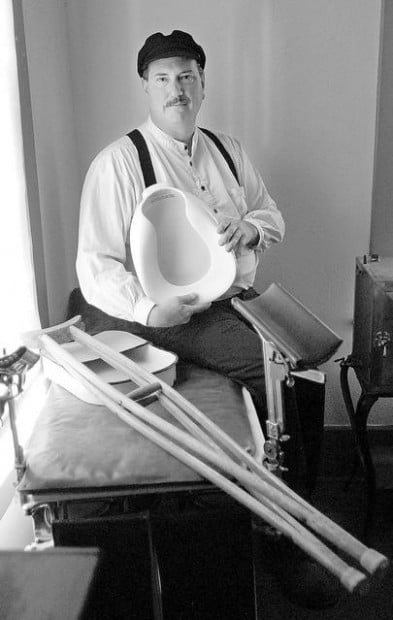
FLAGSTAFF — If walls could talk, they would have colorful tales to tell at the Pioneer Museum, which served from 1908 to 1938 as a hospital for the poor, before it became a boardinghouse and then a museum in 1963.
The venerable stone building on the old Livermore Ranch property still has remnants of its hospital days: an iron lung, a nurse's room, surgical equipment and oral histories about those years.
Completed in 1908, the hospital had a formal name, Coconino County Hospital for the Indigent, but also a nickname: The Poor Farm.
Townspeople dubbed it that because stronger patients grew vegetables in the yard.
"It was a poor farm, a federal designation," said Joe Meehan, curator at the Pioneer Museum. "In order to be a poor farm, you had to have farmable land around the property to qualify for federal money. Patients who felt like it could work in the garden."
People are also reading…
The memories of the indigent hospital were revisited Saturday when the Arizona Historical Society's Pioneer Museum hosted a one-day event to re- enact the years that the hospital was in existence.
The centennial festival included re-creations of the patients, nurses, doctors and the "flunky," an assistant to the cook and all-around maintenance man who graced the hospital's rooms and halls.
There also was a special display of hospital artifacts and an exhibit on the hospital's history.
Les Rowe, director of the Pioneer Museum, provided materials that show the census in 1900 found 1,271 people living in Flagstaff and 5,344 in Coconino County.
According to the ample records the museum has about the hospital, before the indigent hospital was created individual citizens cared for indigent sick and were paid for that care by the county.
For example, back in 1891, John Tabor, a citizen of Williams, petitioned the Coconino County Board of Supervisors to care for a man named Summers, who was sick and indigent and staying at Tabor's boardinghouse.
In 1892, the first county hospital for the indigent opened in downtown Flagstaff.
Located on what is now the northwest edge of Northern Arizona University, the hospital had two private rooms, eight beds for patients and an operating room, according to the Flagstaff Medical Center's history Web site.
"Dr. Raymond also had his own hospital in the basement of his office downtown, where the store Zani is now," Meehan said.
Dr. R.O. Raymond, who came from St. Louis., had first practiced medicine in Williams before moving to Flagstaff in 1909.
He donated land on which a new 25-bed hospital atop Knob Hill was built.
Through the efforts of Dr. Charles Sechrist, the hospital opened Jan. 4, 1936, and would eventually expand into the present-day campus of Flagstaff Medical Center.
The Coconino County Board of Supervisors met to discuss authorization for a county hospital on Aug. 12, 1905.
The bids for construction and furnishings were to include medical care for prisoners, indigent sick outside of the county hospital and people awaiting examination for insanity in the probate court.
The Livermore ranch was purchased for $2,500 to provide a site for the construction of the hospital. The two-story hospital was constructed from tufa stone. It proved fireproof and lighter in weight than sandstone.
People who wanted to be treated at the hospital for the poor had to prove they qualified.
"They had to be declared they were definitely indigent, with no means of support," Meehan said.
"They had to fill out an affidavit, and a county doctor would examine them," he added.
Improvements were made on the hospital through the years, including a barn, a sewer, and an addition containing a bathroom and a sleeping porch.
The hospital also provided a number of jobs.
With the election of Franklin D. Roosevelt as president in 1932 and the start of federal welfare programs, the responsibility for care of the indigent fell on the state and federal governments.
In 1938, the Coconino County Hospital for the Indigent closed.


