Members of the Navajo Nation Council met May 27 with representatives from Energy Fuels and the Navajo Nation Police Department to discuss an accident involving a truck transporting uranium material from Energy Fuels’ Pinyon Plain Mine near the Grand Canyon to the company’s mill near Blanding, Utah.
A semi hauling uranium material to the uranium mill on May 6 was involved in a crash about a half-mile east of the intersection of U.S. 160 and State Route 98 in Shonto.
Navajo leaders raised concerns over highway safety, hazardous materials training, emergency preparedness, response times and long-term transportation oversight to protect Navajo communities located along uranium transport routes.
Investigators determined that the crash occurred when an SUV attempted to pass another semi and, in the process, collided with the front passenger-side tire and bumper of the uranium transport truck while trying to overtake both vehicles.
People are also reading…
Martin Tyler, technical and environmental manager with Pinyon Plain Mine, conducted a comprehensive inspection of the transport vehicle and collected samples to test for any possible leakage.
Following the completion of all inspections and safety assessments, officials determined there was no hazardous material leak related to the crash.

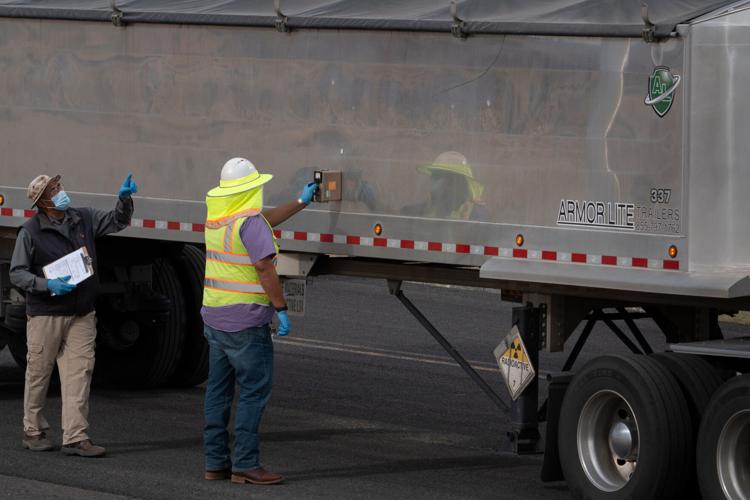
In this 2025 file photo, Navajo Nation Environmental Protection Agency officials inspect a haul truck loaded with uranium ore at a checkpoint south of Cameron, Arizona.
The May 27 leadership meeting also addressed emergency response efforts, highway safety concerns, public communication, and the ongoing investigation into the traffic collision involving the uranium ore transport truck.
“Our communities continue to carry the historical trauma and health impacts associated with uranium development,” said Council Delegate Curtis Yanito. “It’s Energy Fuels’ responsibility to oversee and address concerns to public safety, communication, and preparedness whenever hazardous materials are transported through Navajo communities.”
Yanito emphasized that Energy Fuels has an opportunity to invest in the Navajo Police Department and the Navajo Department of Transportation to strengthen oversight, emergency preparedness and roadway safety related to uranium transport activities on the Navajo Nation.
What is the safety plan for uranium transport?
Michael Henderson, former director of the Navajo Nation Division of Public Safety, said in a previous interview with The Arizona Republic that the emergency response plan followed by Navajo Nation Public Safety in the event of a transportation accident was largely developed by the company responsible for the shipments, "which was a requirement under the agreement to transport across Navajo.”
"Most of the response plan to accidents are put together by the company," Henderson said. "What the Navajo police is honoring is that plan they have in place. It has been working because there's a couple of incidents that were challenging. It's been a cooperative effort between everybody, all the entities. The safety plan has been working so far."
Henderson said the safety plan requires two occupants in each truck, a primary driver and a backup driver, and that cameras are installed inside the truck cabs. He said he does not have a copy of the safety plan, as it is maintained by the Navajo EPA.

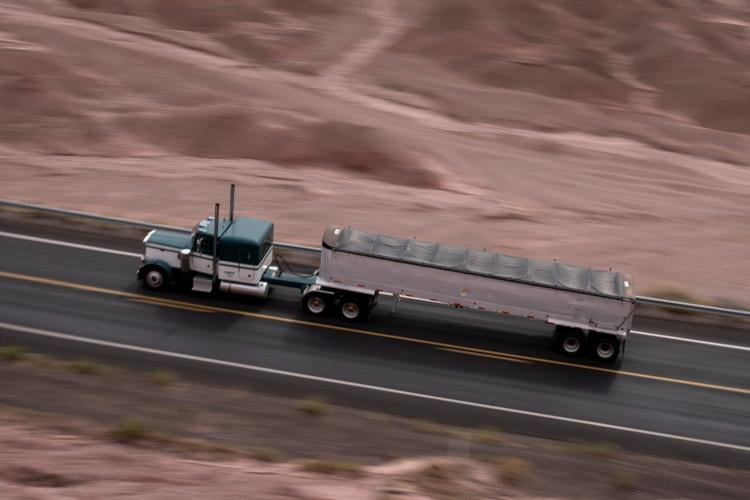
A haul truck loaded with uranium ore heads east on U.S. 160, near Tuba City, Arizona in August 2025.
Navajo Nation Police reported that two individuals involved in the collision sustained injuries and were taken to a local hospital for treatment, and that the truck driver was not injured, but authorities did not say whether the ore-hauling truck had the required second occupant accompanying the driver, as Henderson had explained months earlier.
Council Delegate Otto Tso brought up concerns about speeding along transport routes and called for stronger monitoring and enforcement measures to improve highway safety.
“We want transport operations conducted as safely as possible,” Tso said. “Additional oversight, enforcement, and coordination with transportation agencies are necessary to protect the traveling public and nearby communities.”
Navajo EPA Executive Director Stephen Etsitty reported that EPA personnel responded shortly after the collision and confirmed there was no release of radioactive material from the transport vehicle. Navajo Nation Police officials said the investigation remains ongoing.
Officials also noted that more than 3,000 inspections of uranium transport vehicles have been conducted since current transport operations began and that emergency preparedness resources continue to be shared with chapter communities along transportation routes.
Uranium, rare earth businesses are booming
On the day of the accident, Energy Fuels posted its financial and operational results for the quarter ending on March 31.
"We successfully produced terbium oxide at pilot scale, announced the planned acquisition of Australian Strategic Materials, and made the decision to install infrastructure at the White Mesa Mill to enable future production of heavy rare earth oxides, including samarium, europium, gadolinium, terbium and dysprosium," said Mark Chalmers, CEO of Energy Fuels.
He said development of the company's rare earth and mineral sands business continues across multiple assets, including progress at the Donald Project joint venture in Australia, which could soon advance to construction and provide a long-term source of monazite to the White Mesa Mill in Utah.
As the Navajo Nation presidential race is underway, some candidates have discussed uranium transport and mineral extraction on Navajo Nation.
Andrew Curley, associate professor at the University of Arizona and a presidential candidate, said during a recent meet-and-greet that the Navajo Nation is going in the wrong direction when it comes to resources and spending.
He cited the Navajo Nation’s 2005 Diné Natural Resources Protection Act, which imposed a sweeping ban on uranium mining and processing across the tribe’s 27,000-square-mile reservation, and said it needs to be upheld.
The U.S. Environmental Protection Agency recently designated the abandoned uranium mine in Church Rock, New Mexico, as a "time-critical removal action." This designation will incorporate technology known as high-pressure slurry ablation to allow for the permanent removal of up to 1,500 cubic yards of material from the site.
But environmentalists, community members and critics have concerns and doubts when it comes to this type of technology and note that it isn't cleanup — it's extraction.
"What the (Buu) Nygren administration is talking about is they want to take uranium piles that have been left over from the 1940s and 1950s," Curley said. "They want to re-mine it. They want to use a new mining technology to move radioactive material through the Navajo Nation. They call it cleanup, but it's another form of mining. You need leadership that is clear that we don't want this. You need to have that strong voice in Navajo Nation government. If you have a president who makes compromises, those energy companies will come right in and do their best to exploit."