

A federal judge is weighing Kyrsten Sinema’s request to drop the “homewrecker” lawsuit in North Carolina against her by the estranged wife of her one-time security guard and lover.
In legal papers, the former U.S. senator from Arizona argues that she has no ties to that state and her communications with Matthew Ammel, such as text messages that Heather Ammel recognized as signs of a romantic relationship, were sent from other locations, such as Arizona and Washington, D.C.
Heather Ammel has argued that Sinema, a former Democrat who became an Independent in 2022, has traveled to North Carolina on occasion to be with Matthew Ammel and that her interactions with him are the kind of marital interference that the state wants to punish through its rare anti-homewrecker law.
U.S. District Judge David Bragdon, who joined the federal bench in December, nearly a year after Sinema left office, will rule on her request to short-circuit a case that drew national attention for the allegations that she broke up the Ammel’s 14-year marriage.
People are also reading…
Heather Ammel filed her suit in January and blamed Sinema for breaking up their family. Matthew Joseph Ammel accompanied Sinema on luxe trips to Napa Valley and Saudi Arabia and sipped Dom Perignon with Sinema and Cindy McCain at an event in Las Vegas, the suit said.
In her response, Sinema said her interactions with Matthew Ammel while he was in North Carolina were nothing more than “random and fortuitous.” She insists she had no substantial connection to North Carolina, the legal test she argues is appropriate.
Sinema detailed the dates and locations of a half-dozen sexual encounters with her then-security guard in 2024 to bolster her argument that almost none of her relationship with him happened in North Carolina.
She only visited North Carolina with him after the couple was in the process of separating, Sinema said.
One of the visits happened when Sinema “sat out in the parking lot during (Heather Ammel) and Mr. Ammel’s domestic mediation at (Heather Ammel’s) counsel’s office,” according to court papers.
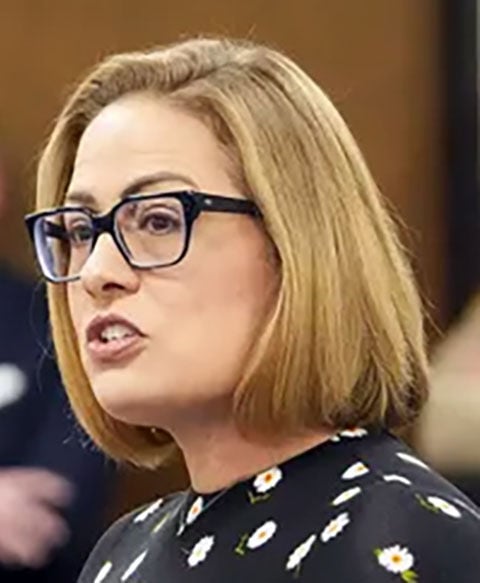
Sinema
Heather Ammel argues that North Carolina’s homewrecker law includes actions that damage marital relations in that state, not that every action must have happened there. In other cases, telephone calls were considered valid evidence of harming a marriage, she said.
Pointing to other cases involving what are known as alienation-of-affection claims, “North Carolina courts have repeatedly demonstrated the importance of protecting marriage,” Heather Ammel’s lawyer argued.
One of the racier texts Sinema allegedly sent Matthew Ammel while he was at home in North Carolina was a photo of herself wrapped in a towel, Heather Ammel’s suit claims. Sinema’s lawyers noted that a photo of this message was “conspicuously absent” in a case where other text messages were included.
Heather Ammel claimed Sinema was “wrapped in a white towel, and the picture showed her bare upper back with cupping bruises.
“Mr. Ammel responded to the picture stating that she needed more iron in her diet, and (Sinema) replied to Mr. Ammel stating, ‘show me a woman who doesn’t.’”
Matthew Ammel, an Army veteran with brain injuries, appeared with Sinema at the Arizona Legislature in 2025 when Sinema appealed to lawmakers to finance trials of ibogaine, a psychedelic drug considered to have beneficial health effects.
He also appeared with her at the Future Security Forum, an event Arizona State University co-hosted last fall. He is identified on ASU’s website as a fellow with the school’s office of university affairs.
Not long after that forum, Matthew Ammel had a violent outburst back in North Carolina that led to felony assault charges stemming from an alleged Nov. 20 attack on a medical worker. The worker told Ammel he could not leave because of an involuntary commitment relating to erratic behavior and threats.
Matthew Ammel is due back in Moore County District Court in Carthage, N.C., on those charges on May 11. The former couple’s divorce case was reopened about the time of the alleged assault.
The Sinema lawsuit brings wider attention to a type of law few states still have and involves an element of moral judgment, an area that had been of interest during Bragdon’s confirmation to the bench.
Before voting against Bragdon’s confirmation, Senate Democrats pressed Bragdon over a personal website he had in the late 1990s.
The website, titled “David Bragdon’s Radical Conservative, Republican, Libertarian Home Page,” outlined his views at the time, including his opposition to abortion rights. He said then that a “woman knows the risk when she chooses not to use birth control and thus must face the consequences.”
Last year, Bragdon, who once clerked for Supreme Court Justice Clarence Thomas, distanced himself from his views then.
“I wrote my website more than 25 years ago. I have no independent memory of what I meant at the time beyond what is written on the website itself,” he said in written answers to the senators.
Sen. Chris Coons, D-Delaware, for example, asked Bragdon what role morality plays in deciding a law’s legality.
“Judges should not decide cases based on their personal views or policy preferences but rather based on the laws of the United States,” Bragdon responded.


