GRAND CANYON NORTH RIM — Ranger Matt left two aspiring junior rangers at the information booth window and trotted to a white government pickup to retrieve his signature wide-brimmed hat.
There was no line of visitors behind the kids waiting for his help. Nearly a year after the Dragon Bravo Fire destroyed the historic Grand Canyon Lodge just down the path, the park’s quiet side was exceptionally silent for the middle of June. Employee housing and a water treatment plant that formerly supplied the North Rim with flush toilets and camp showers had also burned.

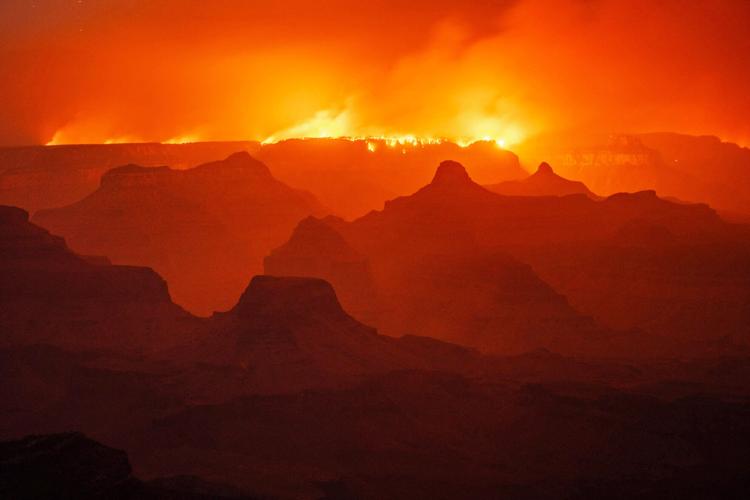
Last July, flames from the massive Dragon Bravo wildfire on the North Rim of the Grand Canyon could e seen from the South Rim.
The ranger hadn’t seen a swarm of tourists on this day, let alone any who were as determined as Grand Canyon enthusiasts Josiah, who's 9, and Liliana, who's 7. He was going to make a proper show of inducting the siblings into the ranks of North Rim ambassadors, and he wanted to dress the part.
People are also reading…
“I pledge to enjoy and protect Grand Canyon,” he said after returning to his post, the children repeating his words with right hands raised on their honor. They promised, “to discover all I can about Grand Canyon National Park and to share my discoveries with others.”
The children had been busy studying their surroundings in preparation for this ceremony, writing down what they had learned about a natural area whose very nature had shifted dramatically less than one year prior.
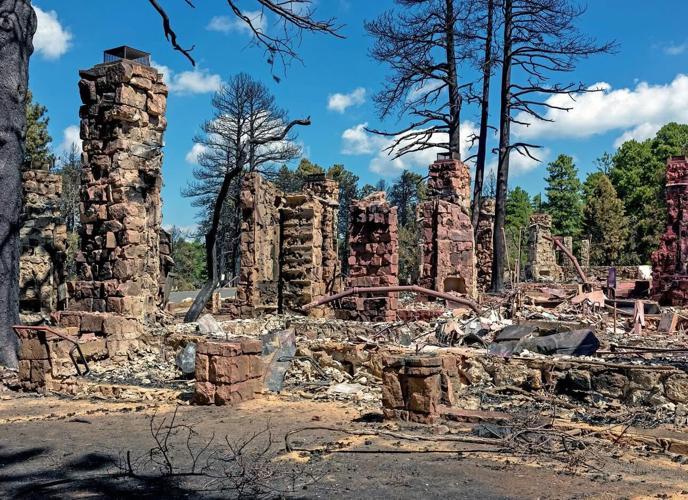
Dragon Bravo destroyed the lodge beloved by employees and repeat visitors for 89 years, now visible to these young rangers only as a collection of roofless stone walls not entirely unlike the remnants of cliff dwellings or kiva ruins in other Southwestern parks.
Blackened evergreens loomed over the Canyon edge. Yellow police tape clung to campground fire pits, indicating a burn ban in a corner of Arizona that remains crispy with drought.
A few miles away, a trout stream that a forester said had held the North Kaibab Forest’s only flowing stream and native trout population had been “nuked,” now apparently devoid of aquatic life.
On the ground, though, undergrowth had begun to sprout from and shade soils that had largely avoided the type of baking that could long deter regrowth. The Earth’s life-giving organic matter was spared by the same force that had destroyed the trees above: winds that had whipped the fire out of control and off to the races instead of letting it settle down for a long scorching.

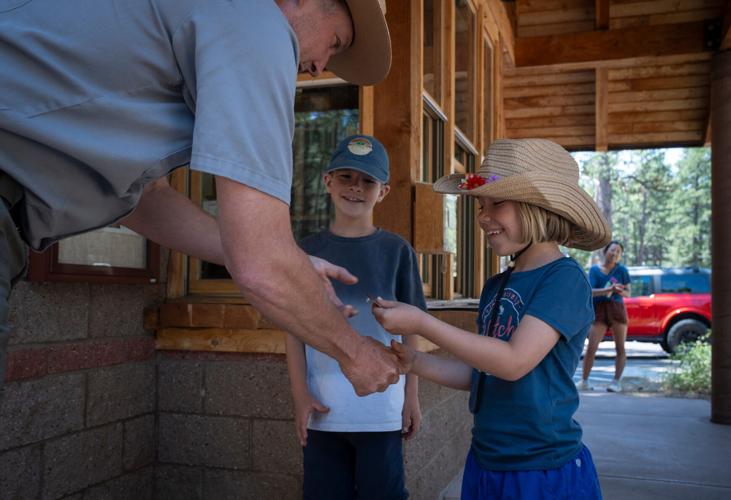
Outback Ranger Matt Baldwin presents Liliana Kirkendall, 7, with her Junior Ranger badge after she completed her activity booklet, at the North Rim of the Grand Canyon. Waiting to receive his badge is Liliana’s brother, Josiah Kirkendall, 9.
But rather than focusing on the fire scar and wreckage, the children had spent an hour and a half working through a checklist in the junior ranger activity book on the little things that remain awe-inspiring on this plateau a mile above the Colorado River. They observed and noted a bug’s actions. They smelled a ponderosa pine’s bark and listed its scent as vanilla. They closed their eyes and noted what they heard. They gazed into the Canyon’s colorful abyss. They wrote haikus about their experience.
The 18-page booklet mandates just three of its many qualifying activities for the badge, mom Kacie Gene Kirkendall said.
“Ranger Matt said you have to do all of them, so it was a little more intense,” she said, “but we also got the full treatment at the end.”
This is a memory that none of them — family or ranger — likely would have shared if a lightning bolt had not ignited a tree last summer that then ignited another and another before strong winds drove Dragon Bravo rapidly south along an island in the sky called Bright Angel Point on its way to the cliff-edge lodge.
The family, from Lancaster, California, had also been on a national parks tour last summer when they drove from Yellowstone to the Grand Canyon on their way home. Jason Kirkendall had been eager to show his wife and children the North Rim as he had previously experienced it, including the dramatic views of the stair-stepping Canyon falling away from the Grand Canyon Lodge’s veranda. The fire hadn’t yet started when they approached the park last year, but the crowds turned them away because none of the campsites were available.
They detoured 200 miles to visit the South Rim instead, and returned this year to see what they had missed. They found the vibe totally changed, mellower, but also melancholy. The North Rim Campground’s listings on Recreation.gov now showed a sea of A’s for “available,” but chain-link fencing blocked access to the hull of the old stone lodge and a pile of downed trees next to another building’s exposed foundation.
“My heart breaks a little bit,” Jason Kirkendall said.
How the fire started and why it exploded
Ranger Matt Baldwin typically wouldn’t have been manning the information booth at all. A Grand Canyon veteran with more than two decades at work in the park, he’s normally a backcountry ranger who would spend his days patrolling remote trails or administering backcountry camp permits. This year, with the North Rim’s housing stock diminished and staffing low, flexibility is necessary. He's alternating with another ranger on eight-day shifts.
Only 25 of 87 campsites were occupied that day. Baldwin said a few dozen visitors had been stopping by for information each day, but many others likely don’t know where to contact the National Park Service after Dragon Bravo’s destruction of more than 100 buildings.
“I chase down visitors because they don’t see scheduled ranger programs,” he said.
While he knows that fire is a natural part of the Grand Canyon and that the forest can heal from this one, he also hinted at some heartbreak. He said he had not yet descended the North Kaibab Trail, the main thoroughfare that rim-to-rim hikers take to access the inner Canyon and the river. That trail was closed after the fire last summer until May, as the park assessed potential hazards where burned slopes may wash out during monsoon rains.
“I kind of just don’t really want to see it, honestly,” he said.
Others who hiked partway down that day, to the Coconino Overlook, said they wished they could have seen it before trees had been blackened and then cut down trailside, or that they could have stood on the lodge’s veranda like so many before them.
“It’s my first time to the Grand Canyon, and I’m a native Arizonan,” said Tempe resident Tysen Schlink, who was hiking with two young sons and the son of a friend. “I know fire happens, but I’ll never get to see the old lodge. I’ll never get to see what it was like. Things change, but it’s sad.”

The remnants of the Grand Canyon Lodge a week after the Dragon Bravo wildfire swept across the area.
The fire started with a lightning strike in Grand Canyon National Park on July 4, 2025, and eventually burned across some 150,000 acres, roughly split between the park and, to its north, the Kaibab National Forest. It burned for three months and became the seventh-largest fire to date in Arizona.
The park’s firefighting effort, which it at first labeled a "confine/contain" strategy for flames that seemed destined to provide ecological benefits associated with fuel reduction, ultimately came into question after winds shifted and rapidly drove the fire south toward the lodge at the rim.
Even then, outside fire experts told The Arizona Republic that the fire could reduce future risks of environmentally catastrophic blazes, and that they feared a backlash could lead to undue suppression of beneficial fires.
Park Service officials at the time said the fire was “expertly handled” despite hot and dry conditions that a Republic analysis later found had brought the fire near the point where the park’s fire plan warns of “the potential for extreme fire behavior.”
But in a U.S. Senate committee hearing this spring, Interior Secretary Doug Burgum acknowledged that a quicker response could have prevented disaster.
“In retrospect,” Burgum said, “an approach of suppression versus containment might have saved hundreds of millions of dollars of historic properties.”
Signs of recovery on the burn scar
Dragon Bravo wrought numerous and mixed ecological and recreational impacts on the Grand Canyon. It created potential flooding and debris hazards on the North Kaibab Trail and caused crews to cut down some burned ponderosas that loomed trailside. It likewise burned more than 12 miles of the 800-mile Arizona National Scenic Trail just north of the park, for which the Forest Service’s burn assessment team recommended cleaning out and expanding water diversions to prevent excessive erosion.
It also opened parts of a dense forest, the remainder of which Forest Service officials are planning to treat with regular prescribed fires to reduce catastrophic fire risks.
“The views are actually better” than before, said hiker Martha Cruse, an environmental scientist on vacation from Klamath Falls, Oregon. “My personal opinion is that the fire did a good thing.”
A federal Burned Area Emergency Response (BAER) team assessment recommended extensive rehabilitation work to prevent erosion. It also prescribed monitoring and prevention of noxious weeds across the burn scar and especially in areas that were disturbed by firefighting methods: 18 helicopter landing and supply sites, 77 miles of dozer lines, 12 large dozer pushouts, 18 miles of hand-dug fire lines, two spike camps and one fire safety zone.
“It is important for the public to stay informed and prepared for potentially dramatic increases in run-off events,” the BAER report warns. “Many burned-area watersheds were already hydrologically responsive to rainfall and prone to erosion and sediment transport prior to the fire and will likely be even more responsive due to post-fire conditions.”
With summer and fall rains, the fire scar dumped soil and ash into streams that fed Bright Angel Creek in the Canyon bottom and deposited black plumes into the Colorado River. Those flows are thought to have killed fish in Bright Angel Creek, a mixed blessing in its own right. While it may have harmed protected humpback chubs, it likely also killed non-native brown trout that eat chubs and that the Park Service has worked 15 years to eradicate from the creek.

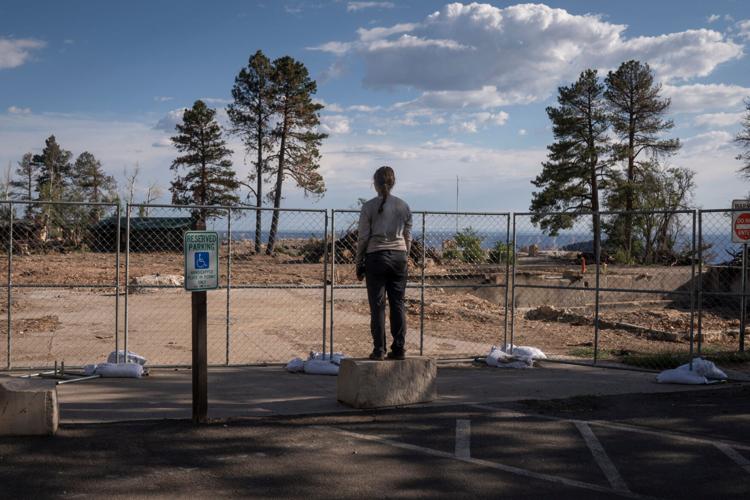
In June, Megan Quinn views the burned-down Grand Canyon Lodge from behind a fence at the North Rim of the Grand Canyon.
Initial survey work on upper Bright Angel found no brown trout there in an area where it previously may have been possible to scoop them out at will, park biologist Emily Omana said during a public presentation in March.
“There might be some hope there,” she said. “Maybe the Dragon Bravo has helped achieve what we haven’t been able to achieve.”
In Dragon Bravo’s wake, Interior officials opted to forgo a planned experimental reintroduction of Colorado River pikeminnows, an endangered top predator fish that dam operations eradicated from the river’s Grand Canyon section, at least until the fire’s effects on the river are clear.
But the BAER team found that almost all of the fire scar sustained low- or moderate-severity burns to soils, allowing them to retain organic matter and the ability to quickly regenerate vegetation. Only 2% of the scar — 3,470 acres — experienced high-severity burning.
Maps show high-severity burn spots dotting the scar inside and outside the park, with the largest concentration occurring on the Kaibab Forest section extending east of Highway 67 toward the rim points jutting out above southern House Rock Valley. Another 38,354 acres, or 26% of the fire zone, sustained moderate-severity burns.
High- and moderate-severity burns could take five to 10 years to recover ground vegetation, according to the report. Low-severity areas should recover within one to three years.

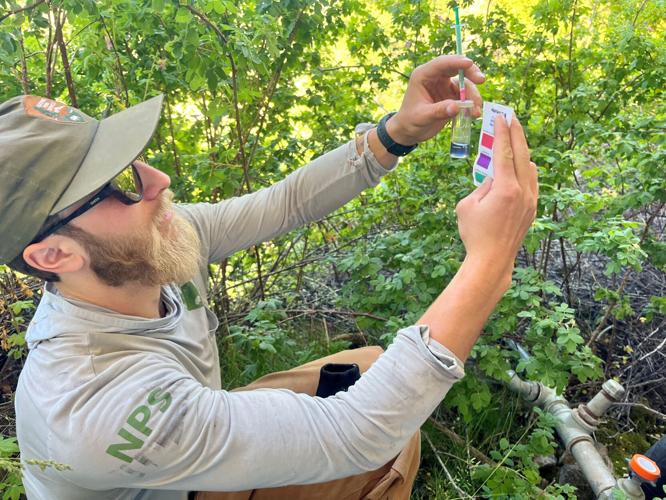
National Park Service hydrologist Zev Axler conducts an alkalinity test in June on a water sample from Big Springs north of the Grand Canyon as part of a long-term springs monitoring research program led by Professor Abe Springer at NAU.
Park hydrologist Hannah Chambless said her crew is monitoring springs that flow water from the North Rim through the ground and into the Canyon, in case any contaminants from the fire emerge as problems for the park’s water supply. Initial measurements found no problems, she said, but it will be important to keep watching in case this year’s monsoon brings heavier rains than the sparse storms that followed the fire last year. Those rains could also pour more ash and dirt into streams.
“We’re worried about larger precipitation events on the North Rim,” Chambless said.
How the fire affected springs at the Canyon
No scientist who has spent countless hours traversing beautiful landscapes wants to see them burn. But when they do, a research team like Abe Springer’s is poised to make the most of it. Springer, a Northern Arizona University professor of ecohydrogeology, has spent decades trekking and sending graduate students to the headwaters of remote springs around Grand Canyon National Park to collect, test and compare water samples.
The Springer laboratory’s dataset on flow, clarity, acidity, origin, minerals and overall quality of these various springs is valuable because of its consistency over time in unmanipulated landscapes.
When Dragon Bravo burned across a portion of their study sites last summer, hydrologist Zev Axler, who works for the National Park Service in collaboration with Springer and NAU, was eager to see what new scientific opportunities it revealed.
On an early June visit to North Canyon Springs along the east rim of the Grand Canyon, where the burn was severe, Axler and two of Springer’s students, Liam Houlgate and Jack Whitehouse, parked their hefty research truck at the end of a bumpy forest road, made sandwiches from supplies in a cooler, then loaded gear into backpacks for the hour-long hike down steep slopes to “the crack.”
After navigating switchbacks made slushy by deep ash from the fire, the trio paused at the turnoff to one of their water sampling sites to comment on how different it looked with so much of the vegetation vaporized. Two tall aspen trees that framed the spot where they typically slid down the slope to suck up spring water in a plastic syringe still stood. But much of the rest of the landscape was unrecognizable, they said.
At “the crack” a mile farther down the trail, the place where this drainage’s fresh spring water drops into the aquifer below for safekeeping and later use, blackened trunks surrounded an ashy puddle now absent of visible aquatic life. Houlgate crouched to pull a sample while Whitehouse searched for a pressure and temperature sensor that appeared to have melted off its mount.
Someday, this forest might recover, and these pools could clear. But for now, the researchers’ focus is on continuing regular sampling to track how fires disrupt groundwater cycles and quality. In an era of climate change drying and warming Southwestern ecosystems beyond their adapted ranges, understanding how burns reshape springs has become an essential part of the routine.
A rapid assessment grant Springer secured from the National Science Foundation, combined with money for the park from the Burned Area Emergency Response program, has allowed the crew to purchase and install three satellite telemetered gauges that can monitor and transmit water quality data from remote locations to the researchers back in their offices, rapidly informing management decisions.
“So now we have these three telemetered gauges, and we can track the data in real time,” Axler said. “If we see something at Robber’s Roost, we can watch how long it takes to see that same response come out at Roaring Springs. The huge benefit of the telemeter data is that, since we visit these sites so infrequently, if something goes wrong with a sensor we often don’t know about it until we come out the next time and we may miss a month or two. Now we get that, and we get data from other important times like around snowmelt when we can’t always access these sites.”
Rebuilding the burned lodge will likely take years
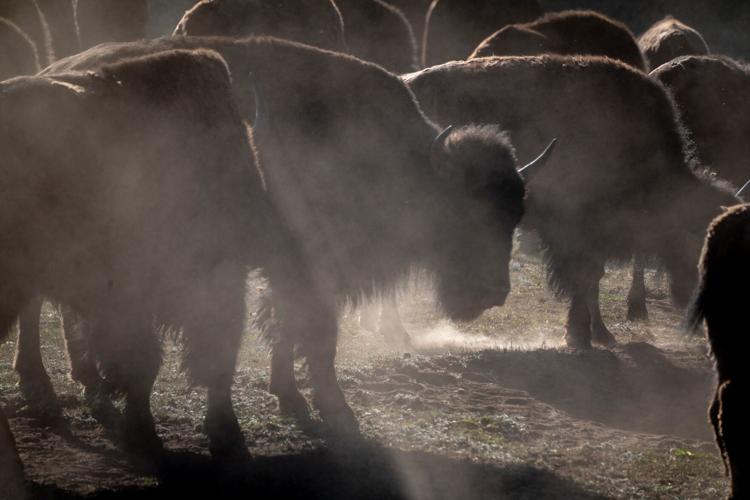
At a Grand Canyon River Guides training session before the rafting season began this spring, Grand Canyon Superintendent Ed Keable told participants he had seen vegetation resprouting in the park even before the flames had gone out last September. Wild turkeys frequented the burn scar, he said, as did a bison herd that may particularly benefit from how the fire opened forested areas to new grass growth.
“The fire actually had a reasonably healthy impact on the environment,” Keable said.
Not so great, Keable said, was the fire’s destruction of lodging, housing and the treatment plants providing both water and sewage services for the North Rim. Replacing these will be a long process requiring federal authorization and funding, a process that several members of Arizona’s delegation have sought to expedite by introducing supportive bills.
North Rim redevelopment will require planning and extensive public comment opportunities, the superintendent said.
“For the 2026 season, our approach is simple,” he said. “We’re opening what we can, where we can and when we can.”
At Jacob Lake Inn outside the park, personnel manager Melinda Rich Marshall — whose family has owned the popular stop for gas or a cookie on the way to the park's North Rim for over a hundred years, and weathered many wildfires in that time — worried last fall about whether Dragon Bravo might be the fire that finally destroys their business model, even if it didn’t burn them down.
Jacob Lake Inn is not just a key fuel provider and lodging option, bridging tourist access to the North Rim. It also maintains the water infrastructure shared by the Kaibab National Forest visitor center at the turnoff to the park, and helps keep local businesses and trucking routes going with their food and supply orders.
Rich Marshall thinks the financial hit Jacob Lake Inn took from Dragon Bravo extends beyond the forest damage and park closures that left them with a torrent of reservation cancellations. They are now navigating fallout from misconceptions created by the national publicity the fire got, that the area is unsafe.
In mid-June, the lightning-sparked 5,000-acre Rock Canyon Fire near the Utah border was burning more than 10 miles from them and spreading in the opposite direction — a fairly typical summer event in the region and not a risk to them. But Rich Marshall thinks it reached them in other ways.
“It’s easy to fearmonger with it,” she said. “I got calls from people the day after that fire started from news places asking if we were going to have to evacuate and I was like ‘No, and can we not go that way with the coverage? Because then people are going to make choices that do affect us.’”
Reopening Grand Canyon Lodge will likely take years. For now, some visitors drive to the end of Bright Angel Point and press against the chain-link fence for a glimpse of the remaining stone walls from the structure that reopened after another fire in the 1930s. That time, reconstruction took about five years.
“Seeing the destructive power of fire is kind of sad and humbling,” said Megan Quinn, a Kaibab National Forest intern who viewed the burned lodge for the first time in mid-June. “It's sad, but also it reminds me why I do my work too, why it's important. So it gives me motivation.”
Quinn’s current work involves replanting trees in the footprint of Dragon Bravo and other fires on the Kaibab. Last summer, when the fire started, she was working as a Grand Canyon National Park intern studying ways to promote fire resiliency, such as placing rock structures in meadows to slow water’s flow to protect trees. She had only been on that job for a week when the fire erupted.
“It was crazy,” she said. “Everyone was very stressed and upset.” But Quinn is hopeful that the forest can recover. “Nature will find a way, you know, it’ll evolve and adapt.”
Indeed, fire is part of the natural landscape, and the forest is likely to return, said Ethan Aumack, executive director of the Grand Canyon Trust, an environmental advocacy group. Nonetheless, he said, it will be a long time, and the type of forest that returns will depend on the changing climate.
“Much of the forests that folks have come to know on the North Rim are no longer,” Aumack said. Their recovery will take decades, he said, and even then the species composition may shift, as in from ponderosa to pinyon-juniper stands. “In a warming climate, forests may not return for the foreseeable future to what they were prior to the fire.”
'We got knocked down. We're getting back up'
Dragon Bravo wasn’t the only major fire to scorch parts of the Kaibab National Forest last July. Another, called White Sage for the area it started on Bureau of Land Management range, burned some 59,000 acres, mostly in the forest to the north of Jacob Lake.
“The Kaibab’s been hurt,” Deputy Forest Supervisor Patrick Moore said. “We got knocked down. We’re getting back up.”
Part of getting back up means removing the most dangerous hazard trees burned but still standing along roads and trails, he said. It also means seeding grasses to hide archaeological sites where potsherds and other artifacts are exposed, and seeding around rare pediocactuses so that invasive cheatgrass doesn’t encroach on them.
Longer term, it will mean shoring up or even moving parts of the Arizona Trail at North Canyon, a creek drainage that looms above House Rock Valley and Marble Canyon beyond. North Canyon previously hosted native Apache trout, a species that was recently removed from the endangered species list but that remains at risk from climate change.
That trout population didn’t originate in North Canyon. The state transplanted them there in the 1960s as the only Apache trout north of the Grand Canyon. Arizona Game and Fish Department Aquatics Program Manager Zachary Beard said he’s unsure whether the goal back then was to expand recreational opportunities or to protect a separate population to ensure species recovery, but the population has been used to restock White Mountain populations over the years.
Now the fish appear to be gone. Staffers have visited the creek twice since Dragon Bravo and have found no trout, Beard said. “I think it’s probably safe to say they were lost following the fire,” he said.
Restoration work is needed to make North Creek a suitable habitat again, Moore said.
“It was the only place on the North Kaibab that had running water and trout — native trout — (and it) absolutely got nuked,” Moore said. “We’re going to have to go back and do some of that work in there under the (federal Burned Area Rehabilitation) program to try to get that system to hold water again.”
Repairing the damage, preventing another big fire
For the long haul, the Forest Service is working with local communities and interest groups on a plan to mitigate the damage from last summer’s fires while preventing a repeat.
That work, slated to break ground in late summer, is a product of close discussions between the federal government, local officials, ranchers, the timber industry, tribal partners and environmental nonprofits — groups that typically occupy different ends of the political spectrum.
“Our recovery strategy builds on decades of collaboration with local communities, partners and stakeholders,” a spokesperson at the Kaibab National Forest said in an email.
Two strategies underpin the new plan: hazard tree removal and strategic fire management in areas spared from flames the first time around.
Fire management will involve mechanical thinning and constructing a 100-mile network of fuel breaks to slow the spread of future flames. The goal is to keep fires that inevitably spark to a manageable size, allowing them to continue fulfilling their role in keeping Western forests healthy.
The second part of the plan is arguably the more delicate one. In the proposal, the hazard tree removal entails removing singed ponderosa pine within hundreds of feet of roads, fence lines, trails and water infrastructure to eliminate their threat to public safety. It’s also a chance to reap some of the timber value from incinerated trees, which is only viable up to three years after the burn.
Just don’t call it salvage logging, said the Grand Canyon Trust’s Aumack, whose team helped develop the proposal. Previous salvage logging efforts have been controversial, as they took a clear-cut approach and were thought to be motivated by profit.
Science has shown that trees still hold ecological value even when charred, linchpins in a forest’s natural regeneration. Removing snags post-fire suppresses habitat for cavity-nesting birds, reduces sapling biodiversity and damages soils.
The Kaibab coalition insists that timber harvest is a secondary motivation. Members have identified 4,359 acres for this work.
“We're focusing on the achievable and what is necessary,” Aumack said. “Not just from a commercial perspective, but driven by other imperatives, public safety being first and foremost.”
A Sierra Club representative agreed that the proposed logging seems limited, even if a lighter touch might be possible.
“Over the years, we have frequently disagreed with the Forest Service on post-fire logging,” said Sandy Bahr, director of Sierra Club’s Grand Canyon Chapter. “That's clearly not what they're doing here.”
“It's less about trying to turn a profit, because the trees really aren’t worth that much,” said Kyle Rodman, a forest ecologist at the Ecological Research Institute in Flagstaff’s Northern Arizona University. “It's to offset the cost.”

Bison graze in a meadow at the North Rim of the Grand Canyon in mid June.
'Bring your own water'
The proposal faces a bigger challenge for now: funding. That goes for all North Rim recovery, including a new lodge and other park visitor services. So far, Congress has yet to pass legislation specifically to finance the full suite of reconstruction and restoration that the North Rim requires, an undertaking that could cost $600 million to $1 billion.
The Kaibab National Forest said it has requested $195 million from the federal government for wildfire recovery beyond the immediate aftermath.
Two non-funding bills are making their way through Congress. Arizona senators and, separately, Rep. Eli Crane, each introduced a bill that would cut red tape for contractors to carry out reconstruction and rehabilitation. To date, Crane’s bill has cleared the House and is headed to the Senate for a vote.
“Congress needs to understand the urgency of rebuilding the North Rim,” Aumack said. “So far, a year out, we have not seen Congress take the steps necessary to find the funds for that rebuilding.”
Grand Canyon Conservancy is raising funds to help. The national park’s nonprofit philanthropic partner is soliciting donations to its Grand Canyon North Rim Recovery Fund for needs including reconstruction, North Kaibab Trail rehabilitation, temporary North Rim visitor services, water quality monitoring, flood risk modeling and more.
The conservancy is also fundraising for some new amenities that could accompany reconstruction, including snowplows that Arizona could operate to keep the North Rim open for visitors and cross-country skiers in winter and a possible dark-sky observatory to complement a rebuilt lodge, spokeswoman Mindy Riesenberg said.
Dragon Bravo temporarily marred the experience of visiting Grand Canyon’s quieter, more contemplative side, she said, but “everything can be rebuilt.”
“It was a tragedy,” she said, “but we’re looking at it as a wonderful opportunity to bring in partners that were not part of the North Rim before and to make it a more reflective, educational experience.”
For those looking for that quiet reflection now, Ranger Matt has some basic, essential advice.
“Bring your own water.”