The federal government has agreed to pump more than $450 million into programs to carry out additional Colorado River water conservation, Arizona Department of Water Resources chief Tom Buschatzke said Monday.
The spending is necessary to make the new proposal from Arizona, Nevada and California work, Buschatzke and other water officials said Friday in releasing their offer to save 700,000 to 1 million acre-feet of river water through 2028. A million acre-feet is the equivalent of approximately 10 years' worth of Colorado River deliveries to Tucson Water.
The U.S. Interior Department proposed that the money be spent, and the U.S. Office of Management and Budget, which must sign off on all federal expenditures, approved it, Buschatze said at a news briefing Monday afternoon on the new plan from the three Lower Colorado River Basin states.
People are also reading…
"When the federal government shared with us that O.M.B. approved their spending plan, that was a giant leap forward in the Lower Basin discussions and in having this proposal come together last Friday night," the formal deadline for the states to submit their proposal to Interior, Buschatze said.
J.B. Hamby, California's Colorado River commissioner, said later Monday that what Buschatzke said is also his understanding of the federal government's position. The federal funding offer would require the Lower Basin states to engage in a cost-sharing effort to contribute money to the water-saving scheme, Buschatzke said.
A U.S. Bureau of Reclamation spokesman, however, offered in response to a question by the Star only a general comment on the Lower Basin proposal that said nothing about financing it.
"While the Bureau of Reclamation has consistently emphasized the importance of achieving a consensus among the seven basin states, we appreciate the Lower Basin states for their proposal and their continued engagement. We are reviewing the proposal as we continue to develop a preferred alternative," as part of the process to follow environmental rules to rewrite operating guidelines for the river and its reservoirs, the bureau spokesman said. The other four states are the Upper Basin's Colorado, New Mexico, Utah and Wyoming.
The bureau and its parent agency, the Interior Department, will have to approve final plans for operating the river after current federal guidelines expire at the end of September 2026. Buschatzke said he's expecting the federal government to issue a final environmental impact statement laying out its preferred alternative for the plan in June and make a final decision in "Julyish."

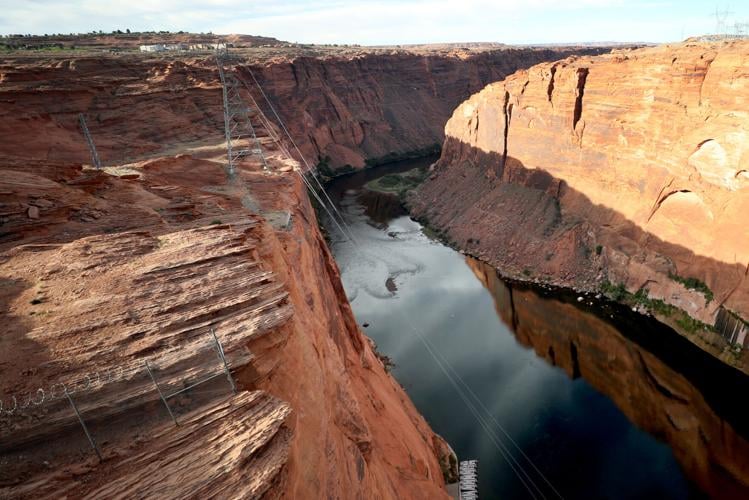
The Colorado River below Glen Canyon Dam.
The spending of federal money to pay Lower Basin water users to conserve water is needed because many of the largest users, such as farmers in the Yuma area and Southern California's Imperial Irrigation District, have senior water rights. Many experts have said those users can't be forced to give up their rights without compensation.
"You've got to give them an incentive to put skin in the game and the skin is dollars," said David Wegner, a retired U.S. Bureau of Reclamation planner and engineer.
Cities such as Tucson and Phoenix have a far lower legal priority for the water than farmers, but they have contracts with the feds entitling them to use river water as long as they pay the Central Arizona Project to cover the costs of pumping it uphill from the Colorado to the cities.
In the future, they may well need to buy water rights from other users who have higher priorities, but they've also taken federal money over the past few years to use less water and presumably would take more of it now.
Behind the series: The Star's longtime environmental reporter Tony Davis shares what inspired him to write the investigative series "Colorado River reckoning: Not enough water."
In 2023 and 2024, in particular, Reclamation under the Biden administration paid billions of dollars to Lower Basin cities and farmers to leave money in Lake Mead to keep its water level from falling too low.
While some of those dollars went for long-term water savings projects — including an $86 million grant to Tucson to build a wastewater purification plant for drinking water purposes — much of it went to one-time farm fallowing programs and for simply leaving water in Mead. Those efforts ended when the money ran out.
At Monday's briefing, Buschatzke said of the federal dollars he now hopes to get, "I think there is an opportunity for some of it to be for longer-term benefits. But we are in a situation, given the poor hydrology and the potential for substantially (more) poor hydrology, to create a Defcon 1 outcome.
"We gotta do what we gotta do. We gotta get water there. Certainly there are opportunities as that's happening to find projects with longer term benefits we all want. It's not like we are going to put all our eggs in (one) basket."
He didn't explain his usage of the term Defcon 1, but in the U.S. military, it's considered the highest of five stages of alertness to severe danger.
In another topic discussed at Monday's briefing, Buschatzke said Arizona's share of the 700,000 acre-feet in cuts — which would amount to 300,000 acre-feet — will be split among various users depending on their legal priority to receive river water during shortages.

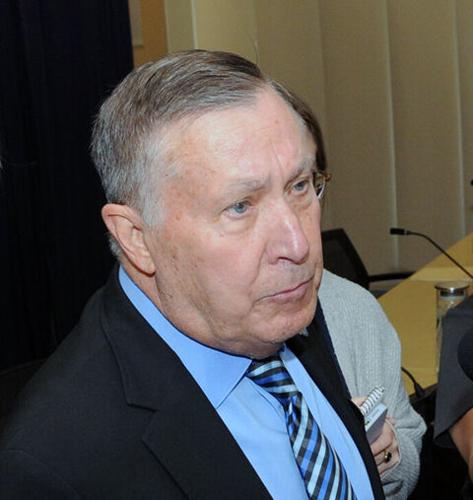
Arizona water chief Tom Buschatzke
The lowest priority users for river water during Colorado River shortages are users of CAP water and some users along the Colorado north of the Yuma area, he said. Of the CAP users, those who would lose their water first would be users of what's known as non-Indian agricultural water, commonly called NIA. Those users, mainly tribes and several Phoenix-area cities, would be the first to lose CAP water.
About 20% of the CAP cuts would fall upon cities and tribes with rights to what's classified as municipal and industrial water and tribal water. Tucson is one of the cities with CAP municipal water rights.
"If any water users with a higher priority wants to throw water on the table and change the calculus, we’d take them up on it," Buschatzke said. "So far, higher priority users have not offered to do so. The Yuma area has indicated one (irrigation) district might be willing to throw water on the table for compensation. There's nothing set in the sand on that."
He was asked at the briefing what would make the Lower Basin states agree to conserve 1 million acre-feet of river water instead of 700,000 acre-feet.
"It’s like you're buying an insurance policy — get as much as you can afford, as much as you should get," he said.
The three states so far have agreed to split the 700,000 acre-feet in savings, with Arizona and California each putting up 300,000, and Nevada saving 100,000. In 2023, when the states reached an earlier, short-term agreement, they set a target to conserve 3 million acre-feet, and "we got 3.7 million to 3.8 million acre-feet (in savings) by the end of the day," Buschatzke said Monday.
Contact Tony Davis at 520-349-0350 or tdavis@tucson.com. Follow Davis on Twitter@tonydavis987.

Tony Davis
Reporter


 Arizona could be hurt by cutbacks in Colorado River water releases