A proposal from Arizona, California and Nevada to shave their take from the Colorado River for the next 30 months is drawing favorable reactions from a large majority of outside experts interviewed about it.
Only three of 10 outside experts in water, the river and related issues interviewed by the Star expressed clearly skeptical or ambivalent views of the proposal. A fourth, author-researcher Eric Kuhn of Colorado, found provisions he liked and didn't like.
Most experts saw this proposal as an important first step toward moving the region toward a more conservation-minded path as river flows keep declining due to drought and human-caused climate change.
But the criticisms from the handful of skeptics run deep, and raise concerns both about whether the new proposal will save enough water, and whether it can gain enough political traction to succeed.
People are also reading…

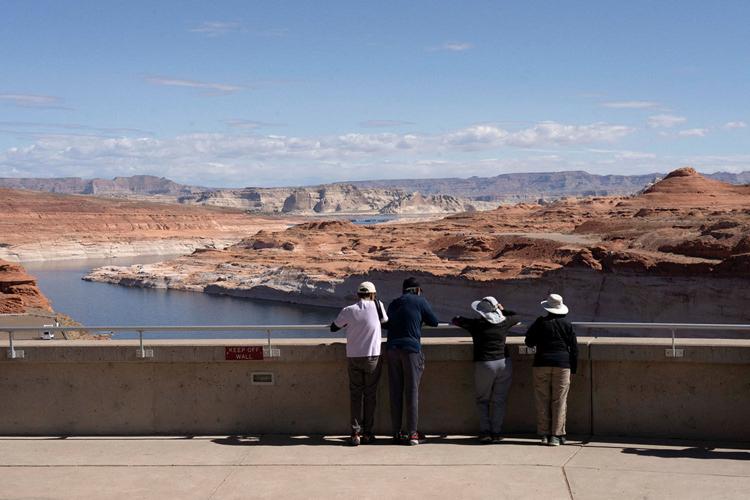
Tourists look at the Colorado River from Glen Canyon Dam near Page, Arizona.
The most prominent among the proposal's many provisions calls on those three Lower Colorado River Basin states to knock down their river water use by 700,000 to 1 million acre-feet — 10 years worth of Tucson's drinking supply — through 2028.
Those sympathetic to the proposal say that at the very least, "it's a start" and a "step in the right direction" toward a more sweeping and comprehensive long-term plan. Efforts to strike a compromise plan for a deal lasting 20 years have run aground after more than two years of negotiations between the river's Upper and Lower Basin states.
One skeptic of the proposal said it wouldn't save enough river water to avert a short-term crisis due to this year's dismal snowpack and expected record low runoff of spring-summer mountain snowmelt into the river. That skeptic, farmer Alan Boyce, also says part of the problem with the new plan is very overoptimistic forecasting by federal agencies of how much water will run down the river — forecasting that helped shape the new pan.
Others are skeptical that the Lower Basin states can get the federal government to approve and fund the water-saving plan without support from the Upper Basin states — Colorado, New Mexico, Utah and Wyoming — and have doubts that those states will support it.
The Lower Basin states' 7-page proposal offers a sweeping overhaul of current river management policies. Besides recommending cuts in water use, it also would set aside a "pool" of water in Lake Mead that would be conserved for use by tribes and would alter some operations of Lakes Powell and Mead.
It would essentially lock into place this year's practice of releasing extra river water from a big reservoir, Flaming Gorge, at the Utah-Wyoming boundary, to Lake Powell for future release into the Lower Basin if Powell's water level is deemed too low. And, it would depend for its success on a large payout of federal money to get cities and farmers to conserve water — to be shared with contributions from the Lower Basin states.

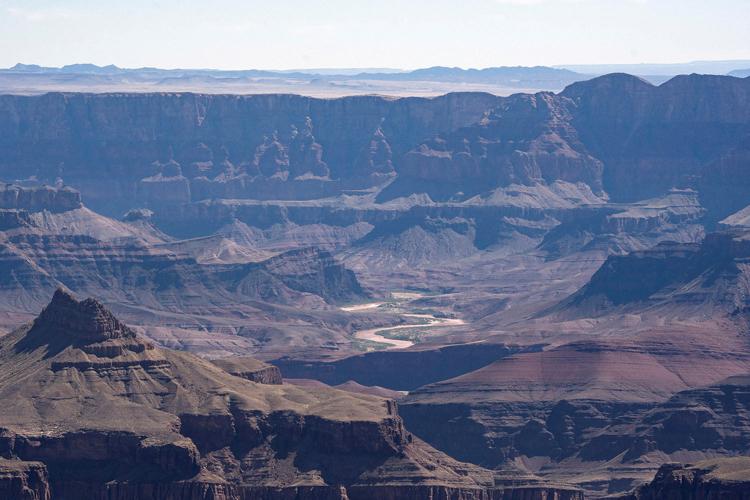
The Colorado River snakes through the south rim of Grand Canyon National Park near Tusayan, Arizona.
Utah State University water researcher Jack Schmidt summed up the views of those favoring the plan, saying, "You've got to start somewhere, for God's sake. Anything is going to be controversial but we've gotta get moving here."
It's a short term plan, really constrained in its scope, but it does have the potential to help water users avoid the worst case scenarios in the short term, said Elizabeth Koebele, a University of Nevada-Reno political scientist whose work focuses on environmental policy.
"Our conversation to date has really been very high level, it's been the Upper v. the Lower Basin. To me this is the first time we’ve seen the conversation brought down to the level of how cuts will be divided among the Lower Basin states."
"It’s advanced the conversation from something very big and vague to something more concrete," she said.
Politically, the proposal is a smart move by the Lower Basin — "a strategic chess move," said David Wegner, a retired U.S. Bureau of Reclamation planner who now sits on a National Academy of Sciences advisory board. "It showed they were willing to move when the Upper Basin hasn’t. It gives them a political leg up."
The plan offers some benefits for Arizona, particularly because it would push back the day when the 336-mile-long Central Arizona Project canal system will have to sustain a "very, very deep" cut, said Sarah Porter, director of Arizona State University's Kyl Center for Water Policy .
When the Bureau of Reclamation proposed five alternatives for the river early this year in its draft environmental impact statement for a 20-year conservation plan, its most likely cut for CAP among those alternatives would have knocked the canal system down by more than 80% from current deliveries, to about 237,000 acre-feet a year. CAP delivers river water to the Tucson and Phoenix areas, including virtually all of Tucson Water's drinking supply.
Although CAP's exact share of the river cuts under the shorter-term Lower Basin plan isn't determined, it would clearly lose far less water that way than under the long-term plan.
But longtime farmer Boyce said the new proposal's cuts are based on what he sees as greatly over optimistic forecasts for how much water will be in the river this spring and summer. He cited Reclamation's most recent monthly forecast for river flows, from April, which he said projected that 2 million more acre-feet of water will be in the river this year than actually will be available.
He bases that conclusion on his own, detailed analyses of data available to the river forecast center that show a wide range of possible projections for actual river flows.
Instead of saving 1 million acre-feet of river water total through 2028, the new proposal should call for saving 1 million acre-feet every 12 months, he said.
Boyce agreed with a statement by Southern Nevada Water Authority General Manager John Entsminger that everyone in the entire river basin needs to "double down on water conservation."
"But this plan is not doubling down," said Boyce, who runs farms in the Yuma area and in Southern California's Imperial Valley.
Other skeptics questioned how easy it will be for the three Lower Basin states to persuade the Reclamation to approve the plan, in the face of likely opposition from the Upper Basin states.
The Lower Basin states say that only the federal government needs to approve and finance this plan.
But because it also touches on the operations of Lake Powell and the Upper Basin reservoirs upstream of Powell, "It is difficult, if not impossible, to imagine the proposal moving forward — at least with respect to those pieces — without Upper Basin consultation and, ultimately, consensus," said Jason Robison, a University of Wyoming law professor and co-director of the university's Gina Guy Center for Land & Water Law.
The Lower Basin states' proposal should not be viewed in isolation, but rather alongside the Upper Basin states' recent call for mediation of the seven-state dispute, Robison added.
Both the plan and the push for mediation reflect a "nugget of wisdom" gleaned from past court cases that show "litigation is a poor way to do Colorado River governance," he said. "Further, both pushes could intersect, with the Upper Basin states' requested mediation (request)."
Having a mediator could create a space in the negotiations to work through the ideas in the Lower Basin proposal, he said.
Another water researcher, Doug Kenney of the University of Colorado, said while this proposal is designed only as a "short-term bridge," it's a comprehensive package containing many items that Upper Basin states are likely to view as "just a repackaging of ideas that are already contested."
In particular, he cites proposals that would continue releases annually from Upper Basin reservoirs into Powell, and that would eventually raise releases from Powell to Mead from this year's low level of 6 million acre-feet a year back to 7 million as they had been in the past.
He also cited the Lower Basin's effort to have federal water conservation funds diverted into the Lower Basin. And he cited the proposal's request for the Upper Basin states to offer "verifiable water contributions of their own."
"Whether or not these are objectively good ideas, it seems pretty clear that they are not points of agreement around which a deal — even a short-term deal — is likely to quickly coalesce," Kenney said.
Even if that happens, it is a bridge to a long-term fix for the river only if the seven states use the next few years to adopt a comprehensive solution, he said.
The river's current operating rules, which expire Sept. 30 after 20 years, were supposed to serve as a similar bridge, "but to no avail."
"Overall, I applaud the effort of the Lower Basin to move the ball forward, but I have a hard time believing that this will be the framework that finally leads to a 7-state truce and a stabilized system," Kenney said.
'We are all in this together'
Utah State's Schmidt, however, said he liked a provision in the new proposal calling on Reclamation to finish work on a study by the end of 2027 to retrofit Glen Canyon Dam so it can continue to generate electricity and deliver water downstream even when Lake Powell is at low elevations. The solution should be put into place by the end of 2028, the states say.
Currently, officials at the bureau and other experts are concerned that the dam's outlet works, steel tubes through which the water would pass at low elevation, could suffer serious damage if used for a long time.
"It's a good idea for the bureau to confirm that the river outlet works in fact have potential of being used a long period," Schmidt said.
Another idea that "makes perfect sense" is for the basin states to rely on annual releases of water stored in reservoirs upstream of Powell to keep it higher, he said.
"You have to begin to consider the Upper Basin (reservoirs) so they are part of a whole system," he said. "We are all in this together."
Upper Basin concerns
But the four Upper Basin states, in a written statement, raised concerns about how the proposal will affect a little-known but important water management program on Lake Mead that allows states to store water there and remove it under prescribed conditions when they need it. It's known as Intentionally Created Surplus, or ICS for short.
Currently, the three Lower Basin states can store water under this program and remove it as long as Lake Mead doesn't fall below 1,025 feet. But under the new proposal, the states would pull out small amounts of stored water when the lake falls to 1,000 feet. States could also use their ICS stored water as a credit toward their water conservation commitments without actually using less water.
“The recent Lower Basin concept proposes new flexibility to allow the use and delivery of ICS to meet shortage obligations and deliveries. The new proposed flexibility to use this water below will accelerate the decline in Lake Mead below 1,025 feet, and blunts the benefits to Lake Mead from Lower Basin (water use) reductions," the Upper Basin states said in their statement.
Responding, California's Colorado River Commissioner J.B. Hamby said, "Regarding storage, California has conserved significant volumes of water at a cost of hundreds of millions of dollars to ratepayers. That conservation has helped raise Lake Mead’s elevation and provided greater water-supply certainty for Southern California.
"Access to that investment is essential, and we continue to work with our Lower Basin partners and the Department of the Interior to finalize a balanced approach. California conserved this water for a less-than-rainy day. Access to that conserved water is essential to California’s participation. Even so, our proposals reflect a prudent and responsible approach by limiting our ability to withdraw that water at lower elevations compared to our underlying rights that enable California to do so."
Contact Tony Davis at 520-349-0350 or tdavis@tucson.com. Follow Davis on Twitter@tonydavis987.

Tony Davis
Reporter




 Tucson, Phoenix create water-sharing plan as Colorado River shrinks