

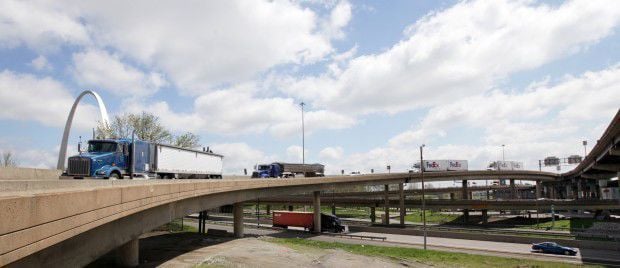

ST. LOUIS • Major downtown highway bottlenecks will disappear near the Mississippi River over the next few years and be replaced by new pavement.
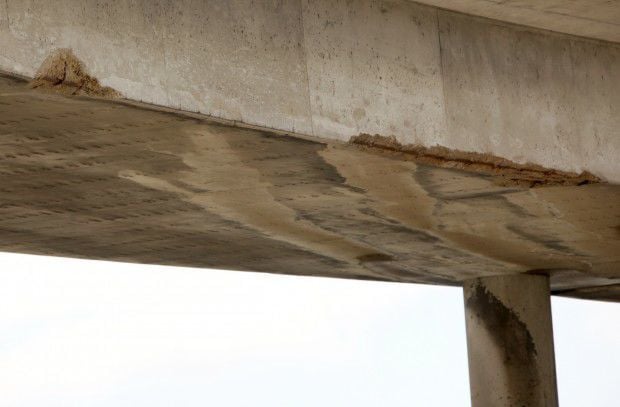
But during that process, transportation officials will be racing the clock to keep traffic flowing during a series of transitions that will see the new Mississippi River Bridge open, the Martin Luther King Bridge close for resurfacing, and the Poplar Street Bridge get its dilapidated ramps fixed.
In the short term, potholes on the Poplar Street Bridge’s driving surface have to be cut out, with good sections patched.
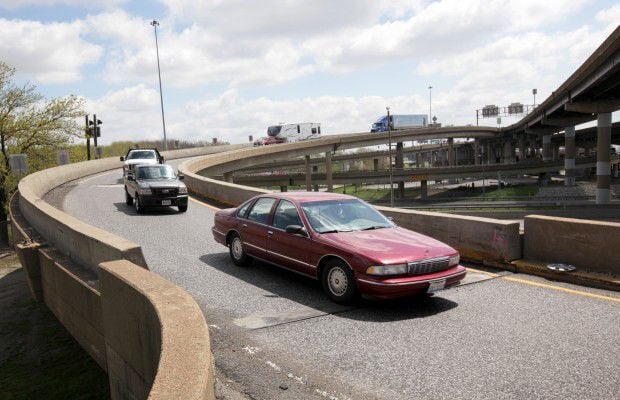
And there are fewer good sections. During the past two weeks, maintenance crews have worked through the night to patch pavement on ramps that carry tens of thousands of vehicles every day to points north and south.
“If we don’t fix them and traffic keeps beating on them, the holes (in the driving surface) become so large we would have to close the ramps down to fix them,” said Deanna Venker, the Missouri Department of Transportation’s area engineer in the city of St. Louis.
People are also reading…
Missouri and Illinois transportation engineers briefed St. Louis regional leaders Wednesday about the new street, bridge and highway improvements that are on the way along the Mississippi River here.
Interstate 70 soon will be taken off the Poplar Street Bridge and run across the new bridge under construction north of the Edward Jones Dome. Recent high water on the Mississippi River has resulted in some delays, but work is continuing, project officials said. The main span and other projects total $667 million.
“All of the projects are on track for February of next year to open,” said Ed Hassinger, MoDOT’s St. Louis district engineer.
MoDOT is directly involved with building a park over the depressed section of what is now I-70, to allow people to walk from downtown to the Gateway Arch grounds. Hassinger said contracts are expected to be awarded this summer and most of the work will occur in 2014 and be completed by 2015.
Memorial Drive will close and drivers will use a downtown street grid that will be revamped in the area bounded from west of the Old Courthouse on the west, the Mississippi River on the east, Walnut Street on the south, and north of Laclede’s Landing on the north, Hassinger said.
“The north-south stuff that used to happen on Memorial is going to happen on Fourth and Broadway, once the City-Arch-River project is done,” Hassinger said.
Drivers will have an easier time navigating the streets along the highway near the Martin Luther King Bridge. Entrance ramps will be moved to Washington Boulevard, Hassinger explained.
There will be significant work on the Poplar Street Bridge ramps connecting to I-70 and I-55. Hassinger told the East-West Gateway Council of Governments that the ramps to I-70 are in “terrible condition,” requiring constant attention. They will be repaired in six separate phases.
One of the most significant measures will physically pick up and slide the eastbound lanes of the Poplar Street Bridge to the south, to accommodate a new lane across the span.
“When it’s done, everything is going to be new,” Hassinger said. “Many of the traffic patterns are going to be changed. Everything is going to be totally remade basically from the (Mississippi) River bridge to Poplar Street and from the Old Courthouse to the river.”
Jeff Keirn, acting deputy director for the Illinois Department of Transportation in Collinsville, said the Martin Luther King Bridge will be closed from August 2014 to March 2015 for replacement of its deck.
In response to crossover accidents, Illinois installed concrete dividers in 2009 that left room only for one westbound lane and two eastbound lanes. The bridge will remain three total lanes after the repairs, Keirn told regional leaders in response to concerns about occasional traffic tie-ups on that span.
Keirn said much of I-70 through traffic used the King bridge as a shortcut to avoid the Poplar Street Bridge. “A lot of that traffic will go up to the new bridge,” he said. “So we will have a reduction of traffic on the MLK, which will help some of the congestion problems.”
Illinois and Missouri officials had sparred over the configuration of the new Mississippi River bridge and, more recently, plans to eliminate a ramp from downtown St. Louis to the Poplar Street Bridge. An impasse temporarily threatened MoDOT’s $54.8 million plan to rebuild the interchange linking Highway 40 (Interstate 64), Interstate 55 and I-70 just west of the Poplar Street Bridge.
Illinois pledged $25 million to cover the extra cost of the compromise plan to widen the Poplar Street Bridge and build the a new ramp, beginning in January 2015, to link the King Bridge to Illinois Route 3.
Regional leaders expressed optimism that the major projects would come together.
“We’ve got a lot of work ahead of us,” said St. Clair County Board Chairman Mark Kern. “But it seems that at the end of the road, this project will turn out to be a great boost to the region.”
St. Louis Mayor Francis Slay said the 3½-year construction effort would be “well worth it.” The fact that Illinois and Missouri officials were able to work through their differences reflects a “success story” for regional cooperation, he said.
“We are part of the same region,” Slay said after the meeting. “We are part of the same economy. It’s important to have good communication, good transportation to and from one state to the other.”
Ken Leiser is the transportation writer at the Post-Dispatch. Read his Along for the Ride column online and every Sunday in the newspaper.


