

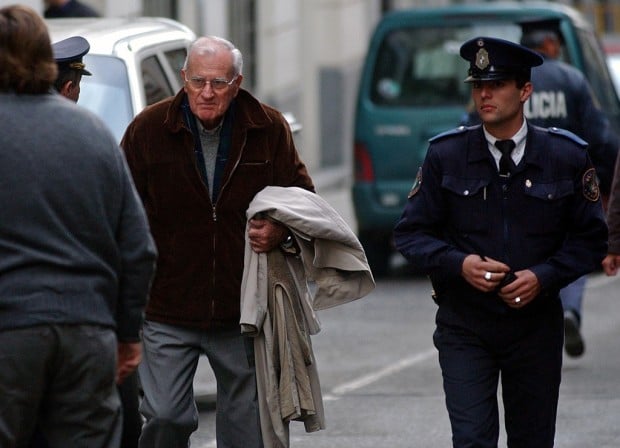
MONTEVIDEO, Uruguay - Former President-turned-dictator Juan Maria Bordaberry, whose self-coup launched more than a decade of military rule in Uruguay, died Sunday in his home, where he was serving a sentence for leading efforts to eliminate leftist dissent in the 1970s.
Bordaberry had been suffering from breathing problems and other illnesses that kept him from serving the 30-year sentence in prison. His death - on his 83rd birthday - was confirmed by his son, Sen. Pedro Bordaberry.
A wealthy conservative landowner, Bordaberry was elected president in 1971 during a chaotic time in Uruguay, when wealthy elites and leftist Tupamaro guerrillas both saw armed revolution as a real path to power.
The Tupamaros were already crushed when Uruguayans awoke to tanks surrounding the legislative palace in June 1973. The military had become so powerful that Bordaberry had to give up control in order to survive politically.
People are also reading…
Rather than lose a minor political fight in Congress, he suspended the constitution, banned political parties, ordered tanks into the streets and ruled by decree until the generals ousted him anyway three years later. Democracy wasn't restored until 1985.
Meanwhile, Bordaberry lived quietly out of public view, and as the dictatorship ended, Uruguay's congress approved amnesties that protected both military figures and former guerrillas - including Uruguay's current president, former Tupamaro leader Jose Mujica.
That pact threatened to break in November 2006, when a judge ordered Bordaberry arrested for the killings of four Uruguayans who had fled to Argentina.
Weeks later, another judge added charges of especially aggravated homicide in the killings of 10 leftist detainees.
Both sets of crimes were determined to be beyond the scope of the amnesties. He was eventually sentenced to the maximum 30 years in prison in February 2010 for violating the constitution by leading the coup.
Bordaberry's family considered him a victim of political pressure from a coalition of center-left parties, unions and social movements that has governed Uruguay since 2005.
But his prosecution also marked the beginning of efforts by this South American country of 3.5 million people to end impunity for those responsible for the disappearances and torture of hundreds of Uruguayans, and the exile of thousands of political dissidents.
A peace commission found in 2003 that the dictatorship killed 175 leftist political activists, 26 of them in torture centers.
Earlier, the Tupamaros also committed killings and other crimes after taking up arms in 1963 against democratically elected governments.
Investigative judges linked Bordaberry to the abductions and killings in May 1976 of two members of the traditional National Party, prominent lawmakers seized in Buenos Aires. Their bullet-riddled bodies and those of suspected two Uruguayan guerrillas were found days later.


