

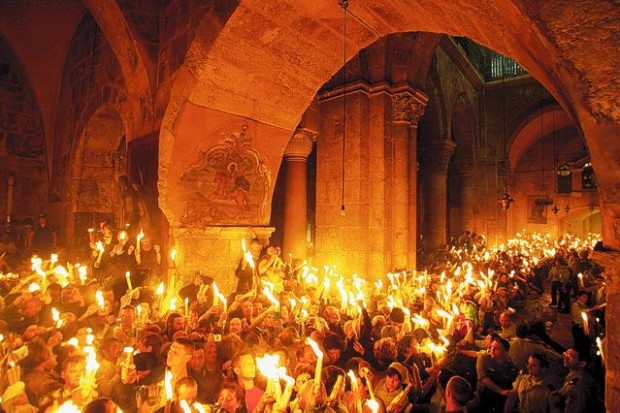
JERUSALEM — Worshippers filled Christianity's most revered church on Saturday, lighting rows of candles, dripping hot wax on their faces and dancing in celebration of the Orthodox Easter "holy fire" ritual.
Orthodox Christians believe Jesus Christ was crucified and buried where the Church of the Holy Sepulcher now stands, and the fire appears spontaneously from his tomb on the eve of Easter as a message that he has not forgotten his followers.
The fire ceremony started with the entrance of Jerusalem Greek Orthodox Patriarch Theofilos III, dressed in his robes and a large yellow-and-white cowl, and carrying a large staff.
He descended into the church's underground tomb to bring out the flame. When he emerged, church bells pealed and flames were passed around to the thousands of faithful, filling the church with light and smoke.
People are also reading…
Worshippers quickly lit their candles — many of them carrying bunches of long tapers tied up with string and decorated with pictures of Jerusalem. Arab Christian women ululated and others beat out drum rhythms. One youth bounced up and down on another's shoulders, waving a candle.
Other celebrants dripped candle wax onto their faces.
The "holy fire" is taken aboard special flights to Athens and other cities — connecting many of the 200 million Orthodox worldwide to their spiritual roots.
Outside the church in Jerusalem's Old City, Israeli police helped worshippers light candles from the flame, many of the faithful stretching their arms across barricades erected to keep back the surging crowd.
Tens of thousands of pilgrims packed into the walled Old City for Easter, and many said they had been unable to get past the barriers to reach the ceremony.
Although police could not give an exact figure, the number of Easter pilgrims in Jerusalem was higher than normal because the calendars of five major Christian faiths coincided this year, bringing Orthodox and Western Christians to the cramped Old City at the same time. This happens only once every four years.
Among those unable, or unwilling, to brave the crush, 70-year-old Athena Kiraguzion, from Thessaloniki, Greece, sat with friends watching live coverage of the ritual on a TV set placed on a chair in one of the Old City's cobbled lanes.
In addition to a crucifix around her neck, she also wore several religious icons and an eye-shaped blue pendant to ward off misfortune.
"I wanted to go to the church but … it was difficult," she said, speaking through an interpreter. "There were many people and I'm sick. I wanted to see but I can't."
The event dates back at least 1,200 years.
Last year, tempers flared as thousands of people waited to pass through security barricades into the Old City. Some priests and pilgrims shoved and punched police, and there were scuffles inside the church. There were no reported disturbances this year and regular worshippers said the police presence was heavier than it had been previously.
Police spokesman Shmuel Ben-Ruby said several thousand police officers were deployed in the area.
On StarNet: For more coverage of faith and values issues, and of religious observances, visit


