

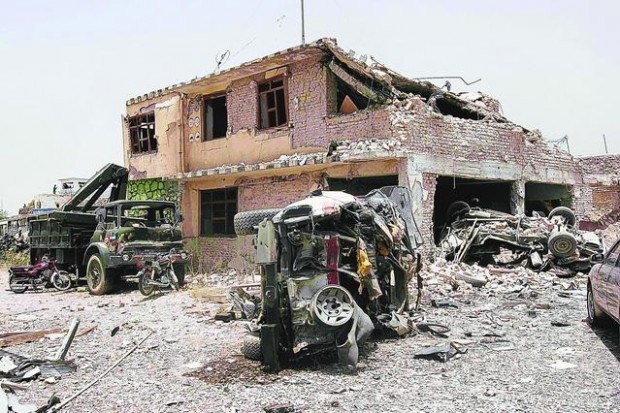
KANDAHAR, Afghanistan — A roadside bomb exploded near a U.S. military vehicle on Saturday, killing four Marines and wounding one in western Afghanistan in the deadliest attack against U.S. troops in the country this year, officials said.
The bomb in the western province of Farah targeted U.S. personnel helping to train Afghanistan's fledgling police force, said U.S. spokesman Lt. Col. David Johnson.
The attack came one day after the U.S. defense secretary highlighted the fact that more American and allied troops were killed in Afghanistan than in Iraq last month.
The Marines were from the 2nd Battalion, 7th Regiment based in Twentynine Palms, Calif. They arrived in Afghanistan earlier this year and were sent to southern and western Afghanistan to train police.
The four deaths bring to at least 44 the number of U.S. troops killed in Afghanistan this year, according to an Associated Press count. No more than two U.S. personnel had been killed in any one attack in Afghanistan this year, according to the AP tally.
People are also reading…
U.S. and NATO troops aided Afghan forces with reconnaissance in a hunt Saturday for 870 inmates who escaped prison after a sophisticated Taliban assault that even NATO conceded was a success for the militants.
Afghanistan's deputy interior minister, Munid Mangal, said about 1,000 prisoners were housed in Kandahar's Sarposa Prison when dozens of militants on motorbikes attacked the facility late Friday. Seven police and several prisoners died in the assault, he said.
One suicide bomber detonated a tanker truck full of explosives at the prison gate while a second bomber blasted another escape route through a back wall. Rockets fired from inside the prison's courtyard collapsed an upper floor.
The police chief of Kandahar province, Sayed Agha Saqib, said 390 Taliban prisoners were among the 870 inmates who escaped. NATO's International Security Assistance Force first said Saturday that 1,100 prisoners had escaped but later revised the figure to around 900.
The NATO force's chief spokesman, Brig. Gen. Carlos Branco, conceded that the militants pulled off a "very successful operation." "We admit it," Branco said. "Their guys did the job properly in that sense, but it does not have a strategic impact. We should not draw any conclusion about the deterioration of the military operations in the area. We should not draw any conclusion about the strength of the Taliban."
NATO was providing intelligence, surveillance and reconnaissance assets to help track fleeing militants, Branco said. U.S. forces helped transport Afghan army personnel to the scene "so that they could catch the prisoners who escaped," said U.S. Capt. Christian Patterson.
There were no indications that the militants received help from the inside, but the prison's chief official, Abdul Qadir, was placed under investigation for possible involvement, said Mohammad Qasim Hashimzai, a Justice Ministry deputy.
Afghan officials warned that the Taliban essentially boosted its force by 400 fighters — including several thwarted suicide bombers — because of the break, but Branco said NATO officials didn't think it would change the military situation.
A man who claimed to be one of the militants who escaped, Abdul Nafai, called an Associated Press reporter and said the insurgents had minibuses waiting outside the prison during the attack and that dozens of militants fled in the vehicles. Other eyewitnesses and officials said the militants fled on foot into pomegranate and grape groves behind the prison.
The prison break did not represent a massive breakdown in NATO's intelligence gathering network, Canadian General Rick Hillier said. He said communication with the Afghan government is still running well and the "setback" simply demonstrates how the mission will not always run smoothly.
U.S. toll in Afghanistan
• Deaths: 447
• Wounded: 2,070
No casualties identified.
Source: Department of Defense.


