POPERINGE, Belgium — In Flanders Fields, justice has come late to Sgt. John Thomas Wall.
His gravestone, pristine white in the milky autumn haze, stands among 950 others on freshly clipped grass at the New Military Cemetery — in death seemingly an equal among equals.
The memory of "Jack" Wall, though, has always been under a cloud. He was one of the hundreds of soldiers of World War I who were shot by their own men for cowardice or desertion.
Just short of 90 years after he was executed at dawn for refusing to take his men to a near-certain death, Wall and 305 other British soldiers were finally pardoned on Wednesday under a law approved by Parliament.
The law now only awaits the formality of Queen Elizabeth II's assent.
"It is better to acknowledge that injustices were clearly done in some cases," said British Defense Secretary Des Browne. "All these men were victims of war."
People are also reading…
"I hope that pardoning these men will finally remove the stigma with which their families have lived for years."
Jill Turner watched the House of Commons vote live on TV and drank champagne. "I burst into tears," she said. "I don't normally drink, and I did have a drink."
Grief and shame mixed
Jack Wall was the young brother of Turner's grandmother, Fanny Evans. Evans' husband was killed in France in 1916, and a cousin died in the assault on Gallipoli in Turkey.
The execution of Jack Wall at dawn on Sept. 6, 1917, brought shame on top of grief — a burden Turner's grandmother carried for the rest of her life.
She mourned the three men for the rest of her days, Turner said in a telephone interview from her home in Eastbourne, England. "She never laughed again."
Jack Wall was an unlikely target for the firing squad. A 16-year-old country youth, he joined the army as drummer boy in 1912 and made sergeant in World War I.
"It is clear he was an excellent soldier," said Piet Chielens, who heads In Flanders Fields, the war museum in the Belgian city of Ieper that was better known to the soldiers of 1914-18 by its French name, Ypres.
"Then one day, he decides to stay in a bunker with eight men because the stretch he has to cover is open to German fire," he said.
"He is charged with desertion and executed for that one crime." What he did "was an error in judgment at best."
During his court-martial on Aug. 20, 1917, in the Belgian town of Poperinge, Wall said he had remained hunkered down to avoid German gunfire.
Excellent war record unheeded
He did not claim shell shock or battle fatigue. "He used tactical arguments in his defense," Chielens said.
His excellent war record was not taken into account. Just ahead of his trial, he had written home that he had met a Flemish girl he wanted to marry after the war.
Amid a death toll of some 600,000 from poison gas, gunfire and shelling in the Flanders region of Belgium, the executions have stood out as a particular horror.
"The grimness of the tales made such a big impression on me as a kid. That is why I really dug into the subject," said Chielens, who is Flanders-born and -bred. "It is the most cruel of all deaths. Worse than dying on the battlefield."
Today, many such cases would be treated as "post-traumatic stress disorder" and the soldiers offered counseling. Back then, "shell shock" was seen as no excuse for "cowardice," and the military used firing squads when motivation in the trenches flagged.
Turner is still dumbfounded at the death sentence. "I could not understand why anyone who entered the forces as an underage soldier and got the rank of sergeant by 21 could have done anything wrong," she said.
Neither could her grandmother, who in her shame mixed as little as possible with the locals around her remote Worcestershire cottage because of the stigma. "It is an isolated country area, and people's memory goes back forever," Turner said.
She remembers her grandmother's refusing to don the traditional poppy that the British wear to remember their fallen on Armistice Day, Nov. 11.
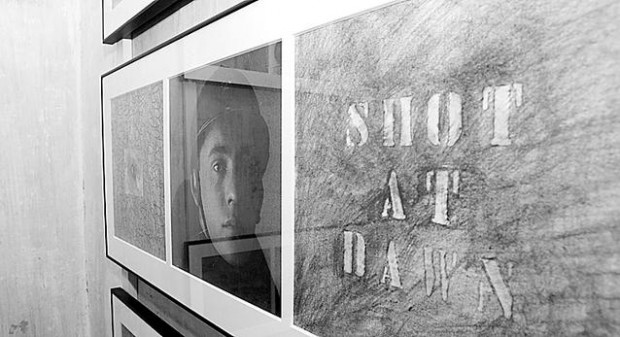
Turner has addressed the issue publicly, buoyed by the "Shot at Dawn" campaign in Britain, which sought the pardons. Some families though, still feel the stigma.
"I have relatives now who do not want their names or addresses or anything about them revealed in the newspapers because of the shame," she said.
 Japanese company invests in mine near Mount Lemmon