The following is the opinion and analysis of the writer:

Charles Sauer
French European Minister Benjamin Haddad recently told public broadcaster France Info about a new piggy bank the European Union can use to reduce the amount member countries pay to support the EU bureaucracy.
So, what is the EU's new ATM? It's money collected from American big tech companies like Meta (parent company of Facebook, Instagram and WhatsApp), Alphabet (parent company of Google and YouTube), and Amazon for their violations of EU antitrust and other laws.
According to the New York Post, Minister Haddad described the €4.6 billion in EU revenue from Google fines as a “windfall” for the EU. Speaking of how the fines would enable the EU to lower the amount they need to collect from member countries, Haddad said, “this is a discussion we have with the European Union every single time, precisely to keep member states' contributions under control. Therefore, this 4.6-billion-euro windfall tied to the Google fine is good news for the member states, as well.”
People are also reading…
The potential to obtain revenue without having to ask for additional contributions from their member states is not the only incentive the EU has for imposing fines on American tech companies. The EU is pursuing what it calls its tech sovereignty initiative. The goal of this initiative is to boost EU tech companies at the expense of their foreign competitors, particularly the leading U.S. tech companies.
One way EU bureaucrats try to give European tech companies an advantage over American firms is by imposing regulations that disproportionately affect U.S. companies and then suing them for violating those laws. One such law is the Digital Markets Act (DMA).
The act targets large tech firms (gatekeepers), in some cases forcing them to share their intellectual property with their smaller competitors. The majority of firms designated as online gatekeepers are American. This June, the EU proposed that two American suppliers of cloud computing services, Amazon Web Services and Microsoft Azure, be designated gatekeepers even though neither meets the act's criteria for that designation.
The EU used the DMA's provision allowing a company that does meet the quantitative criteria to be designated a gatekeeper if the regulators find the company has a “significant impact on the internal market,” or is an “important gateway for business users to reach end users,” or is in an “entrenched and durable position.”
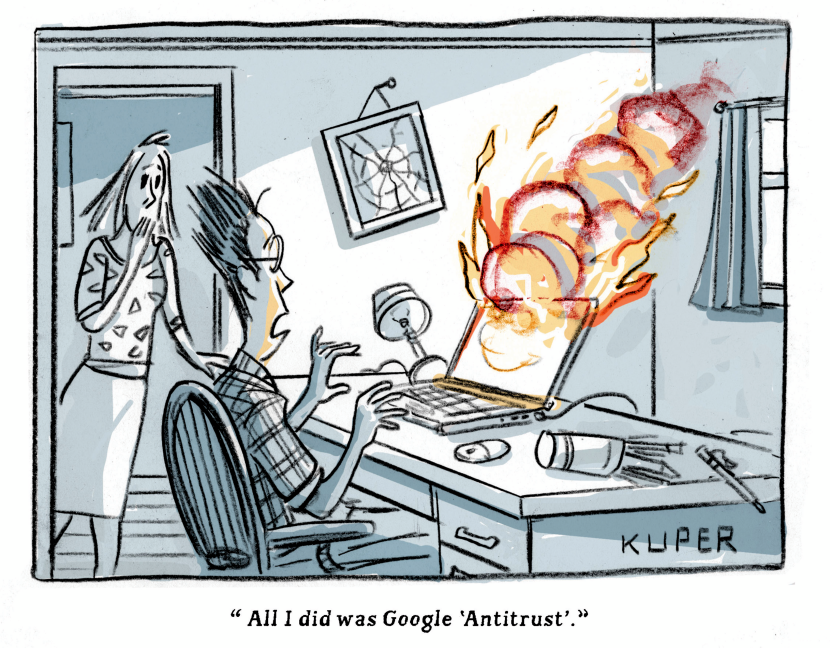
ANOTHER VIEW | Peter Kuper | Cagle Cartoons
Successful American tech companies are also subject to the Digital Services Act, which requires “very large platforms” and “very large search engines” to evaluate and mitigate systemic risks around disinformation, misinformation or hate speech. The Act does not define illegal content. Instead, it refers to speech that “is incompatible with union law or with the law of any member state.”
The act also requires that very large platforms and search engines take steps to mitigate “systematic risks,” of “threats to civic discourse, electoral processes, public security and public health.” In my opinion, this creates an online censorship regime that will affect all internet users. The references to civic discourse, public security and health suggest that this is simply a way to punish tech companies for allowing their users to share, discuss, or even search for information disfavored by European politicians and bureaucrats. Any companies in violation can be subject to large fines.
Federal Trade Commission Chair Andrew Ferguson has been an outspoken opponent of both acts. He has even written leading social media companies reminding them that censoring Americans in order to comply might violate American consumer protection law.
French EU Minister Benjamin Haddad's admission that one reason the EU politicians and bureaucrats enforce laws is to make American tech companies fund the EU should cause Ferguson and his allies, including President Trump, to increase pressure on the EU to stop treating American tech companies as a piggy bank.
Follow these steps to easily submit a letter to the editor or guest opinion to the Arizona Daily Star.
Charles Sauer is the president of the Market Institute and the author of “Profit Motive.” Sauer can be reached at charles@marketinstitute.org.