

The interstate highway system transformed the U.S. economy and American life in the 20th century.

Andy Kunz
High-speed rail can have a similar effect in the 21st century, reindustrializing and reconnecting America and solidifying its global leadership.
President Dwight Eisenhower launched the National System of Interstate and Defense Highways in 1956, envisioning a network vital to America’s economy and defense. The public would fund the new national highway system.
As the commander of the Allied forces in Europe during World War II, Eisenhower observed how Germany’s extensive Autobahn highway network enabled its military to transport troops and equipment rapidly.
He returned from the war convinced that America’s future depended on its ability to build a vast system of highways that would connect the nation, alleviate congestion, stimulate economic growth and enhance national security.
People are also reading…
The result was a monumental achievement of American industry and political leadership. The interstate highway system would eventually span 49,000 miles and cost more than $2 trillion in federal outlays.
In addition to connecting all of America’s mid-size and major cities into one massive passenger and freight transportation network, the highway system provided an economic godsend to rural communities. It spawned a vast industrial supply chain that created millions of jobs.
With the highway system complete and at full capacity, America badly needs more transportation infrastructure to accommodate its growing population. Without it, the country will be stuck in traffic jams and airport security lines for the rest of the century. A nationwide high-speed rail network will provide the additional capacity needed to enable the transportation system to operate smoothly again. It could be this generation’s version of the interstate highway system.
At a time of deep division, an interstate high-speed rail system can reconnect the country, revitalizing rural communities with good jobs and easy access to major job centers, sporting events and entertainment. Traveling comfortably at speeds exceeding 200 mph, high-speed rail will reunite families and friends, making travel a reliable and enjoyable experience again.
An interstate high-speed rail system will create new industries with extensive manufacturing and service-sector supply chains. This will fuel regional economic growth and spur booms in construction, housing and tourism.
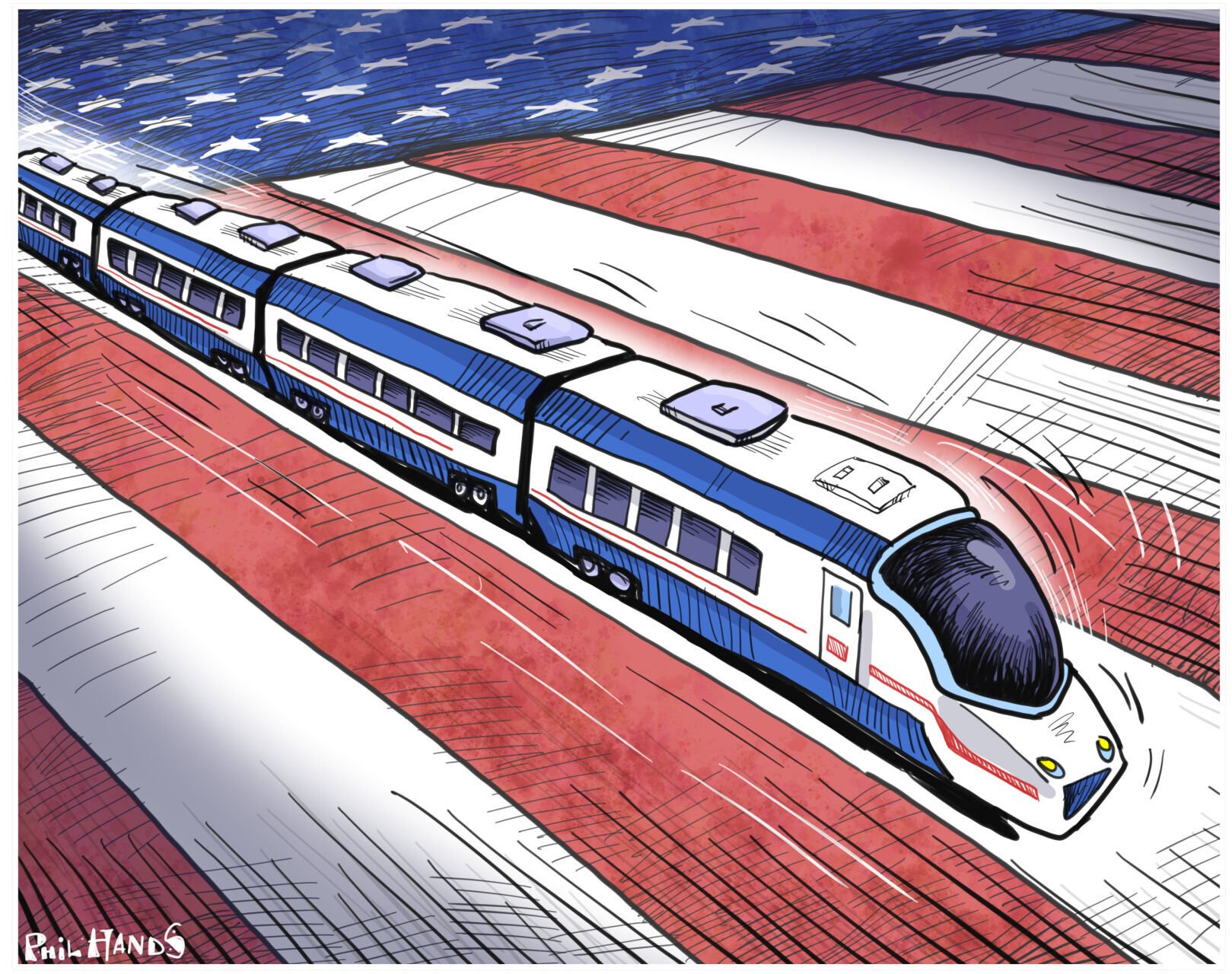
Bullet-train projects will employ American workers to assemble complex trainsets and manufacture components as well as build bridges, tunnels and thousands of miles of track. Industrial giant Siemens announced plans last year to open a factory in New York to manufacture high-speed trains for the Brightline West bullet-train project that will connect Las Vegas and Southern California.
Twenty-six nations have bullet trains that transport billions of passengers safely and quickly. President Donald Trump said “it doesn’t make sense” that the United States doesn’t have bullet trains like other advanced nations.
American voters. A 2024 survey by Public Policy Polling showed that 72% of voters support creating a nationwide high-speed rail network. In that poll, 60% of voters had a favorable opinion of high-speed rail, with only 16% holding an unfavorable view. A Newsweek survey in June 2024 found that 60% of eligible voters favored building more high-speed rail, with only 7% opposed.
High-speed rail is a national priority regardless of party affiliation, region, social status or income. It’s time for elected leaders and policymakers in Washington, state capitals and local governments to work together to bring high-speed rail to all Americans. The nation’s future will be better for it.
Kunz is the president and CEO of U.S. High Speed Rail, which advocates for a nationwide high-speed rail network. He wrote this for InsideSources.com.


