

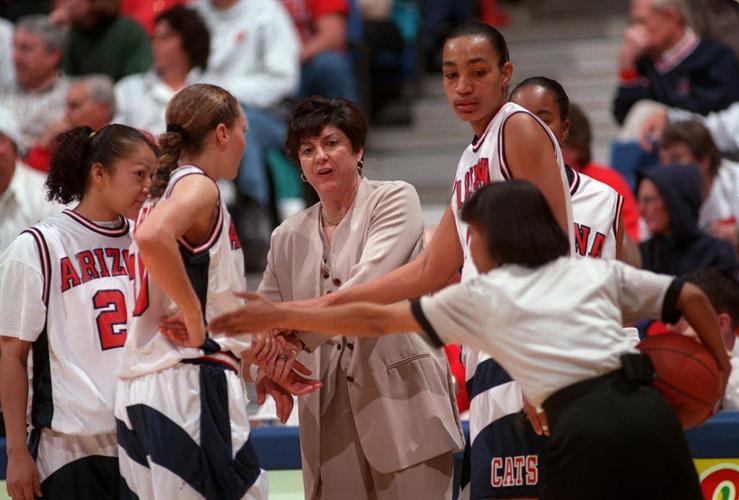
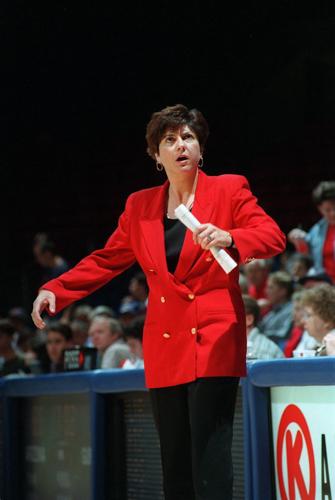
This summer marks the 20th anniversary of the most magical season in Arizona women’s basketball history. Well, the start of it, anyway.
Before Adia Barnes led Arizona to a Sweet 16 appearance and was named Pac-10 player of the year and before Joan Bonvicini was named the conference’s coach of the year, the Wildcats took a trip to Australia.
The NCAA-sanctioned tour saw the team play eight games over 18 days. The Wildcats went bungee jumping, too, and visited the Great Barrier Reef. By the time they flew home, winners of seven of their eight games, Barnes knew the team would be good.
“We didn’t have any big-time stars, but we had all the pieces to make a good group,” Barnes said. “Marte Alexander was a 6-foot forward and could dunk a softball. She was super athletic and long. She got stronger in the offseason. Lisa Griffith was a young point guard with a high basketball IQ and she could shoot threes. We had Felecity (Willis, who also played softball), Mikko (Giordano), Rashea (Bristol), and DeAngela (Minter). We had more of a balanced team. And Joan was a players’ coach. I would’ve run through a wall for her. I loved her and she cared for me.”
People are also reading…
It didn’t take long for the Wildcats to make national noise.
On Jan. 12, 1998, at McKale Center, they faced No. 11 Stanford. At the half, the Cardinal led 39-36.
Down by one, with time running out, Bristol, a 5-foot-10-inch, redshirt freshman guard — nailed a 19-footer for the win. The UA prevailed 91-90, marking their first win over Stanford since 1986.
Bristol, and the Wildcats, made ESPN’s “SportsCenter.”
“It was a great game,” said Bonvicini. “We had a big crowd and it was a TV game and Bristol had the big shot to win the game. Going in, we knew they were much taller and had more accolades than we did. They were a top team. A game like that changes the mentality and expectations for the team. We starting rolling after that and were very confident. We felt we were a very good team and would do well in the NCAAs.
“When you are doing this, you are in the moment. As players and coaches we think about that day, that practice, that game. It’s the writers and others that think about what it means.”
Barnes added: “Stanford was one of the best in the country. It was good to beat them for once as they always beat us. It gave our team a lot more confidence. We celebrated like we won the national championship.”
Barnes scored 22 points against Stanford and pulled down seven rebounds.
“She always found a way,” Bonvicini said of Barnes. “It was hard for another post to guard her. She was quick, a very hard worker, had competitiveness, and was a good scorer. I always knew Adia was talented, but I didn’t know she would be an All-American that year. Once we got that win over Stanford, it gave her credibility. They respected her before, but you need to win. The style we played was uptempo and aggressive — we pressed. This gave her the ability to show her talent. And she had a good supporting cast with Marte, DeAngela, Lisa, and Rashea, who all played professionally. Bottom line we had a lot of fun.”
From there, the UA lost only three games the rest of the regular season — away games to Oregon, Washington and Stanford.
The Wildcats earned a No. 3 seed in the NCAA Tournament, then fell in the Sweet 16 to UConn, 74-57.
Arizona finished 23-7 overall and 14-4 in the Pac-10. The team was ranked as high as No. 7 nationally, the highest mark of any UA women’s basketball team in history.
Bonvicini went on to collect the most wins of any women’s basketball coach in the program with 287. She was nominated for Associated Press Coach of the Year and the Naismith Coach of the Year for the 1997-98 season.
Barnes finished the season averaging 21.8 points per game and scoring 653 points, grabbed 76 steals and collected 212 rebounds. She is the most decorated player in the UA women’s basketball program and landed in the record books in 1997-98 for most points scored in a season (653), highest scoring average in a season (21.8 points) and most field goals made in a season (249).
Twenty years later, Barnes and Bonvicini are back in Arizona, to varying degrees. Barnes is the UA’s second-year head coach, the owner of a talented incoming recruiting class and optimism to spare. Bonvicini, who went on to coach at Seattle University, spends much of her time in Tucson. She has done regional television work for the Pac-12 Networks. The two remain close.
It might not be long until the Wildcats have another season like 1997-98.
“For me, I wanted to do everything I could to help the team win,” Barnes said. “I had the chip on my shoulder. No one ever thought I could do anything. I was always proving people wrong. They didn’t think I could play at UA, they didn’t think we could win the WNIT, they didn’t think we could go to the NCAA, they didn’t think we could go again, and they didn’t think we could be ranked. Joan believed in us and made us believe in ourselves.”


