Born in Lithuania on D-Day, Min Labanauskas doesn’t know exactly how he left his native country two months later and probably never will.
It’s not a fun story.
“My parents didn’t like to talk about it, so it must have been a pretty harrowing experience,” said Labanauskas, who took in Arizona’s Lithuania exhibition games earlier this month with his wife, Judy Bassnett. “I'm sure they were hopping on trains or trying to get rides with the farmers or variety of other ways until they actually got to and were allowed into the American refugee camp.”
All Labanauskas knows is he spent five years in the camp at Wiesbaden, Germany, so his parents could evade Russian efforts to send educated Lithuanians to Siberia. Then he emigrated to the United States, grew up in a Lithuanian neighborhood in Chicago… and never returned to Lithuania.
People are also reading…
At least until the Arizona Wildcats lured him back earlier this month. That’s when the good vibes started rushing through Min and Judy.
Fans of both the UA men’s and women’s teams, and holding season tickets for the women, the couple showed up for the Wildcats’ three exhibition games and quickly built a bond with Lithuanian natives Motiejus Krivas and Ugnius Jarusevicius while also being, basically, adopted by coach Tommy Lloyd and the entire team.

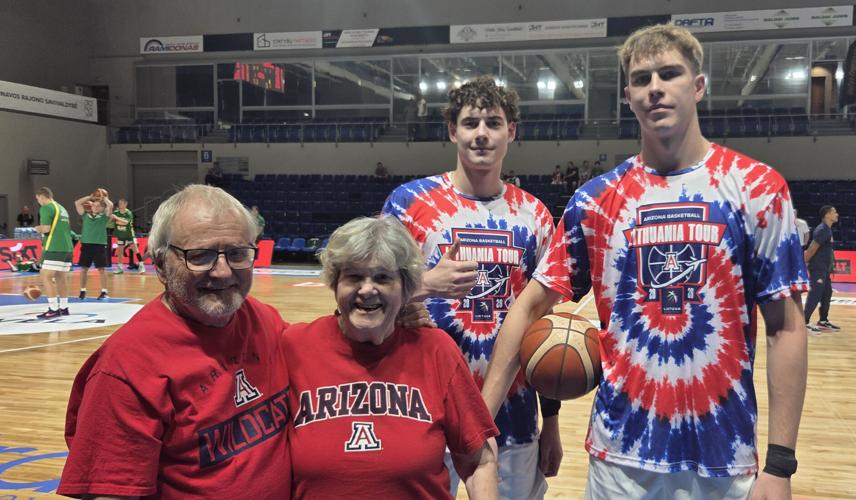
Min Labanauskas and Judy Bassnett pose with Lithuanian UA players Ugnius Jarusevicius and Motiejus Krivas (far right) during a Wildcat practice in Kaunas, Lithuania on August 21, 2026.
“Tommy was very nice and the players were fantastic,” Labanauskas said. “They were really friendly and they knew what we were all about.”
Min, whose name is short for Mindaugas, and Judy appeared to fit perfectly into Lloyd’s annual offseason efforts to build culture into each of his rosters. Already, the coach had asked players to spend time on the plane ride over to watch documentaries about former UA coach Lute Olson and the 1992 Lithuanian Olympic basketball team, and now he had found a couple who were die-hard UA fans with a distinct Lithuanian tie.
Not surprisingly, Lloyd invited Min and Judy to a practice at Kaunas’ Zalgiris Arena, the epicenter of the basketball-mad country, and even had them lead the players in their post-practice huddle. Labanauskas said he thinks he said something to the Wildcats about the difference in their loss to the Lithuanian B team and their win over the Ukrainian national team.
But really, Labanauskas has no clue what he actually said.
“I can’t even remember. I was kind of nervous,” he said. “But I did remember to finish it off with a ‘Bear Down.’"
A drive for survival
While bonding with the Wildcat family was an obvious highlight, Labanauskas was also amazed at what else he saw on the trip. Min said he had been uneasy about returning to Lithuania after all these decades, even after the country’s 1990 independence from the Soviet Union, because he feared seeing a Soviet culture still in place.
But upon arriving this month, he saw no such thing. At first staying in a hotel directly across the street from the presidential palace in the capital of Vilnius, Labanauskas said he was amazed to see not a single barricade, soldier or security guard.
Nor, he said, did he hear a siren in his two days there.
“It was super safe and everyone was so friendly,” he said. “It was really nice.”
If only his parents could have seen that place.
They had fled in 1944, fearing they would get swept to Siberia, a fate they may very well have met if they didn’t get out that summer.
Labanauskas’ aunt was among those who didn't escape it: She spent about three decades in Siberia, and her daughter died there, before she eventually made her way to Canada.
“Everybody in Lithuania feared that anybody educated was going to get shipped out and my parents were both college graduates,” Labanauskas said. “They knew (educated) people were the people they didn't want in the country because, you know, they'd end up being troublemakers.
“The Americans and the Allies were coming from the west, and the Russians were moving in from the east and pinching off the German army. But my parents were probably more afraid of the Russians taking over than they were of the Germans.”
Labanauskas said the family spent five years in the camp inside the American occupation zone, crammed into a Quonset hut, trying to survive. Meanwhile, an uncle who had once captained a Lithuanian warship in the 1930s before eventually moving to Sweden and then Chicago worked to sponsor them.
Labanauskas said he remembers only two things about life in the refugee camp: Hunting for mushrooms with his grandfather and a little bit of mischief.
“I remember my dad getting very mad because some of us little boys jumped on some of the trucks that were driving by to catch a ride,” Labanauskas said. “He was incensed. I think I got a good whipping.”
Being young had its advantages when they finally gained passage on a U.S. troop carrier that headed across the Atlantic and into Boston, a rocky voyage that took about a week.
“This was definitely not a luxury cruise,” Labanauskas said. “We were down in the hold essentially where the troops would have been put up. The accommodations weren't perfect. My parents got seasick. The kids that were on the ship were the only ones that seemed not to get seasick.”
From Boston, the family eventually found its way to Chicago, into an apartment that his uncle had set up for his grandmother in a Lithuanian neighborhood. There, the family found some comfort, speaking their home language, eating their home foods, attending a Lithuanian church, and gradually melting generally into society.
Still, despite their education and backgrounds — Labanauskas’ mother was a chemist and his father was an accountant in Lithuania — they had to start at the bottom of the job market first.
“They went to work in the stockyards of Chicago. That was where you could get a job,” Labanauskas said. “My mother was cutting up chickens and I can't even remember what my dad was doing.”
Eventually, Labanauskas said his father found work at a Nabisco loading dock, where a supervisor eventually noticed him studying English and accounting, then offered him an accounting job. He worked there until he retired, while Labanauskas’ mother finished as an executive secretary at Sears.
Their drive for survival and success, no doubt, was passed down. Min Labanauskas said it didn’t take long to “soak up” English in the streets of Chicago, and he eventually attended Saint Mary’s University of Minnesota for an undergraduate degree before earning a PhD in biophysics at the University of Wisconsin.
“Then I dropped out,” Labanauskas said, chuckling.
Uninterested in following an academic and administrative trail with those sorts of credentials, and saying he was more of an outdoors person, Labanauskas moved on to the state of Washington, living in what he called a “semi-communal” community and working on contract projects for the U.S. Forest Service.

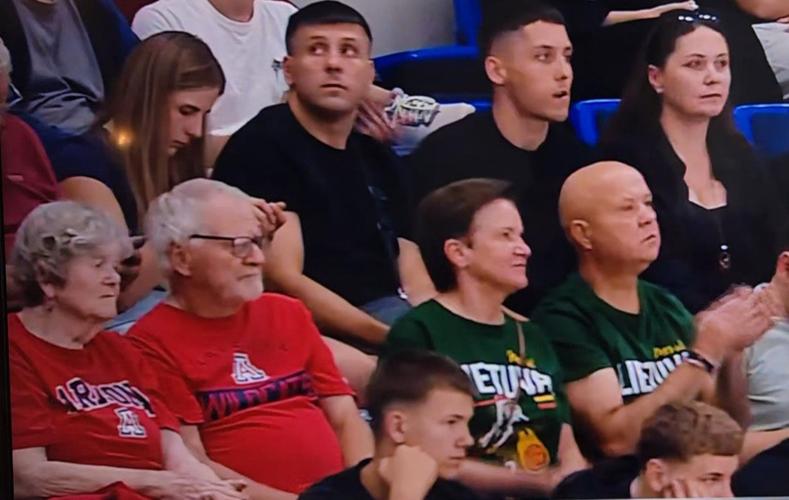
Judy Bassnett, far left, and Min Labanauskas keep an eye on Arizona's game with the Lithuanian B team on Aug. 19, 2026, in Jonava, Lithuania.
Some of the laborers he hired there had roots in Mexico, which came in handy when Labanauskas opted to move south of the border during what he called “kind of a midlife crisis." They alerted him that some prime property he had expressed interest in had become available for sale north of Puerto Vallarta.
Villas Punta El Custodio is marketed today as a small, secluded community along the Riviera Nayarit, a “tiny, gated community on a dramatic point surrounded by the Pacific Ocean,” according to its website.
While Labanauskas was managing the place in 2003, a man claiming to be a surfer from Hawaii named David Carerra knocked on his door and inquired about buying property. While Labanauskas left town later that day, the man stayed and socialized with nearby vacationers, who called Labanauskas a few days later, believing they had seen the man on “America's Most Wanted.”
Saying FBI and Mexican authorities told him they couldn't do anything with the tip, Labanauskas and his then-wife, Mona Rains, contacted a reality TV bounty hunter named Duane “Dog” Chapman.
The couple then followed the suspected fugitive as he went club-hopping in Puerto Vallarta one night, and Chapman later arrived. At a taco stand, Labanauskas said, Chapman jumped out to apprehend the man who was actually known as Andrew Luster.
The great-grandson of cosmetics tycoon Max Factor, Luster had been convicted in absentia by a California court and sentenced to 124 years for multiple counts of rape, poisoning and drug possession.
Chapman actually wound up arrested because bounty hunting of foreign nationals was illegal in Mexico — something Labanauskas told CNN at the time he was unaware of — though the charges were later dropped. But Luster began serving his sentence upon his subsequent return to California.
It’s “my other 15 minutes of fame,” Labanauskas said of a story that still lives online in an ABC News story and CNN transcript. “He's still in jail.”
Bitten by a 'rabid' fan
By 2005, Labanauskas had enough of Mexico and moved to Tucson while going through a divorce. Seven years later, thanks to Match.com, he found Judy, a longtime UA employee who once worked as associate dean of the school’s College of Fine Arts.
Judy was, Min said, a “rabid” Wildcats fan.
“I was mildly interested and then she got me totally hooked,” Labanauskas said.
It was in her blood. Even before Judy moved to UA to work in academic administration, she worked at a school in Greencastle, Indiana, where former UA football coach Dick Tomey once attended DePauw University. Then she took a job at Michigan’s Albion College, where coincidentally three former UA athletic directors had attended: Pop McKale, Cedric Dempsey and Dave Heeke.
“I met the Dempseys, and they said, ‘Judy, do you know there's this connection with Albion and the U of A?’” Bassnett said. “My parents were living north of Tucson, and when I came out here to help take care of them, they were huge basketball fans. Huge Lute Olson fans, and my mother — I swear to God — she thought she was Steve Kerr's grandmother. I think that's funny.”
Between her job and her fandom, Judy has kept an eye on generation after generation of Wildcats. One day, she said she saw Damon Stoudamire returning to the Fine Arts College while finishing his degree after winning the NBA’s Rookie of the Year award in 1996.
“He just walked in with the biggest smile on his face. I’ll never forget that,” Judy said. "I said, ‘Damon, you look so handsome. I didn't know that you were that good-looking.’ He said, ‘It’s the money.’
“There’s some things you just never forget. He was a great guy.”
Min and Judy didn’t realize it at the time, but a bond existed far before their Wildcat-following days together, too: Judy was born in England but also rode across the Atlantic in 1949 — though she did it via the Queen Mary. The two also became naturalized U.S. citizens in the same Chicago courthouse in 1955, though they didn’t know each other at the time.
More than 70 years later, thanks to an NCAA rule change allowing college teams to take foreign exhibition tours every summer, Arizona arranged a trip to Lithuania. The trip was intended to bring Krivas and Jarusevicius home, to reinforce the deep recruiting ties Lloyd has in the country, and to expose the other Wildcats to a region full of basketball and other culture.
After decades away from his native country, Labanauskas said it was “serendipitous” when he read in the Star that the trip was happening.
“Judy and I looked at each other and said, ‘Why not?’ ” he said.
Lithuania, finally, was about to become a memory he would never forget.
Contact sports reporter Bruce Pascoe at bpascoe@tucson.com. On X(Twitter): @brucepascoe
Bruce Pascoe
Reporter