College Football Playoff executives did what they do to a Heisman Trophy-winner level over two days of meetings this week outside of Dallas. They punted.
All the most pressing and controversial issues were discussed. No decisions were made. Everyone agreed to consider, ponder and reconvene in a few months.
Expand to 16 or 24 teams? Punt.
Change the weekly ranking shows on ESPN? Punt.
Adjust the access method for the Group of Six? Punt.
Somewhere, the late Ray Guy is grinning ear to laces.
"They did a really good job of considering things that otherwise could come back to haunt us if we don't make a good decision and look at everything that's associated with it," CFP executive director Rich Clark told reporters Wednesday afternoon.
People are also reading…

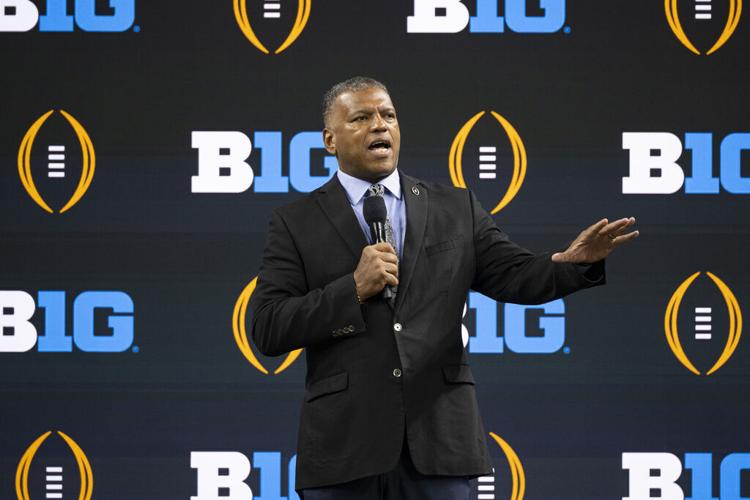
College Football Playoff Executive Director Rich Clark talks with reporters during an NCAA college football news conference at Big Ten media days at Lucas Oil Stadium, July 24, 2024, in Indianapolis.
Clark was referring to the hottest topic of all — whether to expand the 12-team field — but the sentiment effectively applies to all the issues.
Only in college football, which is both incredibly popular and utterly leaderless, would powers-that-be overhaul the postseason format and then, just two years later, seriously consider another round of major changes.
Where do things stand on the major and minor issues?
Here's a summary:
– The CFP will remain a 12-team event next season, albeit with one notable change: The highest-ranked Group of Six team will receive an automatic bid. Previously, that slot was allocated to the highest-ranked Group of Five conference champion. (The Pac-12 hadn't yet reconstituted).
The CFP management committee, which consists of the 10 FBS conference commissioners and Notre Dame's athletic director, has considered switching back to the previous model using the top-ranked G-6 champion. But no changes were made this week.
– Nor did the management committee and ESPN agree on tweaking the weekly ranking shows that are the source of consternation for the selection committee but generate terrific engagement for ESPN.
Through its exclusive contract with the CFP, the network is paying for five Tuesday shows that mean nothing and the single Sunday reveal that means everything.
Eliminating the weekly shows altogether isn't realistic, but the management committee should, at the very least, negotiate to scrap the edition that airs the Tuesday of conference championship week. It boxes the committee into corners that undermine its credibility when the final rankings are revealed five days later.
– Expansion discussions are likely to continue into the fall and perhaps next year, such is the depth of the impasse between the Big Ten and SEC.
The conferences have codified authority over the future format — they are merely required to consult with the other leagues — and face a Dec. 1 deadline to inform ESPN of changes for the 2027 season.
The Big Ten proposed a 24-team format earlier this year but received little support, with the SEC, ACC and Big 12 favoring an incremental move to 16.
But the tenor has changed dramatically, to the point that the SEC now appears to be the lone holdout against doubling the size of the field.
There are several versions of the 24-team format. But the preferred model would grant byes to the top eight seeds, with No. 9 through No. 24 playing in the opening round and the winners advancing to face No. 1 through No. 8 in the second round.
The selection committee would pick the teams — there would be no automatic bids, except those reserved for the top Group of Six team(s).
Both rounds would be played on campus, with the quarterfinals and semifinals hosted by major bowls.
The Big Ten views massive expansion as the best way to generate more revenue and create a barrage of high-profile nonconference matchups.
(In theory, coaches would not be as fearful of losing in September because teams with 9-3 and 8-4 records would be included in an event with 24 participants.)

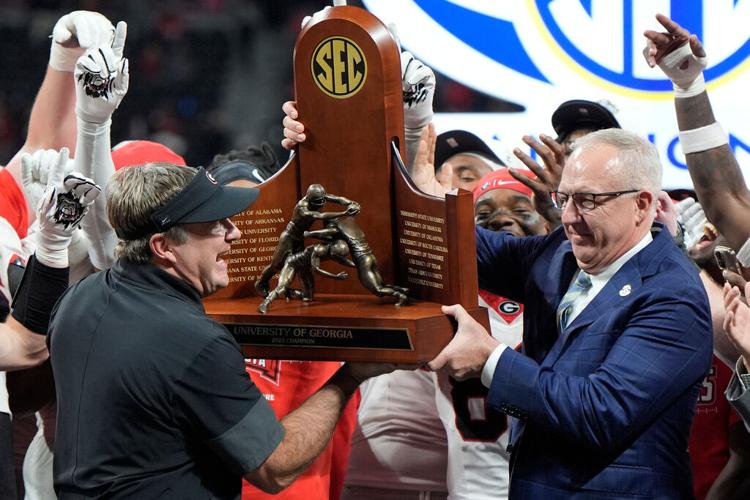
Georgia head coach Kirby Smart is handed the SEC trophy by Commissioner Greg Sankey as the team celebrates after a Southeastern Conference championship game against Alabama, Dec. 6, 2025, in Atlanta.
The SEC favors 16 teams, in large part because its title game on ABC is a huge money-maker (roughly $75 million) and expanding the field to 24 would result in the elimination of conference championships. (The games would lose whatever remaining relevance they currently hold.)
– However, there is a vastly more cynical explanation for the Big Ten and SEC taking opposing sides in the expansion discussion: They are doing the bidding for their media partners.
Fox owns the Big Ten's media rights and wants access to CFP games that, for contractual reasons, would only come from expanding to 24.
But ESPN, which owns the rights to the SEC and CFP, seemingly has no reason to agree to format changes that would provide access to its primary competitor in the college sports space.
Expansion to 24 is bad for ESPN, and the SEC opposes.
Expansion to 24 is good for Fox, and the Big Ten favors.
To be clear: Both conferences have unrelated (and valid) reasons for their positions. But fans should not overlook the connection between their stances and those of their media partners.
The networks effectively run college football. It's deeply unfortunate but also an unalterable reality.