Fifteen spring practices are not enough to solve all of the Arizona Wildcats’ problems.
When you’re coming off a 3-9 season — and planning to integrate a host of newcomers — progress comes gradually. There are no quick fixes in this business.
“We’ve just got so many unknown guys that I think have the talent and are going to be good enough to win with, but until they do it in a game, you don’t really know,” UA coach Rich Rodriguez said. “I feel good about their attitude. I think we’ve got a bunch of guys who love football. There’s no question we’ll be better.”
Arizona has only one way to go, and that’s up. But a look at Arizona’s roster reveals a plethora of unanswered questions. With spring practice having ended last week, we examine three lingering issues – one on offense, one on defense and one on special teams.
People are also reading…
1. The quarterback situation
It has to start here, for two reasons: (1) The identity of the starter is unclear coming out of spring; and (2) it’s the one position where a big leap in production could change the fortunes for the entire team.
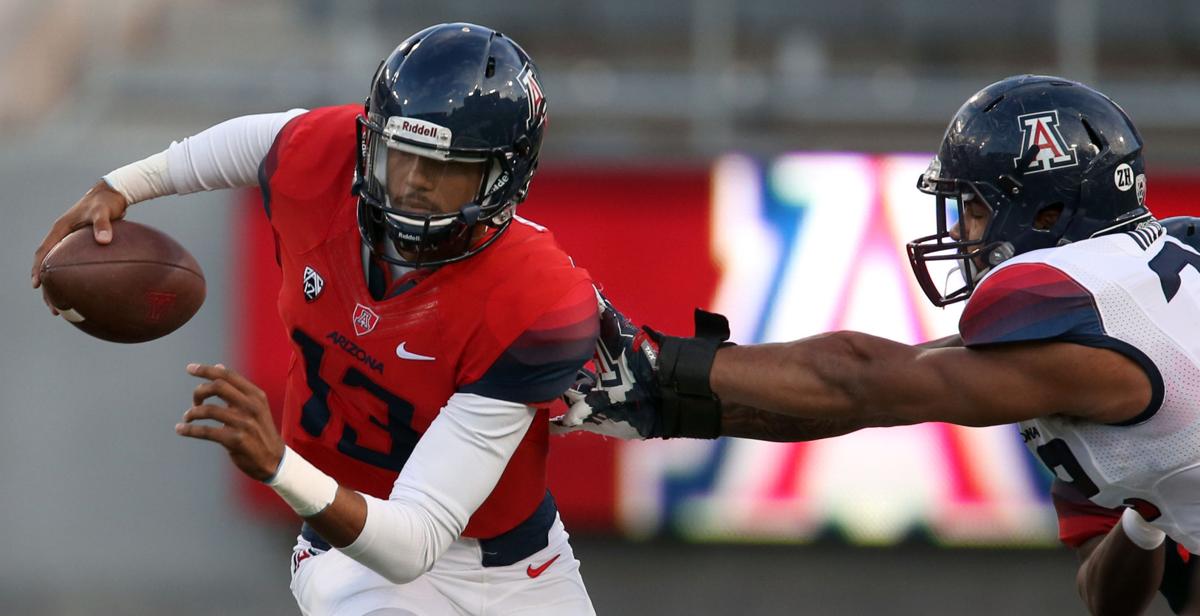
With a week left in spring ball, the job appeared to be Brandon Dawkins’ to lose. He entered spring practice with a leg up, having started nine games last season. He also has been on campus learning the system since 2014.
But then challenger Khalil Tate had a monster scrimmage Friday night. Unofficially, Tate completed 16 of 19 passes for 245 yards. He looked confident and in control — far different from the freshman who struggled in his lone start against USC last season.
Of course, it’d be irresponsible to put too much stock in a scrimmage in which Dawkins and Tate were immune from tackling — and in which Tate had the superior supporting cast. Afterward, Rodriguez was relatively reserved in his praise for Tate, suggesting that the scrimmage had been his best practice of spring. He is far from a finished product.
In some ways, the quarterback dynamic is similar to last year’s. Anu Solomon was the known commodity, and Dawkins was the promising youngster. Rodriguez eventually picked Solomon — without any sort of official announcement before the season opener against BYU. Solomon ended up getting hurt four days later and missed most of the season. He since has transferred to Baylor.
Now Dawkins is the incumbent, and the perception has changed. Like Solomon, Dawkins now is viewed as the lower-ceiling, higher-floor option, at least in comparison with Tate. We know what Dawkins can do as a runner. Can he take the next step forward as a passer?
If he believes his job is on the line, Rodriguez might make the safer choice — i.e., Dawkins. No matter which way he goes, Rodriguez needs to bring clarity to the situation at some point. The lack thereof was among the many factors that contributed to Arizona’s demise last season.
2. Defensive improvement
There’s no disputing that all the defensive changes the Wildcats made last season — new staff, new scheme — did not have the intended effect. Arizona did not improve in any easily measurable way.
The expectation is that the defense will be better in Year 2 under Marcel Yates thanks to greater familiarity with his system.
“We all have an idea of what to do and what to expect,” senior defensive lineman Parker Zellers said. “Going into our second year with the new defense, I hope and I think things will start to click more and go a lot more smoothly.”
They should. But there’s a significant factor working against that cause: a dearth of experience at linebacker.
No matter how you arrange the depth chart at the “Mike” and “Will” positions, the only player with any notable experience is redshirt junior Brandon Rutt — who has one career start. If UA rotates four players at those spots, three of them will be freshmen or redshirt freshmen.
The good news is some already have shown promise. Redshirt freshman Jacob Colacion had an encouraging camp, and multiple veterans praised true freshman Tony Fields II.
At least four more linebackers are set to join the team in summer, with the expectation that at least two will compete for immediate playing time.
“When the new guys get here, we’ll see where they fit in,” first-year linebackers coach Scott Boone said. “If anybody comes in and is in a position where Tony is … they’ll have a chance to step in and help us.”
How quickly the linebackers develop could determine how much better the defense performs in 2017.
3. Sorting out
special teams
The ’16 Wildcats struggled in multiple areas and didn’t get the boost from special teams that they sorely needed. Arizona played with a field-position deficit in almost every game, and its longest kick return was 33 yards.
Special-teams coach Charlie Ragle left in the offseason for a similar post at Cal. Rodriguez hired Brian Knorr, a former Division I head coach and defensive coordinator, to bring a fresh perspective to those units.
Rodriguez expects the wave of newcomers to significantly alter the composition of the return and coverage teams. Arizona also is enhancing the competition at kicker.
The ’17 signing class includes Lucas Havrisik of Norco, California. His impending arrival will give the Wildcats two scholarship kickers: Havrisik and redshirt junior Josh Pollack.
Pollack served as Arizona’s placekicker all of last season and its punter for most of it. The coaching staff abandoned that setup late in the year, and the plan moving forward is to have Pollack concentrate on placekicking.
He performed adequately in that role in his first year on the job but has ample room for improvement. Pollack made all eight of his field-goal attempts inside 40 yards but only 1 of 6 from 40 and beyond.
He views the addition of Havrisik as a positive development.
“Competition’s always great for making yourself better,” Pollack said. “You’ve gotta stay on your feet. You don’t ever get too comfortable.”
The same applies to the Wildcats as a whole: They might have had a promising spring, but it doesn’t mean anything without a follow-up in the fall.