A Congressional sponsor of a bill that goes after what he terms “vulture practices” by private equity firms in youth sports says the wave of Democratic wins in the midterm elections could give the measure the momentum it needs to pass.
“It makes me optimistic,” says Rep. Chris Deluzio (D-Penn.), who won re-election over Republican Tony Guy. “This cuts through politics because anybody who's involved in youth sports, either because of their kids, they coach, whatever their involvement, they see this problem that people are getting priced out, that it's becoming a hellscape of luxury pay to play.
“They want things to change and I think people now know that there's a villain in this story and it's these what I call vulture investors and that we can take action. We don't have to accept this.”
Deluzio, along with Sen. Chris Murphy (D-Conn.) and members of the Monopoly Busters Caucus, introduced the “Let Kids Play Act” in May. They called out “vulture practices” by firms that, the Congress members assert, extract money and strike fear of missing out concerns in parents.
People are also reading…
“What I sense is there is public support that has grown and I think that will translate into support on Capitol Hill, especially with so many of the new Democratic members, a lot of them being young parents themselves and knowing these issues,” Deluzio said, “so we're gonna work it hard in the next Congress and I expect Senator (Cory) Booker and Senator (Chris) Murphy and others will work with the Senate, but I'll get a lot of Democrats with me on this. I want some Republicans to join us, too.
“You gotta be willing to pick some fights with some powerful private equity folks and I'm up for that fight."
We spoke with Deluzio about the boost he feels the bill has gotten, what it might take for it to pass, and what it would mean for the youth sports landscape.

Chris Deluzio was re-elected on Nov. 3 to serve another two-year term in the U.S. House of Representatives for the 17th District of Pennsylvania.
What is the Let Kids Play Act?
The Let Kids Play Act is a federal bill that takes aim at private equity firms operating within youth sports.
The bill would ban “vulture investors" in youth sports who engage in practices such as requiring that families stay at specific hotels for kids sports tournaments. A “vulture practice,’’ according to the legislation, is “any practice, term, condition, tactic, instrument, method, or act that causes harm or creates long-term risk of harm to an acquired entity in order to extract profit, assets, or other value for the benefit of a covered firm or its affiliates.”
The law would empower parents and state attorneys general to sue companies that engage in such practices. It also holds the firms liable for debts and safety violations, and establishes a “Youth Sports Fund” for penalties paid or money taken from private equity companies. According to the bill, the fund would be used to “provide scholarships, reduce costs for families, and keep local fields open for free community use.”
“My bill goes after the worst practices, but to really make youth sports something for everybody, you gotta fund parks and fields and school districts need support to be able to support programs beyond just the high school level,” Deluzio says. “So it takes more than just the Let Kids Play Act but I think you need that alongside real investment to keep the parks and fields and rec league options strong for people.”
What momentum has act gained?
While the bill was introduced by Democrats, bipartisan members of the House Subcommittee on Early Childhood, Elementary, and Secondary Education held a June 30 hearing to address what it terms private equity’s "vertical integration" that has families paying thousands of dollars to play sports.
Rep. Kevin Kiley (independent-Calif.), who lost a House re-election bid this month, has chaired both of the committee’s hearings on private equity’s influence in youth sports. The first one was held in December 2025.
“Recent investigative reporting has highlighted certain practices that deserve closer examination,” Kiley said at the June hearing. “In some markets, consolidation is driving up costs for families while limiting access to more affordable community based options. In many cases, families face a ‘pay more or quit’ dynamic if they want their kids to continue playing.
“Some operators have used strategies that prioritize revenue over participation. Families report higher fees, mandatory add-on costs, stay-to-play requirements that force them to book hotels and lodging through affiliated partners, vertical integration that requires participation in some operators’ leagues, tournaments, camps and streaming services.”
Rep. Michael Rulli (R-Ohio) said Black Bear Sports, whose practices USA TODAY has investigated, supported upgrades to a facility in Youngstown, “roughly exceeding $1.2 million.”
However, Rep. Burgess Owens, R-Utah, called out an underlying issue.
“Youth sports continue to play an important role on physical, mental health development for our children,” Owens said at the hearing. “We are unfortunately, though, seeing a growth of an industry of bad actors who create a system that is pricing parents and their children out of the growth opportunity. We’re seeing the growth of a system that is making it harder to access youth sports, depriving our youth from opportunities for self-improvement and important character-building life lessons.”
During the election season, Deluzio says he saw Democrats who were “willing to name the names of private equity vulture investors that have driven up the cost of things like we see in youth sports.”
“I've always said I would gladly welcome Republicans to work with us on this,” Deluzio says. “I think all of us who care about kids having a shot to play sports know that we have to make this thing better and make a change.”

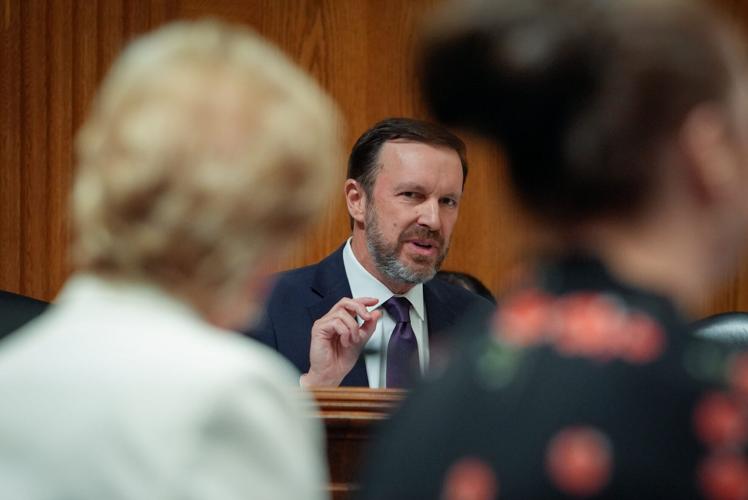
Sen. Chris Murphy, D-Connecticut, questions Education Secretary Linda McMahon during a Senate committee hearing on June 3, 2025.
Will there be modifications to act?
The bill’s literature and summary provide details about what “vulture practices” might look like, such as “take-it-or-leave-it terms to trap players,” “junk fees that jack up prices,” “stay-to-play schemes that hold teams hostage” and “systems that mine kids’ data for profit.”
“If you can certify and attest that you haven't done those things, then the prohibitions in the bill won't be there for you,” Deluzio says. “So we're going after the worst practices and that was done with us being pretty careful about drafting and looking at really what are the practices that have priced people out and made it really hard for rec leagues to stay viable.”
However, he says, he has had a field hearing with his constituents through the Monopoly Busters Caucus to solicit constituents’ views about the bill. He is open to suggestions to “get it right.”
“That’s the committee markup process,” he says. “Folks have good ideas; let's do that and have a markup and have those robust debates. We really took our time and talked to a lot of folks. I think we can use that markup process to get this bill in a place that can earn big support in the House next Congress.”
What are consequences if not passed?
Deluzio, who has four kids ranging in ages from 2 to 9, mentioned he just participated in basketball season signings. Even rec leagues, he says, can cost families with multiple kids hundreds of dollars.
“I think kids having a shot to play sports is a piece of the American dream. It fits into a broader sense of what is it to be someone in this country? What shots do kids have?” he says. “Look, not every kid’s gonna be a pro athlete. I certainly didn’t end up as a pro athlete. But you learn a lot on the field or on the court, you learn about hard work and discipline. It gives you something to do that's not sitting in front of a screen. Like this is something that every kid should have a shot to do. … I think it really matters to a lot of people.”
“We don't have to just accept this all as inevitable. I think people understand that rec leagues have a lot of value and want to keep that as a strong option for kids beyond being really, really young. I'm already seeing the pressure that comes in here. I think parents are more aware of it and, well, when you see a ‘South Park’ episode about how ridiculous travel and youth sports has become, it tells you this has jumped into the mainstream of what people are mad about.”
Steve Borelli, aka Coach Steve, has been an editor and writer with USA TODAY since 1999. He played baseball in high school, rowed in college and spent 10 years coaching his two sons’ baseball and basketball teams. He and his wife, Colleen, are now sports parents to a college and high school baseball player. For his past columns, click here.

Gilboa hosted a panel earlier this month at the TrueSport Talks, held at the U.S. Olympic & Paralympic Museum, about social media pressures confronting young athletes.