

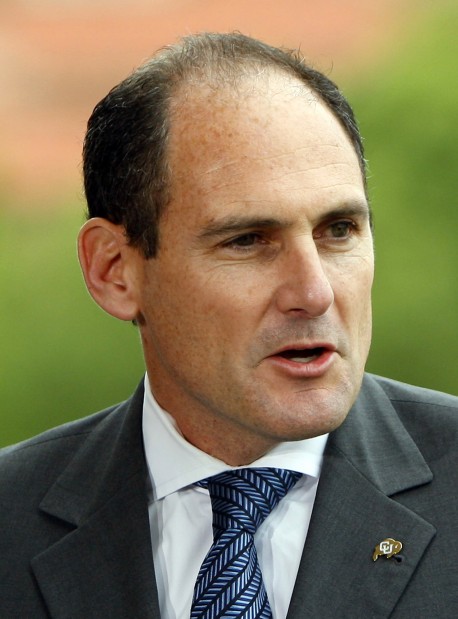
When the Pac-10 took on several messy questions by adding Colorado and Utah in June, the tension facing commissioner Larry Scott was inevitable.
Not everyone would agree on how to form divisions for football. The high-profile Los Angeles schools were expected to fight a transition from the league's current appearance-based revenue distribution formula to a straight one-twelfth split. And there might even be talk about where to place a championship football game.
But, aside from a few disappointment-toned remarks from USC athletic director Pat Haden, the league has managed to tackle the issues quietly and with a minimum of public disagreement.
The school's presidents and chancellors plan to meet Thursday in San Francisco for a few hours, and Scott has said he should be able to announce their decisions immediately afterward.
People are also reading…
Then he will hop on a plane to catch Thursday night's UCLA-Oregon football game in Eugene.
It'll be just another whirlwind week for Scott. He met with reporters at Saturday's WSU-Arizona game in Pullman, then flew to Seattle to do the same at the Washington-Oregon State game. Earlier, he attended games at OSU and Oregon on the same day, and headed the Pac-10 athletic director meetings on Oct. 6-7 in Millbrae, Calif.
After those meetings, Scott shared with the Star about where the league went this summer - chasing Texas and other Big 12 schools for a would-be megaconference - and where it is now.
How do you feel about the league's expansion efforts?
A. I feel very good about how it's gone. We have been aggressive and progressive, and therefore we've taken on a lot of issues. These are as ambitious an issues as we've had. The league hasn't expanded since 1978, and we're making some weighty decisions in a short period of time. I've been very pleased with the positive spirit people have brought to it.
Are you disappointed a 16-team conference didn't happen?
A. There certainly was some disappointment because a lot of people were excited, but our disappointment didn't last long because we were working on parallel tracks, and we had the 12-team conference all teed up. We secured Colorado even before we met with some of the Big 12 South schools. We didn't linger long after we realized it wasn't going to happen. We were not naive.
We realized there was a high degree of difficulty in making 16 happen so we had another plan. And Colorado fit in any of the plans we looked at.
Did you promise Colorado would be in the same division as the Los Angeles schools?
A. There was some public misunderstanding about that. There was no commitment. There were pretty clear views about what those schools wanted, but there was no commitment.
Did you think things would be moving as fast as they are?
A. I can't say I did because coming in from outside the industry, I didn't come in with a specific road map. I had to go through a process for six months as I was getting to know the leadership and the conference, listening to what the agenda should be.
Do you feel the Pac-10 set itself up well if there's another round of conference realignments in five or 10 years?
A. I think we'll be well-positioned regardless of what happens, and our job is to make sure the conference is as strong and well-positioned as it can be. And I think we're going to have a very successful 12-team conference, and that's what we're laser-focused on. In the future, I want to make sure the Pac-12 is one of those places that has got a lot of value, and is a coveted conference to be a part of.


