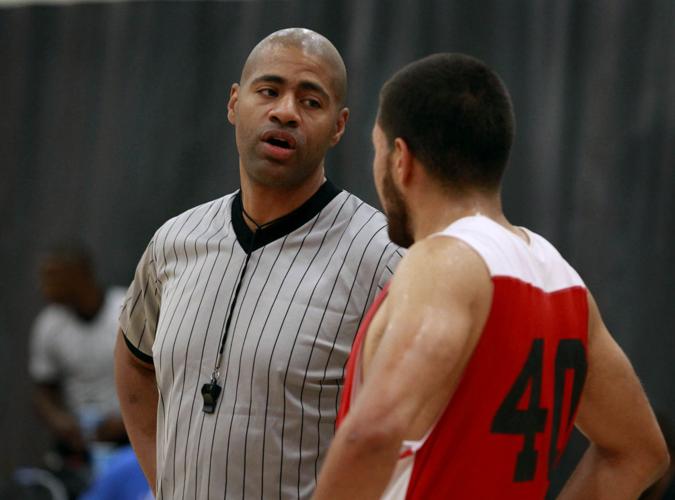
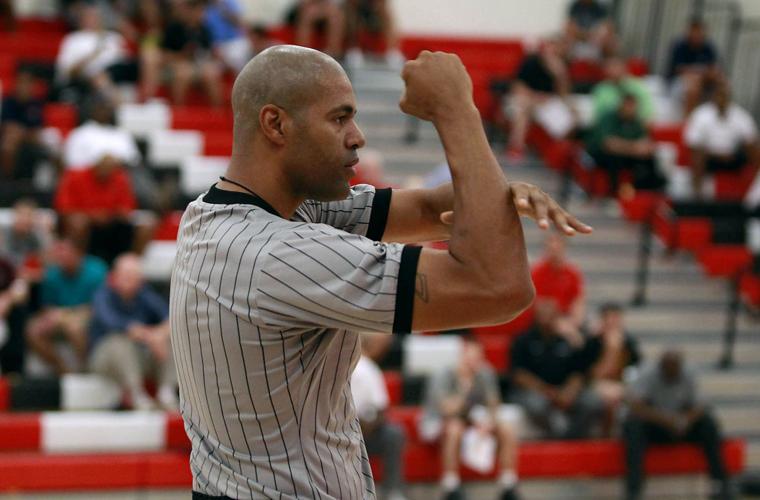
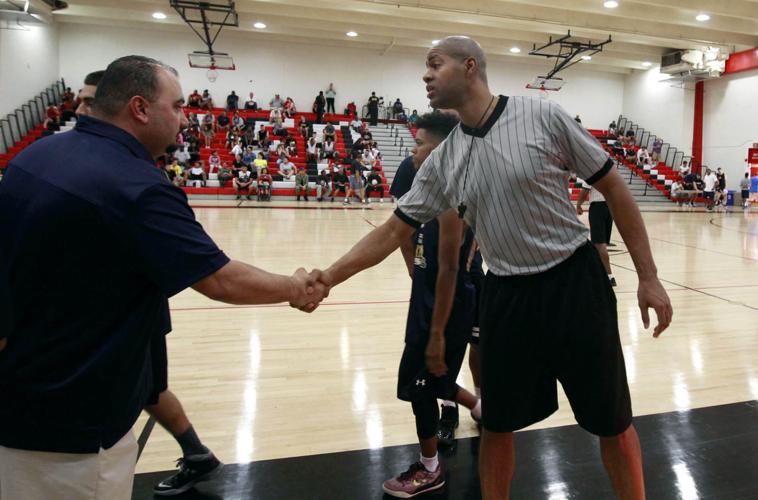
Veteran Arizona basketball officials Bob Scofield and Steve Goodman have been working with young refs for years, so they have this question pretty much down:
What does the ideal male basketball referee look like?
Maybe he’s about 6 feet 6 inches, so as to fit in with a game of big men. Athletic, able to get in the right position to make the right call. Has experience playing the game at a high level, so as to command respect and see the game from both sides.
Also, preferably, unflappable and personable, able to turn the yell of a coach into a low-volume conversation while allowing the wrath of fans to roll off his back.
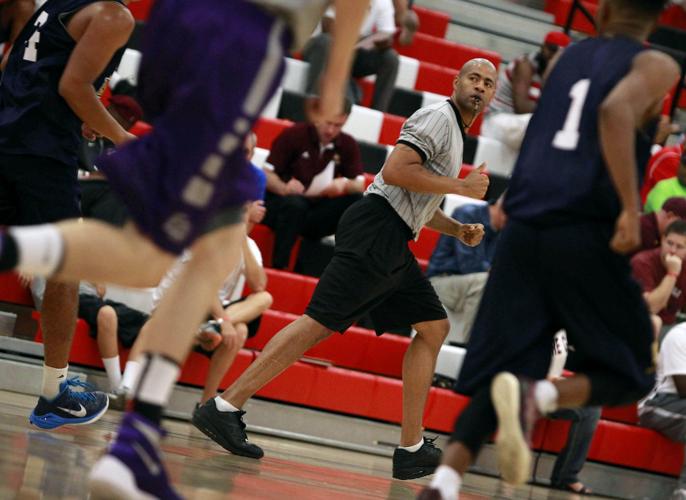
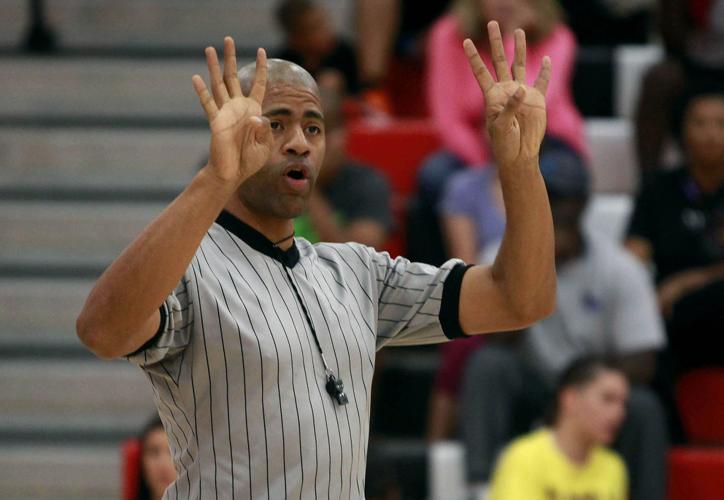
Eugene Edgerson has shown signs he’s all of those. That’s why the former UA player — a bouncy, aggressive forward on the Wildcats’ 1997 national champions — is getting a chance at Division I basketball for the first time this season.
People are also reading…
Edgerson will be working Big Sky Conference games, after taking up the vocation just seven years ago, while continuing to work junior college and lower-level high school games across Arizona.
“This guy has it all,” says Goodman, the Phoenix-based coordinator of the Arizona Community College Athletic Conference. “He’s polite, looks like a player, he can run great, he has great judgment and a tremendous feel for the game.”
He also projects modesty and eagerness — attending a college officiating clinic in Phoenix last month in a dress shirt and tie when most refs showed up in golf shirts or polos — even if he knows what everyone may be thinking.
“A lot of people look at me, and they’re like, ‘Man, you have what they want,’ ” Edgerson said.
All that doesn’t even consider what Edgerson also has to offer inside, either: Some rich life experiences, both good and bad.
•••
When the Wildcats played before a rowdy crowd at BYU on the night of Nov. 28, 1998, during Edgerson’s junior season, the game became physical under the basket, and Edgerson was fed up. A “powder keg,” as he put it.
According to replays, Edgerson and BYU’s Bret Jepsen tussled for a rebound and then, on another possession, Jepsen’s elbow and forearm landed near Edgerson’s neck.
Edgerson pleaded with officials to take a look.
“I told him this guy was doing all these cheap shots,” Edgerson said. “But the ref’s ego was such that, ‘I’m not gonna listen. I don’t know what you’re talking about.’ And that’s the worst thing you can do as an official: ignore players and coaches. You don’t have to have a dialog with them, but at least be respectful and listen.”
In the moments, days, months and even years afterward, Edgerson wasn’t proud of what happened next. As the teams transitioned at midcourt, he leveled Jepsen with an elbow to the head.
That blow knocked the BYU big man out for 30 seconds with a concussion and eventually prompted Jepsen to retire from the game a year later.
Afterward, Edgerson called his actions “unethical” and said he humiliated himself with “poor judgment.” While it’s no excuse, of course, Edgerson says today he can still see what led to it all: Undiffused anger and frustration, the kind that can cloud judgment.
“I knocked the kid out because the referee wouldn’t listen,” Edgerson said. “My response was, ‘OK, you’re not gonna listen? I’m gonna screw your game up.’ ”
Edgerson did exactly that, overshadowing what was otherwise a thrilling overtime UA victory with the blow and putting the referees into a tough situation. They were racing downcourt as Edgerson hit Jepsen, so weren’t in position to make a call even as the BYU player lost consciousness.
Instead, it was UA coach Lute Olson who basically blew the whistle, taking Edgerson out of the game and later suspending him for the next game after he reviewed the tape, reasoning that Edgerson’s actions would have warranted exactly the same penalty if they were whistled.
“To me it makes no difference if a foul was or was not called,” Olson said at a news conference a few days later. “If it was a flagrant foul, we’re going to impose a game penalty whether it’s called or not.”
It was a bad scene for everybody, really. Now, Edgerson is determined that something like that won’t happen on his watch as a ref, in large part because he says he can recognize a powder keg.
“I can sense the cheap shots, the rough physical play — I used to do it all,” Edgerson said. “I can read the temperature of the game and know, ‘OK, we need to put a whistle on this because if we don’t, it can explode. …
“You are out there to not only run the game but to make sure every player out there can play the next game injury-free. And if a player ever comes to me and asks me to look for something, I’m gonna acknowledge that. Maybe there’s nothing out there that he wants me to see, but I’m at least giving that player the benefit of the doubt, that ‘I’m listening to you. You can talk to me.’
“When you don’t acknowledge players and coaches, that’s where you mess up as an official, because things can only go bad from there.”
•••
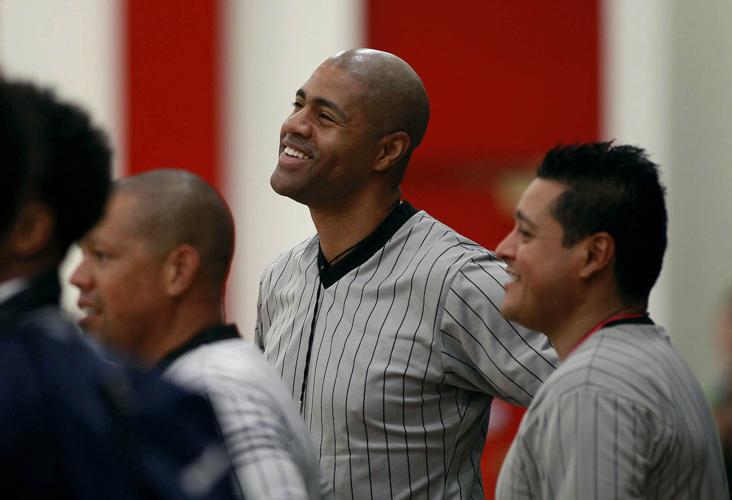
During the officiating clinic in Phoenix last month, Bobby Dibler pretty much told his guys the same thing. Dibler, coordinator of officials for all Western Division I conferences except the Big Sky, said officials should respond to coaches’ complaints about a call by saying, “You might be right” or even “I missed that” instead of saying “I’m 100 percent right” or ignoring them.
After all, a good score for a college official is getting roughly 80 percent of the calls and non-calls correct. They’re not going to be perfect. But they can be consistent and communicative.
“There’s only three of us and 10 players, so you’re not going to see everything out there,” Edgerson said. “But sometimes we miss stuff, and the best thing you can do is be honest.”
That’s what struck Goodman about the former Wildcat, who kept appearing at his summer camps, trying to add junior college assignments to the work he still does as a high school freshman and junior varsity official.
“Officiating has changed,” Goodman said. “The officials are now trained to be more receptive and just listen to the coaches. He’s good at that. He knows when to say what and when to stand his ground.”
•••
The lessons that helped give Edgerson that ability didn’t come just on the floor. Since he left the UA in 2001, Edgerson has had stints in the D-League and with the Harlem Globetrotters while basing himself largely in Tucson, working a cluster of jobs that built off his bachelor’s degree in elementary education and master’s degree in teaching and teacher education.
Now 37, Edgerson has been an education consultant with the Apache Nation and now serves as a substitute teacher for the Sunnyside School District and as an on-call juvenile detention officer for Pima County.
In those roles, too, his life experience has made a difference. He grew up in a rough New Orleans neighborhood, and in 2009 was arrested twice over two months on charges of domestic violence assault against his wife.
He says those experiences give him credibility as a detention officer.
“The kids don’t want someone talking to them who hasn’t gone through what I’ve gone through,” Edgerson says. “They want someone who’s had some hardships.”
•••
Not long before the domestic violence arrests, Edgerson had started dabbling in officiating, encouraged by Scofield to attend one of the local camps for aspiring refs that he and fellow Tucson official Chris Rastatter hold every year.
Scofield saw it all, too: The athleticism, playing experience and personality that could make Edgerson an ideal ref.
“I would see him around, playing in the J League (Jewish Community Center) and with all of the guys, so one day I saw him and said, ‘Hey, why don’t you try reffing?’ ” Scofield said. “He was like ‘What, are you crazy?’ ”
But Edgerson gave it some thought. Then he showed up for a camp, and Scofield noted that one thing just wouldn’t work: That signature afro, which Edgerson had grown out fully to complement his playful “Wildkat” persona with the Globetrotters.
“I told him, ‘Dude, if you wanna get serious about this, you’ve gotta cut your hair,’ ” Scofield said.
Soon after, it all came together. Edgerson said the wear-and-tear of his six-year Globetrotter career had sapped his love of the game and put pressure on his marriage.
So he left the Globetrotters, cut his hair, saved his marriage — and began to get serious about officiating as a career.
“If the situation between me and my wife hadn’t happened, maybe I wouldn’t be reffing,” Edgerson said. “I had to take a step back from the Globetrotters and reassess what’s really important to me. I had just gotten married and she wanted me home, but I was still trying to chase a dream and it wasn’t the best thing for my family.”
Edgerson worked local high school games, added junior college games and took only outside jobs that allowed him the flexibility to take whatever assignments came up on the court.
Like the one on Nov. 20, when Edgerson is scheduled to officiate his first-ever four-year college game, as the Big Sky’s Sacramento State hosts Division II Holy Names of Oakland.
It’s his first shot at Division I, which Big Sky officiating coordinator Marla Denham says he’s earned. A former ASU player and official herself, Denham said she’s scouted Edgerson for five years between her camps and his assignments.
“He’s worked hard to be a ref,” Denham said. “He always keeps getting better. He was very young but mature. He’s got a background in education, and he’s been an asset because he’s played at that level.”
He has what they’re looking for.
“I hear that all the time, and that makes me want to work hard,” Edgerson said. “Because if people are saying these things, that means there’s some kind of potential. It means I have to work hard and maybe I’ll get a shot.”