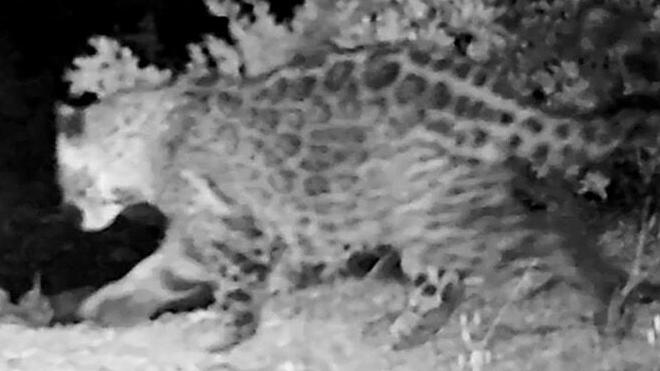
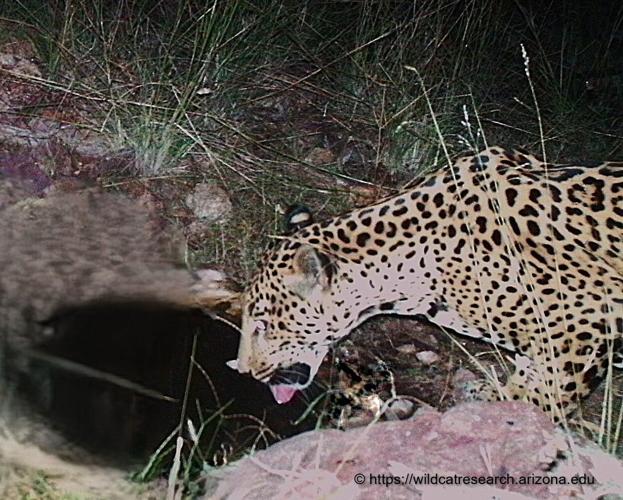
Southern Arizona’s newest jaguar has been caught on camera once again, but environmentalists warn that his route back to Mexico is closing fast.
On Tuesday, the Tucson-based Center for Biological Diversity released new footage from June and July of the adult male jaguar roaming through an unspecified sky island mountain range north of the San Rafael Valley, where federal contractors are in the midst of building two parallel 30-foot-tall border walls.
The cat was first documented late last year by motion-activated wildlife cameras operated by scientists and volunteers at the University of Arizona Wild Cat Research and Conservation Center. He has since been nicknamed Cinco because he is the fifth different endangered jaguar to be recorded in the U.S. since 2011.
People are also reading…
“This cat is showing us exactly where jaguars roam naturally and which corridors need to be protected, not walled off,” said Russ McSpadden, Southwest conservation advocate for the Center for Biological Diversity. “Each new video of Cinco is a glaring reminder that jaguars need to move freely between (the) U.S. and Mexico and that Trump’s border wall is a deadly threat to their continued existence in Arizona.”

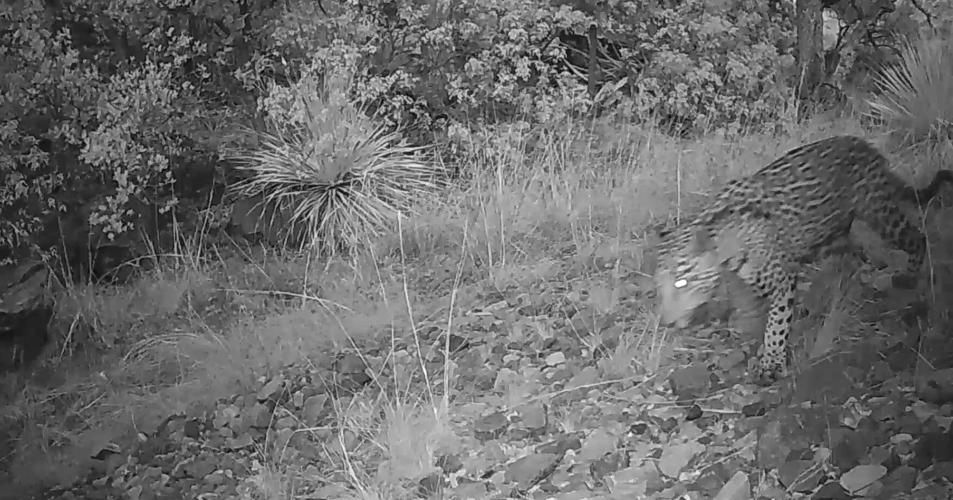
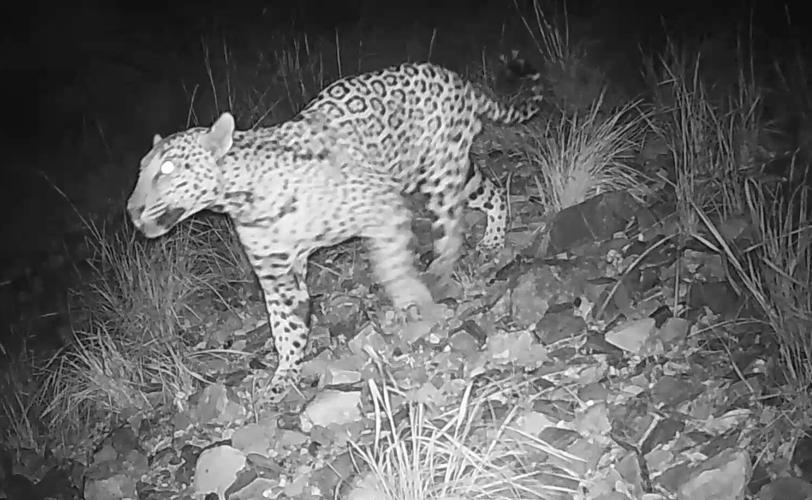
A motion-activated wildlife camera captured new footage in June and July of a male jaguar, nicknamed Cinco, in an undisclosed Southern Arizona mountain range.
The environmental group released two different clips of the spotted cat moving down the same rocky slope at night. You can barely hear his soft footfalls over the sounds of crickets, rustling leaves and gurgling water.
Separate videos captured at the same spot show two bears, a coyote, a deer and a mountain lion moving past the trail camera.
The Wild Cat Research and Conservation Center also recorded new detections of Cinco in June and July.
For the protection of the animal, researchers and conservationists are not identifying the specific mountain range or ranges where the jaguar has been documented.
“In these latest images, Cinco is seen quietly moving through tall summer grasses, a reminder of just how elusive these remarkable cats are and how easily they can move through the landscape unnoticed,” the U of A-based research center announced in a July 28 post on Facebook. “Each detection provides another piece of the puzzle, helping us better understand habitat use, movement patterns, and the importance of connected landscapes for wide-ranging wildlife. These recent detections also suggest that Cinco continues to find the resources needed to support his movements across the landscape, including adequate prey, water and cover.”

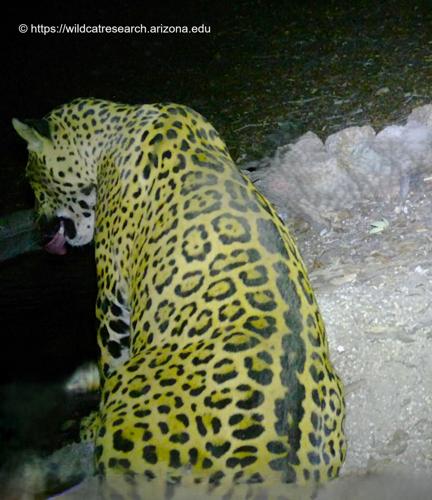
A wild jaguar known as Cinco appears in a remote-camera image taken in Southern Arizona in March and released last month by the University of Arizona Wild Cat Research and Conservation Center.
All five jaguars documented in the U.S. over the past 15 years have been males. Researchers believe the animals were born in Mexico and dispersed north from breeding territory there.
Arguably the most famous of those cats, nicknamed El Jefe, was documented numerous times in the Whetstone and Santa Rita Mountains south of Tucson from 2012 through 2015 before turning up again in central Sonora in 2021.
The Trump administration’s updated plans to seal off the entire southern border behind a double layer of barriers could prevent future jaguars from crossing into the U.S. and keep Cinco and any other jaguars here now from returning to Mexico to find a mate.
For the past two weeks, protestors in the San Rafael Valley have been taking turns camping in the branches of a giant Fremont cottonwood to stop a border-wall construction crew from knocking the tree down.
A protestor camps in the branches of a Fremont cottonwood tree on Tuesday to protect it from destruction, as federal contractors work nearby on the construction of primary and secondary border barriers through the San Rafael Valley, about 20 miles east of Nogales, Arizona. Video courtesy of Erick Meza/Sierra Club.
A spokesman for the protestors, Erick Meza from the Sierra Club, said on Wednesday that the contractors are still working nearby, but the tree-sitters are “staying strong” and the tree is still up.
Protesters could not prevent three other cottonwoods in the border ghost town of Lochiel from being destroyed by heavy equipment late last month to make way for wall construction.
Congress has allotted $46.6 billion to U.S. Customs and Border Protection to wall off the border from the Pacific Ocean in California to the Rio Grande River in Texas. Work on those primary and secondary barriers is now underway at multiple locations in Arizona.

Cinco the jaguar shows off his distinctive pattern of spots in a trial-camera image captured in March by the University of Arizona Wild Cat Research and Conservation Center.
Contact reporter Henry Brean at hbrean@tucson.com. On X: @RefriedBrean

Henry Brean
Reporter


 Second wall planned across Arizona as Trump administration doubles down on border