New Arizona hitting coach Jack Meggs is still a pup at 31 years old.
But when it comes to college baseball, he’s a grizzled veteran.
“I know I'm pretty young ... in a lot of people's eyes,” Meggs said. “But I've been in a college dugout since I was 2 years old. I've been learning about practice plans and scouting reports since I could start reading and talking. So I feel like I've been in this for a long time.”
Meggs is the son of former Washington head coach Lindsay Meggs. When Jack was born, his father was the head coach at Chico State. After that came a stint at Indiana State.
Lindsay Meggs coached at UW from 2010-22. His primary center fielder from 2014-17 was his youngest child, Jack.
People are also reading…
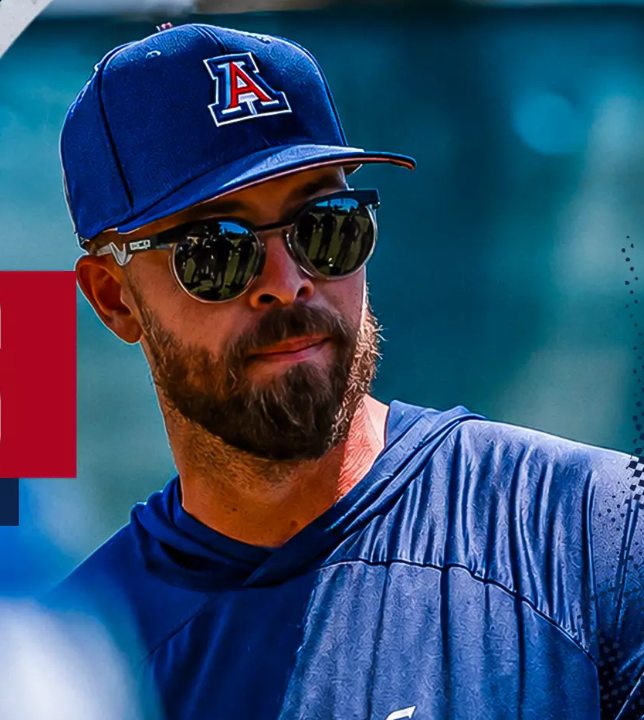
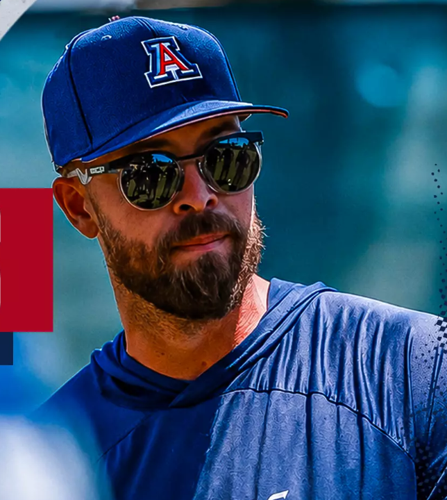
Meggs
“It's definitely a benefit — a major benefit — to be able to call my dad and say, ‘Hey, we're struggling with this. What do you think?’ ”Jack Meggs said.
At Arizona, Chip Hale is hopeful that a former Dawg can teach the Wildcats some new tricks.
Arizona finished last in the Big 12 in multiple offensive categories last season after losing several standouts to the MLB Draft and enduring a slew of injuries.
Meanwhile, St. Mary’s, with Meggs as its hitting coach, led the West Coast Conference in multiple categories and knocked No. 1 seed UCLA out of the NCAA Tournament. It was one of the biggest upsets in recent college baseball history.
“It was awesome,” said Meggs, who will make his UA debut when Arizona faces Hermosillo in the opening game of the Mexican Baseball Fiesta on Thursday at Kino Stadium.

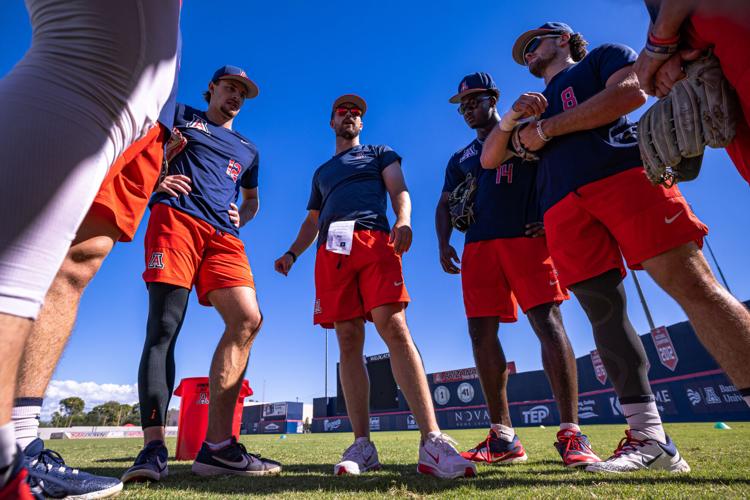
New Arizona hitting coach Jack Meggs (second from left) talks to some of the Wildcats during practice at Hi Corbett Field on Sept. 24, 2026.
“I think we got them at the right time a little bit. They were a little beat up. I know their Friday (starter) was hurt. They had a suspension in the conference tournament, too. So everything lined up good for us. And we were playing really good at the same time. We got hot towards the end of the season.
“That's what's crazy about baseball. It doesn't matter how much NIL money you have … or the draft picks on the other team. If you can just play better baseball than anybody that day, you have a chance to beat them. And we were fortunate to do that twice.”
Hale clearly took notice. He already had built a relationship with Meggs, who previously provided intel on Blake McDonald, a catcher who transferred from St. Mary’s to Arizona, and Owen Cuffe, who pitched for the Gaels before serving as an assistant coach for the Wildcats.
Meggs discussed his admiration for Arizona, his coaching philosophy, what he learned from his dad and more in an interview with the Star. Highlights from that conversation can be found below. It has been lightly edited for clarity and brevity.
What appealed to you most about this opportunity?
A: “I've always been fascinated with the program at Arizona. I played in the ... original Pac-12 with Arizona, ASU, all those schools. And this was always my favorite place to play, just because of the support that this program gets, the history that this program has with the national championships, the trips to Omaha — everything is just incredible.”
How would you describe your philosophy as a hitting coach?
A: “We have a couple main keys that we all hammer as a team, and then a lot of it is very individualistic with our guys. Not everybody moves the same. Tony Lira is a completely different hitter than Cash Brennan. Their bodies are different; they move differently in the box. So it's finding what works for them and sprinkling in the philosophies that we have.

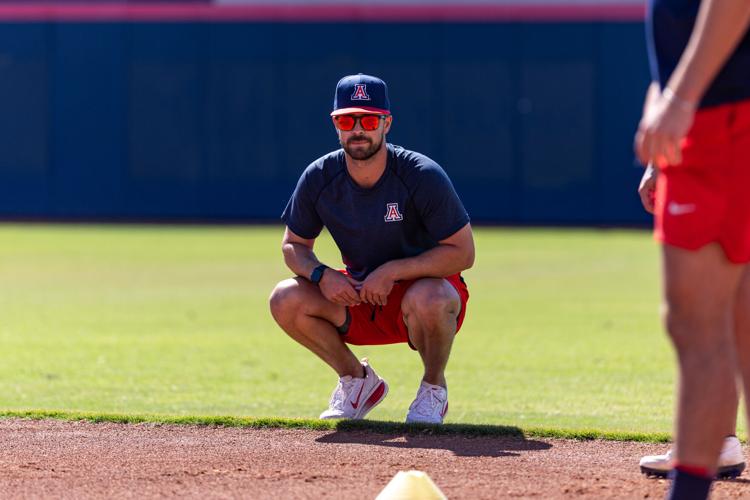
New Arizona hitting coach checks out the action in the infield during practice at Hi Corbett Field on Sept. 24, 2026.
“A ton of it is just understanding what the game is throwing at you. Being able to take a team at-bat if there's a runner on second base and nobody out in the sixth inning and you need to move a runner. It's being able to do that and being bought in to do that, too. You have to have your guys bought into the things that you're doing and the type of baseball that you want to play.
“That's what wins you baseball games — when you aren't one-dimensional. You can win a one-run baseball game. You can win a slugfest.
“When you get to the postseason — we talk about it all the time — it seems like every single game is a one-run game. So you have to be able to do the dirty work and bunt when you need to bunt and move the ball a little bit and move runners. Our guys are bought into that, and it's been a fun last four weeks.”
Chip has talked about wanting guys to hit the ball low and hard and take advantage of the dimensions at Hi Corbett Field. How do you implement that mindset when guys want to hit the ball over the wall?
A: “You have to learn how to be a complete hitter before you really start talking about launching balls and trying to hit home runs — to the pull side, especially. For us, it's really important to be able to go the other way. You have to be able to hit a good fastball the other way.
“The shift's not banned in college baseball. If you look at every single college game, for the most part, someone's usually in a pull-side shift. So when you have the ability to hit the ball the other way and hit the ball where it's pitched and trust that you can hit the ball to all fields, that's when you're at your best and your team's at your best.”
To what extent have you watched film, watched the guys hit in person and/or made individualized plans for them?
A: “(Since) late June ... it was all about our guys. All about the guys that are returning and guys that we have who are incoming or transferring in. It was watching video of when they were successful versus why they struggled. I spent a ton of time with that in the summer, just taking notes of what I thought our guys were missing a little bit or what they needed to work on.
“And then the last four weeks, it's been, ‘OK, how do we get these guys better? Is it more of a mental thing for them? Is it a physical thing?’ That's my favorite part of the year, the individual stuff — when you can dig deep into these guys and figure out what makes them go.”
You were talking about players doing the dirty work. Would that be a fair way to describe how you were as a player?
A: “Yeah. I didn't have a major tool. There was always somebody faster than me. There was always somebody stronger than me or had a better arm. I just wanted to be a better baseball player than they (were), and that's why I had some success and why I had a shot to play professional baseball.
“I always knew where to go with the ball. I knew what the game needed that day. I didn't let anybody ... play harder than me.
“We talk about that as a team all the time. You just have to be the tougher team. No matter who we're playing, you have to be the tougher team and willing to get hit by a pitch or take an extra 90 feet with a ball in the dirt. You just have to be able to do those things — especially in our league where everyone's good and there's no weekends you can take off. If you're the tougher team, you usually have a good chance to win that day.”
What do you remember about being a little kid and hanging out at the ballpark while your dad was coaching?

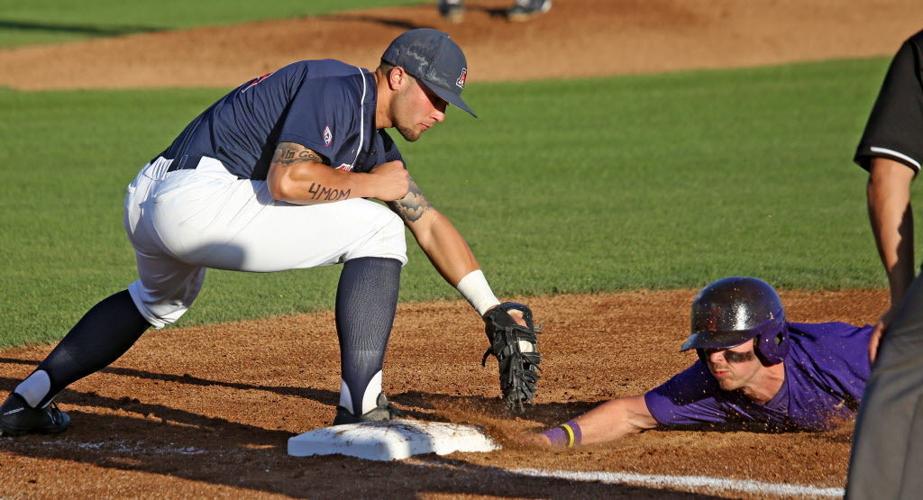
Arizona first baseman J.J. Matijevic, left, is a little late in tagging Washington's Jack Meggs in the first inning on May 10, 2015, at Hi Corbett Field.
A: “I just loved practice. I loved watching games, and they won a ton of games. But I loved how they got after it in practice.
“You couldn't tell if they were the No. 1 team in the country or if they were the underdogs (or they were) ranked 500th in the country. They practiced exactly the same. It didn't matter if you were the fourth-year starter at shortstop or a freshman that was coming in. Every single guy went 100% and battled.”
What are one or two things you learned from your dad that you are still applying today?
A: “I think the toughness part was huge with him. When ... you think of the old Pac-12, you think of schools like Arizona, where we're at right now, and UCLA and Stanford. Washington was really never picked to win the Pac-12 ever. So we took it upon ourselves to be the tougher team and always had a chip on our shoulder.
“That's always stayed with me. Just outwork everybody and do the little things the right way.”
Eventually, you played for your dad at UW. What was that like?
A: “It was fun. There were some tough days, as you can imagine, when your dad's the head coach, and you have a tough day at the plate. It's not always the funnest to go home on a Sunday and have a family dinner. But I wouldn't trade it for the world.
“I had some opportunities to go elsewhere, but I wanted to play for him and try to get him to Omaha and win a national championship.”
When did you decide to transition from playing to coaching?
A: “During the COVID year. I was with the Brewers (in the minors), and we were Day 2 into spring training. They brought us in and said, ‘Hey, this thing's gonna go on for about a week. Just hang out at the hotel.’ And then it was two weeks. And then it was, ‘Go home, the season's canceled.’ So once that happened and I had an opportunity to go to the University of Kansas and get my master's and start my coaching career, it was a no-brainer.”
Is your long-term goal to become a college head coach?
A: “Yeah, absolutely. (But) I'm in no rush for that. I love the University of Arizona. I love this place. I want to get this place back into the postseason where it belongs and competing for a national championship.
“Just like everybody who's a college coach right now, the dream one day is to be a head coach. If that happens in 10 years, it happens in 10 years. I'm in no rush and very happy where I am right now.”
Contact sports reporter/columnist Michael Lev at mlev@tucson.com. On X (Twitter): @michaeljlev. On Bluesky: @michaeljlev.bsky.social
Michael Lev
Sports Reporter/Columnist


 5 takeaways from Arizona football’s 34-24 victory over Washington State | Michael Lev