

AWENDAW, S.C. — With owls swooping through trees as a warm breeze washes in from the nearby Atlantic, a raptor center newly opened to the public here may transport some younger visitors straight to the pages of a Harry Potter book.
For their parents, it's a chance to break the mold of the typical South Carolina tourist trip that revolves around golf courses and beaches.
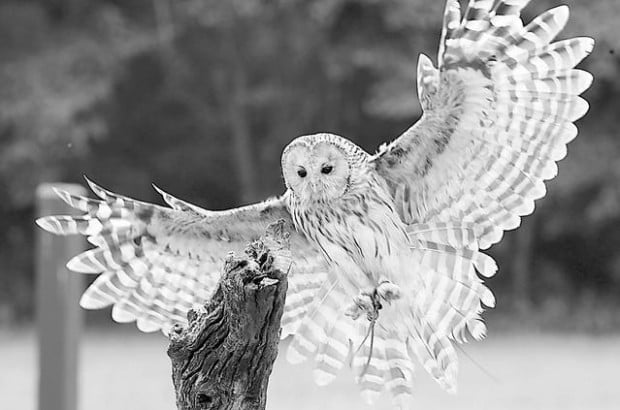
At the Center for Birds of Prey, you can see owls, hawks, kestrels and other raptors take flight. And you can wander through the lavishly landscaped two-acre Owl Wood with its collection of owls from around the world — like the large white and brown striped Ural owl that skims inches above your head before alighting on a tree stump to the delight of visitors sitting nearby on wooden benches.
Elsewhere, white gravel paths wind gently past aviaries featuring raptors including golden eagles, bald eagles, falcons and red-tailed hawks from the center's collection of about 100 birds.
People are also reading…
The center had its beginnings in 1991 as a medical center for injured raptors. That first center a few miles away was too small to accommodate visitors, so workers and volunteers took raptors to the public, showing them at schools, festivals and other events. It received some of its more widespread publicity from "Skyward," a novel by Mary Alice Monroe published three years ago that was loosely based on the center.
Now, the center, which is part of the Avian Conservation Center, has moved to a new 152-acre tract next to the Francis Marion National Forest about 15 miles northeast of Charleston.
Since June, the center has welcomed visitors for flight demonstrations and tours of the aviaries — quickly becoming another attraction in the state's small but growing ecotourism industry. It joins activities such as whitewater rafting in the northwestern mountains, dolphin-watching off Hilton Head Island and water tours of the pristine marshes, beaches and islands between Charleston and Beaufort.
Away from the crowds, the Avian Conservation Center also operates a new, larger medical clinic as well as a treatment facility for birds tarred in oil spills. In the first year the center opened, it treated eight raptors. This year, it will treat more than 400 injured birds from South Carolina and five nearby states. In the future, the number will rise to as many as 700 a year as workers begin treating injured shore and wading birds as well, said Jim Elliott, the center's executive director.
The medical treatment informs the public portion of the center — and helps turn a visit into the biology class you wished you'd had in high school.
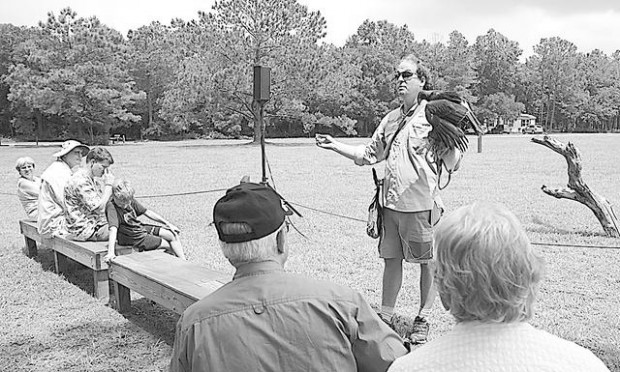
Stephen Schabel, the center's director of education, tells about raptors in an easygoing, friendly way.
By the time you're done with the 50-minute tour of the aviaries, you're well-versed in even the more complex terminology. Even those Latin names on the small signs begin to make sense as Schabel explains the similarities and differences among the majestic birds.
It's entertaining, but important to the raptors as well, because, as Schabel will tell you, the biggest threat to the birds is people.
"They get hit by cars; they run into power lines; they get shot; they eat things they shouldn't eat that have poison on them. One of the compelling factors is that most of those things have something to do with us," he says.
For instance, he says, people might think it is harmless to toss an apple core or a banana peel from a car because, after all, they are biodegradable. But the food can attract rodents, which then can attract raptors that get hit by cars.
"Perhaps we will make changes in our lives to better protect the birds," he says.
The highlight of the visit is the half-hour flight demonstration featuring, on one recent day, an owl, hawks and kestrels.
The birds, all raised from hatchlings, soar into nearby pines and oaks, and then swoop toward handlers to receive treats. At one point, a young boy selected from the tour pulls a line with what appears to be a rabbit.
Quickly, two Harris' hawks swoop down on the decoy, sailing within a few feet of the lad's head and sending him scurrying.
But the tawny-colored hawks with white beaks, a patch of yellow on their faces and bells on their talons have little interest in the child. It's the lure they are after.
If You Go
The Center for Birds of Prey
www.thecenterforbirdsofprey.org or 1-843-971-7474.
Allow at least two hours for a visit to learn about raptors, from eagles and falcons to hawks and owls. The center offers a 50-minute guided tour of the aviaries and a 40-minute flight demonstration. Visitors can wander the grounds after the tour and visit the two-acre Owl Wood with its collection of owls from around the world. Demonstrations and tours are canceled or delayed in bad weather.


