

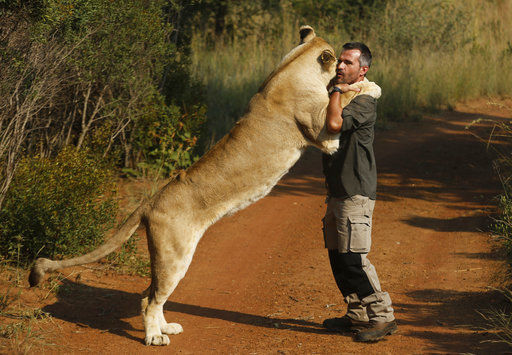
DINOKENG GAME RESERVE, South Africa — The male lion brushes through the tall grass and strides into a clearing in a South African wildlife sanctuary. A man beckons the big cat with purring sounds. The lion, Bayetsi, responds with a gentle growl and caresses Kevin Richardson, popularly known as the “lion whisperer,” with its mane.
Richardson hopes his hands-on stunts with lions will highlight the plight of the African predator, whose numbers have dwindled. It also thrusts him into a sensitive debate about human interaction with lions; some conservationists say Richardson’s message is sound and sincere, but note the limits of what he can do to address big-picture problems facing the vulnerable species.
The number of lions in the wild in Africa has dropped by more than 40 percent to about 20,000 in the past two decades, according to some estimates.
People are also reading…
Made for viral viewing on social media, the spectacle of Richardson lounging and cavorting with lions as though they were house pets might resemble a circus act in the African bush. But he uses the attention to condemn the South African industry in which customers kill captive-bred lions in relatively confined areas.
He and other critics describe that practice as “canned hunting” and also condemn the tourist draw of lion cub petting in special enclosures, saying those same animals would not be able to survive in the wild and often get cycled into the “trophy” industry to be shot for a price.
“Today’s lion cub becomes tomorrow’s trophy and the unsuspecting tourists have blood on their hands,” said Richardson, who once worked at a park that offered lion cub-petting. The tourists, he said, “have been hoodwinked into believing that their contribution of funds is going into lion conservation.”
One South African operation, the Lion and Safari Park, said it stopped lion cub petting but had to resume it because of a “dramatic and unexpected” drop in visitors and tour operators who sought out cub petting elsewhere. It said it keeps its lions until they die of natural causes or donates them to “reputable” zoos and parks.
Today, 42-year-old Richardson, who is married and has two children, manages a wildlife area with 31 lions within the Dinokeng reserve north of South Africa’s capital, Pretoria.