
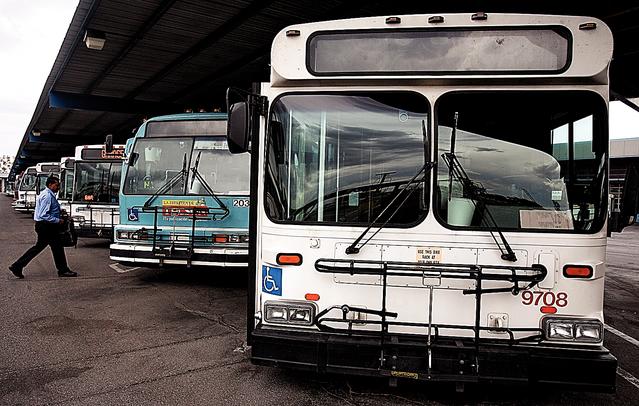
The Regional Transportation Authority plans to spend $2.9
million giving Sun Tran a new image this year, repainting buses and
making new bus stop signs.
The move comes just months after the City Council struggled
with whether to raise fares or cut service due to the ongoing
budget crisis. Ultimately, it did neither.
The new identity for the Sun Tran buses is scheduled for
unveiling at an event Thursday morning.
Sun Tran officials were unwilling to discuss the plans because
they wanted to keep the details under wraps until their press
conference. RTA officials were initially unwilling to talk about
the change, but later they provided information about the costs in
response to a public-records request submitted to the city.
However, at a public meeting in September, officials described
a new gray-and-blue color scheme as having a more "cooling" effect
for passengers waiting to board, especially in the summer heat. Sun
Tran buses have long been mostly white, with red and yellow
accents.
People are also reading…
Thirty-seven new city buses ordered to expand the fleet and
replace older buses will come with the updated paint scheme, said
Jim DeGrood, director of transportation services for the RTA.
After the "unveiling" of a newly painted bus, the Regional
Transportation Authority Governing Board is scheduled to consider a
contract to paint buses already in the fleet, ultimately to create
a more unified identity across the various transit systems in the
metro area, said Gary Hayes, RTA executive director.
The new "regional seamless transit concept" is intended to
help passengers on all transit systems better understand how they
work together, he said.
Along with the new paint job, the RTA plans to spend $5.3
million on updating the fareboxes for Sun Tran, Van Tran and other
transit systems.
The ultimate goal is to have all transit systems in the region
accept the same computerized "smart card" to pay fares, instead of
having different ways to pay on each system, DeGrood said.
The RTA also would like to have a consistent fare structure
for the transit system if possible, DeGrood said.
Riders aren't likely to see the farebox part of the rebranding
campaign until 2010.
Even after the City Council approved the city budget last
June, discussions about whether the city would raise the bus fares
by 25 percent remained a hot topic.
Initially, the rate-increase proposal was framed as a dire
situation, that if the council didn't approve it, service cuts
would be necessary.
The council ultimately decided not to raise the rates, basing
the budget on projections of increased ridership. The council
decided to see if the greater number of passengers would bring in
enough fare revenue to avoid service cuts.
All of the efforts to unify regional transit systems are in
keeping with an RTA board vote in 2006, after voters approved the
plan, Hayes said. In that vote, the board said it wanted to move
toward regionalization of all of the transit systems, Hayes
said.
With the economy staggering nationwide, RTA officials have
seen a dip of about 5 percent to 10 percent in sales tax
collections the last several months — below what was expected when
the plan was crafted. Still, they don't expect the current subpar
tax receipts to greatly affect the 20-year plan.
The Sun Tran and RTA event Thursday will be held in the Grand
Lobby of the Tucson Convention Center, 260 S. Church Ave., from
10:45 to 11:45 a.m. If you attend, plan to park in Lot B off
Granada Avenue.
Contact reporter Andrea Kelly at 573-4243
or akelly@azstarnet.com.


 Northwest Tucson's Uptown project lands 2 restaurants, tasting room