

Soup and sandwich, with a side of hope
{child_byline}COLT SHAW
Staff Writer{/child_byline}
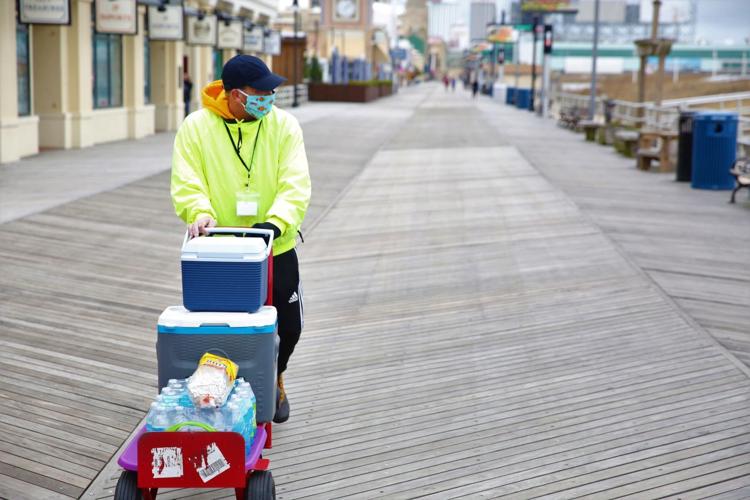
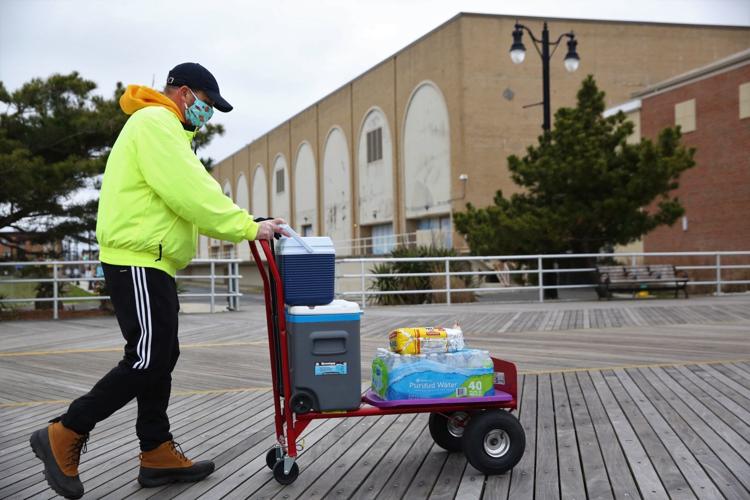
ATLANTIC CITY — Twice a day, Chris Ponteri dons protective gear to venture out into a ghost town. A mask across his face and latex gloves on his hands, he pushes a hand truck loaded with water, sandwiches and soup across the Boardwalk.
With a statewide stay-at-home order in place, Ponteri is looking for those who can’t.
There’s a simple formula in his mind.
Bustling casinos mean a crowded Boardwalk and an opportunity for the homeless who live there to make a few dollars. When the gambling houses closed March 16 on the governor’s orders, the meager revenue of the mostly men who busk and panhandle along the boards dried up in short order.
People are also reading…
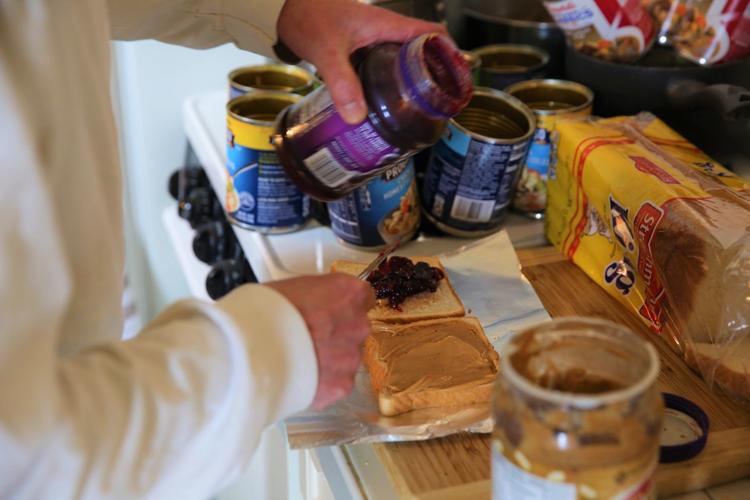
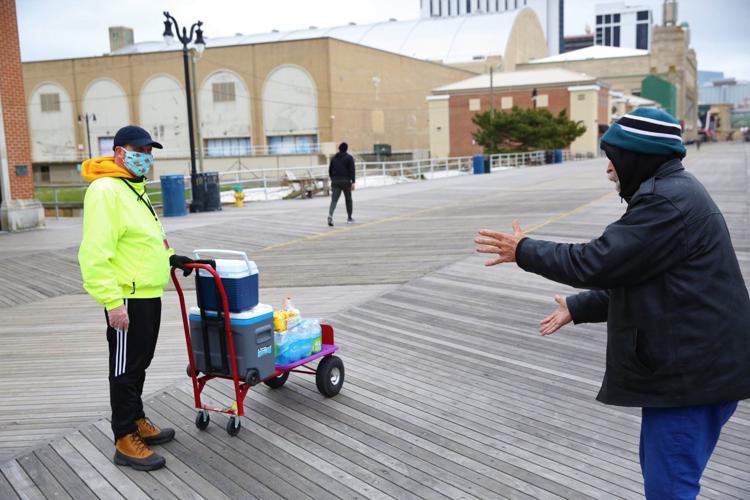
Every day since that Monday, when the internal engine of the seaside resort came to a grinding halt, Ponteri has left his Boardwalk condo with soup, water and peanut butter-and-jelly sandwiches on a mission to feed and hydrate the homeless. On Tuesday, when he came across someone — often a familiar face but sometimes a newcomer — he placed a meal on a bench at least six feet away and asked how the person was holding up.
“Not to sound dramatic, but it might actually get someone through the day,” said Ponteri, 51, an Ocean City native and graduate of Holy Spirit High School and Stockton University. “During these times, just step up. What am I doing, bro? Even if I’m spending 25, 30, 40, 50 (dollars) a day ... it’s a lot of money for me, but eventually I’ll pay it off.”
On Tuesday, Ponteri handed out 26 sandwiches, 26 soups and more than 50 water bottles. He plans to go until the casinos reopen.
Ponteri is just one example of the countless individuals who have stepped up in small and large ways to help their neighbors, and even strangers. It is an unprecedented and alienating time, and as the spread of COVID-19 has upended much of society and pushed most people indoors, it has also compelled some to push back, to reach out, to watch out for their fellow human.
Walking the boards, Ponteri will call out the names of regulars when he sees them. They’ll often do the same.
One man, Mike McLean, 63, was already up and walking toward Ponteri when he arrived Tuesday afternoon. He accepted a can of chicken noodle and a can of beef barley. McLean, sporting a Philadelphia Eagles beanie and a white beard, said he sleeps “wherever God lays my head.” He plays gospel music and has a guitar slung over his back, even now with no one to play it for. He could make $13 an hour on a busy Friday night from tourists who like his sound, McLean said. He pulls in $3 or $4 an hour now, if he’s lucky.
“I’m making way less than minimum wage,” McLean said. “So a lot of times I just practice by myself. I go out on the beach and play.”
“Satellite” bathrooms on the Boardwalk are closed from Labor Day through Memorial Day, and the three main bathrooms have been closed for repairs, said Karen Martin, spokeswoman for the Casino Reinvestment Development Authority. That cuts off the chance for privacy and water for those without an address, Ponteri said. The closest open bathroom to where he was on Florida Avenue is three to four miles away, McLean said.
“This man right here, if it wasn’t for him, I wouldn’t have any water,” McLean said of Ponteri. “God ... gives you brothers and sisters to help you. He sends you brothers and sisters to help you, there’s no question about it.”
Ponteri agreed. “That’s my brother right there,” he said.
McLean bought some coffee, bacon and eggs from Walmart one recent night. He has a portable burner, and Ponteri got him a propane canister, which allowed him to have a rare feast for dinner.
“I’m eating like a king because of him,” McLean said, laughing.
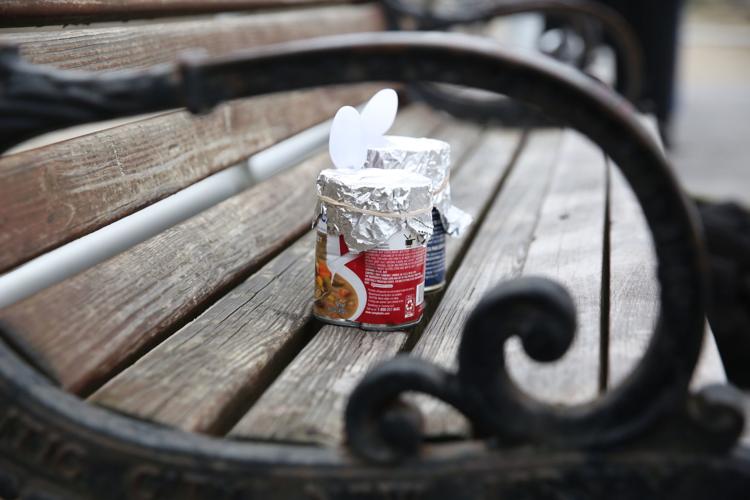
Ponteri, twice a day, cooks in his small kitchen and loads up his coolers. At 2 p.m. he heads for the Boardwalk, and about 4:30 p.m. he drives along Atlantic Avenue, stopping at hot spots for homelessness. Progresso soup offers the best bargain and nutrition at $1.60 a can at Walmart, he said. He heats it up on the stove and carefully ladles it back into cans, covering them in tinfoil held tight by a rubber band which also holds a plastic spoon. He then lowers them into his cooler.
Ponteri could make PB&J sandwiches blindfolded by now. He quickly slathers the filling and loads them, wrapped in tinfoil, back into the see-through Stroehmann’s bag for portability. Sometimes he throws in a bag of cucumber slices or a banana to round out the meals.
“The cans keep the soup super warm, which I never knew,” Ponteri said. “Everything’s so efficient. I think every meal is somewhere between $2 and $2.50. ... And I’m talking everything: (The) drive there, gas costs.”
Generosity has sprung up around Ponteri’s mission. He went over his daily budget one day at Dollar General, and the manager, knowing his mission, covered the $15.60 difference.
Ponteri’s mask, decorated with fish, was homemade and donated.
One section of the city near Texas Avenue puts Ponteri on edge when he goes by himself in the evening, and a large homeless man that goes by “House” offered to escort him there to hand out meals. One homeless man offered his jacket on a rainy day, thinking Ponteri looked cold. Another declined a meal one day because he had enough snacks to get him through the night.
“One thing I’ve learned is nobody takes more than they can handle,” Ponteri said.
Friends on Facebook have donated soup, water and cash. But Ponteri is mostly keeping his little operation going on his own dime. His accounting degree from Stockton makes him analytical, he said, and running a small business — Ponteri has a few employees that flier for shows and events on the Boardwalk — has taught him to track every penny. He has a daily budget, and had handed out some 235 meals through Wednesday.
“I’d rather (people) just donate supplies,” Ponteri said. “As soon as somebody gives me cash, I’ll go to the store, take a picture of the receipt so it’s totally transparent. ... I don’t need anyone’s money. ... I want to be like a total nonprofit.”
The deserted Boardwalk has meant fewer donations from passers-by, said Mark Charleston, 45, sitting on a bench a little after 2 p.m. Other homeless men have expressed the same concerns. They’re “just trying to make do,” Charleston said.
“It’s very helpful. It’s very helpful,” he said of Ponteri’s work. “Everyone appreciates what he’s doing.”
Some friends, though, have cautioned against what he’s doing.
“I’ve had a lot of people complain to me — more than one — (that) I’m doing the wrong thing, I’m gonna be a superspreader. This is for government to do, not me. This is for charity to do, not me,” Ponteri said. “But I don’t see anybody out there.”
There are soup kitchens in the city that feed the homeless and indigent — the Salvation Army on Texas Avenue and the Atlantic City Rescue Mission near the Convention Center. Still, Ponteri sees gaps in a city with a 40% poverty rate and its main employers dormant indefinitely.
If a system was in place that got everyone fed consistently or, better yet, kept people off the streets, Ponteri would be going about his life, likely quarantining as his neighbors are. Until then, he feels compelled to push on, he said.
“I don’t want to do this. I’d much rather be doing whatever I usually do. You think I want to do this, you’re freakin’ nuts,” Ponteri said. “Nothing would make me happier than to come back with all my soup ‘cause nobody’s out there.”
{child_tagline}
{/child_tagline}


