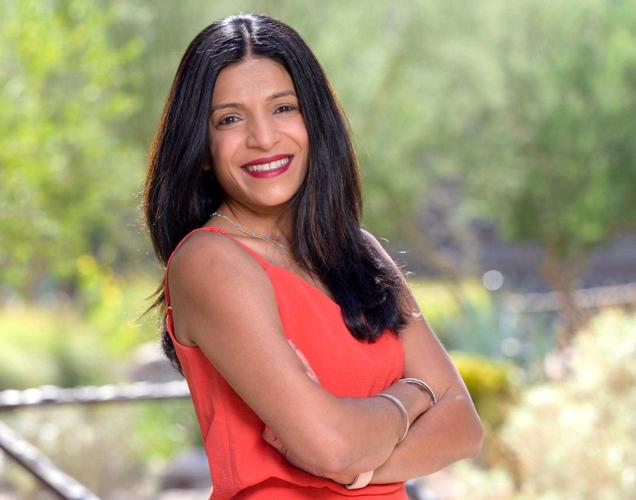
University of Arizona cancer researcher Dr. Rachna Shroff, who died Oct. 11 of the disease she spent her career trying to find cures for, had a “love for living” and wanted to fight to “live as long as she could for her family,” says her husband, Dr. Puneet Shroff.
Rachna loved her family dearly, said Puneet, a clinical professor of medicine in the UA College of Medicine-Tucson. He reminisced about her taking their son, Sachin, to see the Arizona Wildcats play in the Final Four of the 2026 NCAA Tournament, and pulling out all the stops to see their daughter, Simran, perform in a summer theatre show in Chicago while she was undergoing chemotherapy.
“She flew to Chicago, but of course, the plane was diverted and she had to take a 3-hour car ride from Moline, Illinois, to Chicago to make it to the show,” Puneet told the Star in an email. “She was so committed to seeing her daughter's performance that nothing would hold her back even though she wasn’t feeling 100%.”
People are also reading…

Rachna, associate director of clinical investigations and co-leader of the Gastrointestinal Clinical Research Team at the University of Arizona’s Comprehensive Cancer Center, spent most of her career studying gastrointestinal cancers and their cures.
She died at the age of 47, months after she was diagnosed with cancer. As first reported on The Today Show on NBC, she developed a swollen lymph node, discovered in May, that may have originated in her stomach or intestine.
While the swollen lymph node was initially thought to be lymphoma, a type of blood cancer, it was later confirmed to be terminal adenocarcinoma, a type of cancer that starts in the glandular cells lining organs, such as the lungs, colon, breast or pancreas.
A week before she died, Rachna held a “Celebration of Living” for herself, an idea inspired by Puneet a few months ago. There, they played a clip of her teaching a dance she had choreographed to Ed Sheeran’s “Sapphire” and taught earlier this year to The Cholangiocarcinoma Foundation, a global organization that works to cure bile duct cancer.

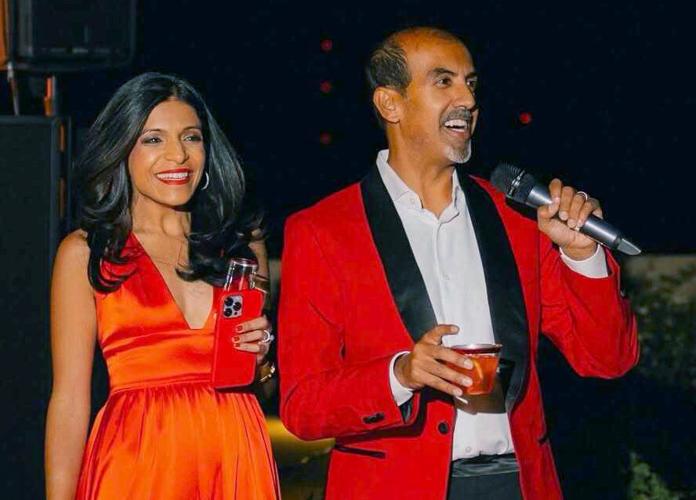
Dr. Rachna Shroff and her husband Dr. Puneet Shroff.
This was “incredibly moving and heartbreaking all at once," Puneet said, adding that the event was “truly a celebration and not a grieving.”
“It was an opportunity to celebrate 'infinite love' with family, friends and colleagues,” he said. “Because so many people wanted to be here with her during her journey. It was truly magical as she was surrounded by love that she had garnered from so many circles and was able to link them together. That was one of her many superpowers.”
Clara Curiel, co-director of UA’s Skin Cancer Institute, was a close friend of Rachna's and worked with her on cancer center leadership for more than a year and a half. She said there were about 100-150 people at the celebration, all connected by the love and appreciation they had for Rachna, and the sadness they felt.
While Rachna was a “giant” in her field at a young age, Curiel said her greatest impact was the number of lives she touched along the way and how she empowered people and lifted them up.
“She had this capacity that was so remarkable about her, to connect with people on a human level,” Curiel told the Star. “She really made people feel heard, valued, no matter what position they had.”

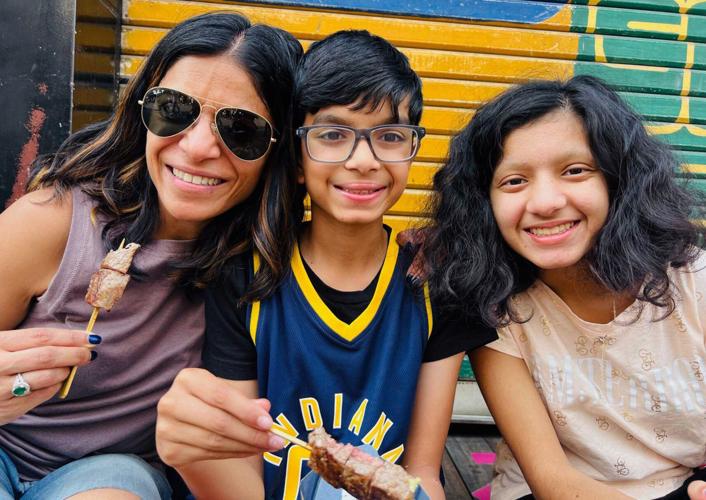
Rachna Shroff with her children Sachin and Simran.
Parents at The Gregory School, Rachna's alma mater and the school her children attend, are working toward placing a bench on the campus in her honor, along with a memorial plaque, says an email sent to the school’s parents last week. The email says the idea was approved by Rachna herself before she died, as well as by Puneet and daughter Simran.
Cecilia Alter, a parent and board member at The Gregory School, told the Star that Rachna was not just a school parent but also a trustee on the school’s board. She said she was a strong advocate for her children as well as a “renowned professional” in her field.
The idea is to place the bench somewhere meaningful, such as in the school’s science courtyard, where people can just sit, reflect and be with her, she said.
A ‘grueling’ battle
Puneet told the Star that while their family knew from Rachna's work about the impact of cancer on patients and their families, it could never have prepared them for “how grueling this battle truly was.”
Having gone through this journey with her, and experiencing what it’s like to be a cancer caregiver, he said it will simultaneously be “an honor and a challenge” that will stay with him the rest of his life.
“Watching Rachna fight day in and day out to, at first lead a normal life — and then, to lead a life without pain, was heartbreaking,” he said. “We knew that she had an army of people trying to make the best disease plan for her and get her the best treatments, but even that wasn’t enough to bring victory against this aggressive disease.”
Rachna, who spoke at the annual conference of the American Society of Clinical Oncology just days after she was diagnosed, noted in an interview with NBC News earlier this year, “I’ve spent my entire life trying to eradicate cancer, primarily pancreatic cancer, but also liver cancers."
Puneet said being diagnosed with cancer at any stage is “devastating” for anyone, but that in Rachna’s case, it was even more intense since she knew so much about her particular malignancy and its poor prognosis. However, with whatever knowledge she had, she wanted to fight to live as long as possible for her family, he said.
Dr. Dan Theodorescu, the Nancy C. and Craig M. Berge Endowed Chair for the director of the UA Cancer Center, said Rachna understood the science, statistics and realities of these diseases since she’d spent her entire career helping patients as they faced “devastating diagnoses.” So, for him to see her become a patient was “heartbreaking.”
“But she never let her diagnosis define her,” Theodorescu said. “She certainly acknowledged the reality of it, but she continued to show up for her patients and her duties in the cancer center. Her resilience wasn’t about pretending everything was okay. It was about refusing to stop living. She continued to live with courage and purpose.”
Curiel said that, in the face of mortality, everyone reacts differently, and it really shows who they are as a person and what matters to them. She said for Rachna, facing this reality meant deciding to spend the rest of her time taking care of others, making a difference in people’s lives and leaving a legacy.
“That’s what she did,” Curiel said. “She went to the conference. She met with the people. She continued to see her patients. She had Monday clinics. She continued to come to her clinic every Monday, and I think she stopped seeing patients just about six weeks ago … Her resilience was based on what was important for her.”
‘She wanted to give patients more time’
Puneet said Rachna continued receiving multiple types of chemotherapy and was ultimately treated with a “novel targeted therapy” that would specifically target the mutation she had.
“Rachna devoted her career to taking care of patients with gastrointestinal cancers,” Puneet said. “She knew that no matter how good a treatment was, the only acceptable treatment would be one that could cure. She had long been interested in the origins of cancer, as she had studied biochemistry as an undergraduate at Brown (University), and was particularly interested in targeted therapy. This is why she devoted her research time to clinical trials and especially clinical trials that would truly target the genesis of GI (gastrointestinal) malignancies.”
Theodorescu said for Rachna, research wasn’t an “abstract science,” and she believed discovery doesn’t change lives unless it reaches patients. He said for her, “every study, every clinical trial, every grant application ultimately came down to a person sitting in front of her who desperately needed hope.”
He said that was the reason she was a champion for clinical trials. She wanted all patients to have access to the “newest and most promising therapies possible.”
“She chose to devote her life to some of the most difficult gastrointestinal cancers, like cholangiocarcinoma that for many years had very limited treatment options, because she believed those patients deserved advocates just as much as anyone else,” Theodorescu told the Star via email. “She wanted to give patients more time with their families, more milestones and more memories.”
Even as she neared the end of her own life, she was thinking about others and created an endowed award to support future clinical researchers, he said.
She completed her goal of establishing the Conquer Cancer — Rachna Shroff, MD, MS, FASCO Endowed Young Investigator Award in Biliary Cancers within weeks and raised more than $1.35 million to support the future of cancer innovation.
‘Life of a party’

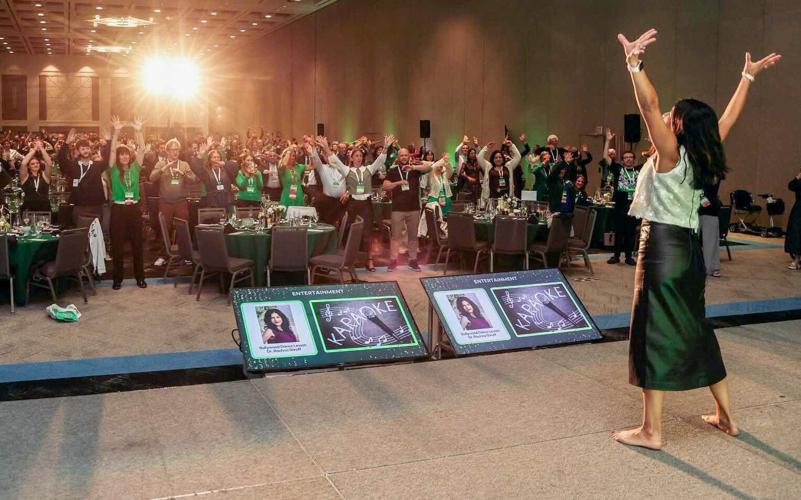
Rachna Shroff teaching a Bollywood dance to The Cholangiocarcinoma Foundation.
Theodorescu said what he’ll remember most about Rachna is how she brought “incredible energy and humor” to a conversation. When he first interviewed for the job at the UA as director of the cancer center in June 2025, he didn’t want to move from Los Angeles to Tucson, he said.
But when he met Rachna and spoke with her, her passion for her work, the cancer center and for Tucson, where she’d grown up, struck him, and she was one of the major reasons he decided to make the move. He said he saw how emotionally invested she was in her work at the cancer center, and also what she had accomplished in terms of clinical trials and mentoring junior faculty to become clinical investigators.
Puneet said Rachna was his "greatest champion" and that they enjoyed a shared love of traveling and human connection.
“One of our important family traditions is celebrating the holiday of Diwali,” Puneet said, talking about the Indian festival of lights.
“One thing I will always remember is how Rachna organized an annual celebration, 'Diwali — Dhamaka,' to bring together not only our family, but also our friends, coworkers and community members to celebrate this festival of lights. She always had a way of bringing people together in a way that honored our family values and traditions to share positivity with one another.”
Curiel said Rachna was a “big dancer” and the “life of a party,” and that she loved celebrating her birthday and Diwali. She would throw “some of the best parties in town,” and they were “delightful,” Curiel said.

Rachna and Puneet Shroff celebrating Holi, the Indian festival of colors.
“She was not afraid of sharing what she had,” Curiel said. “You see, some people like to keep their lives private. She kept it open, for everyone to be a part of it. So, the generosity of opening doors and windows of your home to welcome so many — that really spoke to who she was, you know, the authenticity.”
Reporter Prerana Sannappanavar covers higher education for the Arizona Daily Star and Tucson.com. Contact her at psannappa1@tucson.com or DM her on Twitter.
Prerana Sannappanavar
Higher Education Reporter