

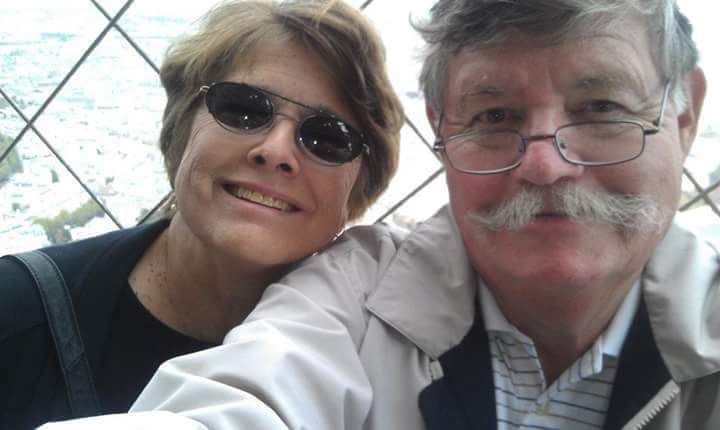
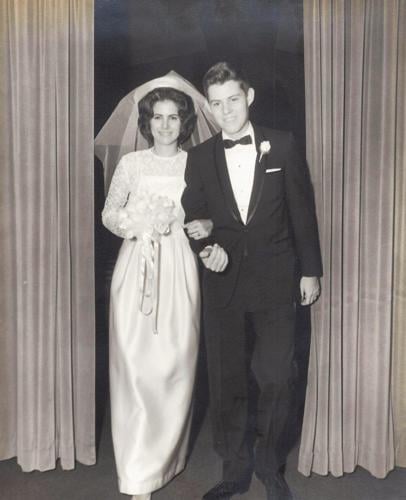
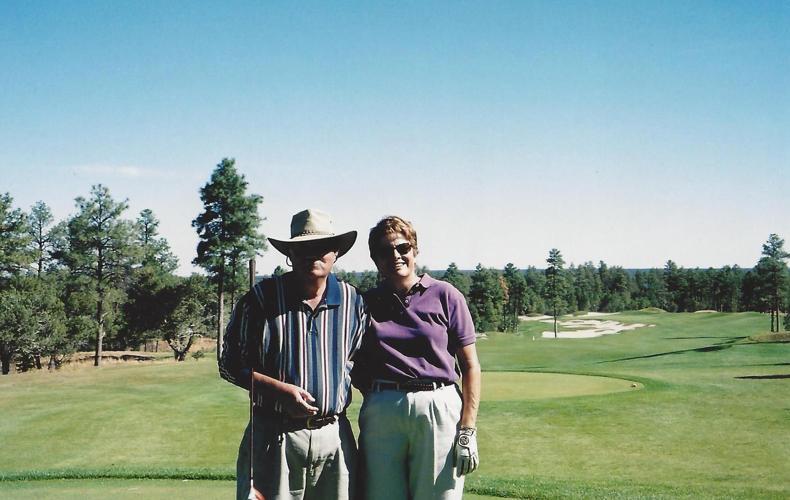
I still say “we.” And “our.” After 53 years, it’s hard to shift from the plural to the singular.
On Jan. 3 of this year, my husband died. It was a quick, peaceful death, and he was surrounded by family. That, I tell myself, was his gift to us. On the other hand, I’m not sure he knew what was coming. A true optimist, he held out hope to the very end.
The beginning of this ending began on April 23 of last year on the golf course. As he was hitting out of the rough, my husband experienced what he called “belly pain,” the worst pain, he would later say, that he had ever felt.
Still, he continued the game, quitting after nine holes.
Almost immediately he started having difficulty breathing. Never again would he be able to lie flat to sleep. We went to urgent care in Show Low, where we were living for the summer. They took X-rays. Nothing. Still, the breathing problems persisted. A pulmonary doctor in Show Low put him through a battery of tests and gave him an inhaler. It did not help.
People are also reading…
Toward the end of May, he went to the Mayo Clinic in Scottsdale for more breathing tests, along with another X-ray. That night the doctor called. He had seen fluid buildup around the heart and lungs and arranged an EKG for a few days later. The results came in quick and brutal. “Your husband has heart failure,” I was told.
We were floored. Here was a man whose cholesterol counts were ridiculously favorable. I was the one on statins, not him.
He was admitted to the Mayo Clinic Hospital in Phoenix, where he underwent an angiogram. The diagnosis was grim. He had suffered what is called a “widow maker,” leaving his left anterior descending artery too blocked for stents or a bypass.
Three days later, we returned to Show Low — he on blood thinners and diuretics, me on a quest for low-salt recipes. For three weeks it went on this way. Still, he struggled to sleep in anything but a sitting position.
On June 16, about 9 p.m., my husband again suffered more pain in his abdomen and raced to the bathroom for the nitroglycerin. He was fumbling with the bottle and starting to drool.
“Bob,” I shouted. “You’re having a stroke.”
I called 911 and he was soon shuttled to the only hospital in Show Low. Because he was on blood thinners, he could not be given the drug to dissolve the clot causing the stroke. The entire left side of his body was shut down, though he could still talk and seemed to have full use of his mental capabilities.
An hour later, he was helicoptered back to the Mayo Clinic Hospital.
I followed in the car, a three-hour drive through a blacker-than-midnight forest, its darkness broken occasionally by the glare of opposing headlights.
Suddenly I was in charge of everything, including the bill paying — something I had not done in 30 years. My husband had done it all online.
“What’s the password?” I asked him the next morning. He quickly rattled off the numbers.
After a few days at Mayo, Bob was transferred to a rehab facility in Tucson, closer to friends and family. Three days later, he suddenly lost consciousness and coded. Emergency workers brought him back, then transferred him to a hospital next door. A few days later we were approached by a cardiologist who thought he could help. Tests were positive and two stents were successfully implanted.
Then came stroke rehab — six weeks at two different units. Bob came home in a wheelchair in the middle of August. I was his sole caregiver. Within days, he was walking with a cane. Much of his left side had come back, though his left hand was still weak. He also had what is called left neglect, meaning his left eye was not receiving the correct signals from his brain. Only by purposely swiveling his head to the far left could he see anything on that side.
He could not read from left to right, as we are all taught to do. He — who had thrived with every technological advance — could not operate the computer or even the TV remote.
All that fall he underwent a regimen of physical therapy, both inside and outside the home. But slowly he was losing this battle. The stroke had caused swallowing difficulties, making it hard for him to eat all but the smoothest of foods.
Toward the end, he was drinking only high-calorie liquids. Even so, he was shedding weight at an alarming rate.
After Christmas, we both came down with the flu, even though we’d had the shots. On the second day of the new year, I took him back to the hospital, which was overflowing with flu cases. The next morning he was wheeled into the ICU with an irregular heartbeat. Around 1 p.m., he again complained of belly pain, then suddenly had some sort of seizure. He closed his eyes and spoke no more. An hour later, he was gone.
I had expected it for some time. I went home to an empty house and poured myself a stiff drink. And I reflected on the last nine months — months that had led us into a strange yet tender new relationship.
Oh, how grateful he was for everything I did for him. Oh, how I wished I could do more, while wondering how long we could go on like this.
After his death, the grief, while ever-present, had to be put on hold for more-pressing matters. There was a service to plan, bills to pay, kind attentions of friends and family to acknowledge. I had to reapply for new bank checks and credit cards in my name only. The car was due for its annual checkup. I had to find someone else to do the taxes.
Through it all, I have been struck by the kindness of strangers — strangers who invited me to their book club, to go out to lunch, to come over to watch the ballgame.
I resumed my volunteer work and started attending a grief support group. We laugh, we cry, we eat the little chocolates so thoughtfully provided. And we find that we are not alone.
Silence is still something I avoid. The TV is constantly on, spewing out each day’s outrageous news. “I would rather be angry than sad,” I tell a friend by way of explanation.
And yes, I am still angry at times, especially when I see men my husband’s age out and about, enjoying life. Why them and not him, I wonder. For the grief I feel most sharply is not for me but for him. He is the one who will never hit another golf ball, watch a sunset, kiss a grandchild.
This thinking, of course, does no good. Nor will it bring him back. “It will be a year before this will seem like the new normal,” the pastor told me at the service.
Maybe so. Still, I wonder how long — if ever — it will be before I no longer say “we.” And “our.”
Bonnie Henry is a former reporter and columnist for the Arizona Daily Star. Contact her at Bonniehenryaz@gmail.com



 Jim Click’s Tucson dealerships sell for $93 million
