
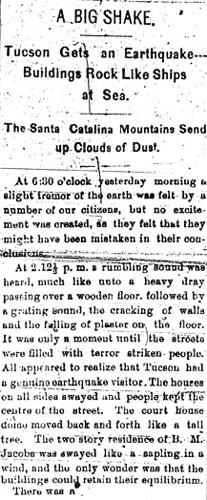
According to the regulator in Black’s jewelry store, the trembling began in the afternoon of May 3, 1887, at exactly twelve and a half minutes past two. At least, that is when that timepiece froze.
Then, for nearly two minutes, an earthquake shook Tucson, much of southern Arizona and northern Mexico.
[photo moved to image asset]
The Arizona Daily Star, May 4, 1887.
According to the Star’s report the next day, the earthquake began with a rumbling sound. “But it was not a sound to cause the least merriment, but on the contrary it was like unto that which strikes terror to the mind of man and at once causes him to realize his insignificance as compared to the power which holds the earth in the hollow of his hand.”
Folks on the street reportedly got sick from the waving motion, the dome on the old courthouse moved back and forth “like a tall tree.” When a school building started swaying, one teacher fainted, which probably didn’t calm the already frightened children.
People are also reading…
In the Santa Catalina mountains, a cloud of dust quickly rose obscuring the peaks from view. “Great slices of the mountain gave way and went tumbling down into the canyons.”
[photo moved to image asset]
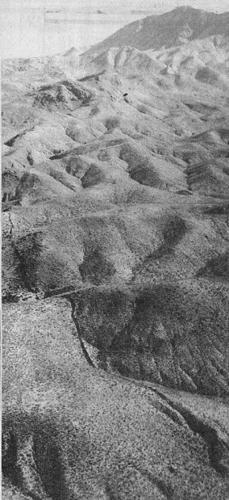
1976 photo courtesy of Dr. John S. Sumner, UA geophysicist.
An aerial photo near the Santa Lucia Mountains in northeastern Mexico. The 1887 scarp is clearly visible.
The quake was actually centered near Bavispe, Mexico, about 200 miles southeast of Tucson. Although there was structural and interior damage here, over fifty people died in Mexico, 42 in that small Sonoran town.
Modern calculations have tried to measure the strength of the quake and put it at between magnitude 7.2 and 8.2 on the Richter Scale. The waves fanned out about 400 miles. It was estimated to be traveling at 5 miles per second when it arrived in Tucson.
[photo moved to image asset]
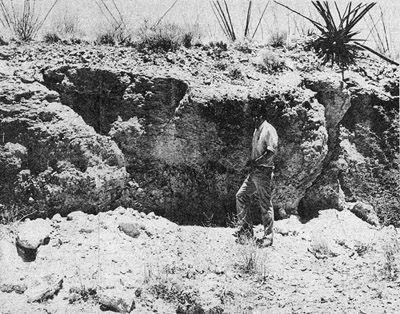
1974 photo courtesy Dr. Sumner.
Near the epicenter, the scarp, or low, steep slope, shows the displacement caused by the quake. There is no split in the earth in front of the scarp. It is a shadow.
For several days in the Star, the reports kept trickling in. There was one account of an active volcano in the Whetstone Mountains. “A bright fire was visible shooting upward from fifty to a hundred feet or more.” This was shortly debunked by the Tombstone Epitaph who labeled the reporter who sent in the item the “Benson Liar.”
It was believed that there might be a significant change in water supply for the region, with reports of new springs and rising water levels. “If these be facts, then Arizona may appreciate a salutary change in its water supply as well as other climatic conditions.”
As to what caused earthquakes, here is the 1887 version:
“There are many theories advanced concerning earthquakes. Some claim they are caused by electrical disturbances, others from the earth’s shell cracking under the ocean and letting water into the fiery interior region, causing explosions which find outlets in volcanoes and eruptions. Some of the ancients believed the earth was a great living being, and earthquakes were simply a bad case of colic.”


 Northwest Tucson's Uptown project lands 2 restaurants, tasting room