
Megan Hawks can’t get into Yellowstone.
Hawks and her family were en route to the national park when record rainfall and flooding over the weekend forced officials to close all of its five entrances Monday.
They’re among an unknown number of people hastily trying to figure out next steps amid upended travel plans.
The family was supposed to stay in Gardiner, Montana, for two nights. Now, the plan is to stay in Jackson on Monday night, and head to Island Park, Idaho, on Tuesday.
They’re safe, but Hawks is worried about getting their hotel costs refunded.
“As you know things are so expensive,” she wrote in a Facebook message.
No visitors will be allowed into Yellowstone until conditions stabilize. As of Monday afternoon, the closure was set to end no sooner than Thursday.
People are also reading…
“We will not know timing of the park’s reopening until flood waters subside and we're able to assess the damage throughout the park," Yellowstone Superintendent Cam Sholly said in a statement. "It is likely that the northern loop will be closed for a substantial amount of time.”
Video footage shows Carbella Bridge in the Gardiner area, otherwise known as Tom Miner Bridge, collapsing amid a disastrous flood.
Officials on Monday were evacuating those still inside the park, beginning in its northernmost reaches, where the impacts — including road washouts, bridge failures, rockslides and mudslides — were most severe.
The park recorded 1.75 inches of rain at the north side of Lake Yellowstone as of 9 a.m. Monday, according to the National Weather Service, including 1.37 inches in 24 hours — more than triple the previous single-day record. The far northern part of the park received an estimated 2-3 inches of rain.
With rain expected to persist through Tuesday night, concerns about rising flood levels and strain on wastewater and water treatment facilities prompted additional evacuations to the south.
“The heaviest rainfall has moved off to the east already, so they're not expecting a lot of heavy rain,” said Jason Straub, lead meteorologist for the Riverton office of the National Weather Service. “But there still might be showers in the area today, tonight and tomorrow.”
Much of the park still has snow on the ground, according to Tony Bergantino, director of the Water Resources Data System at the Wyoming State Climate Office.
It's been too warm during the past couple of nights for any of the recent rain to turn to snow. So all that water is pouring freely into the park’s rivers.
Gauge height on the Lamar River peaked at 16.7 feet early Monday, shattering the record of 12.15 feet set in 1996 and surpassing the maximum recordable height by nearly 2 feet. Flood levels on the Yellowstone River near Corwin Springs, Montana, broke the local record, which has stood for more than a century, also by about 2 feet.

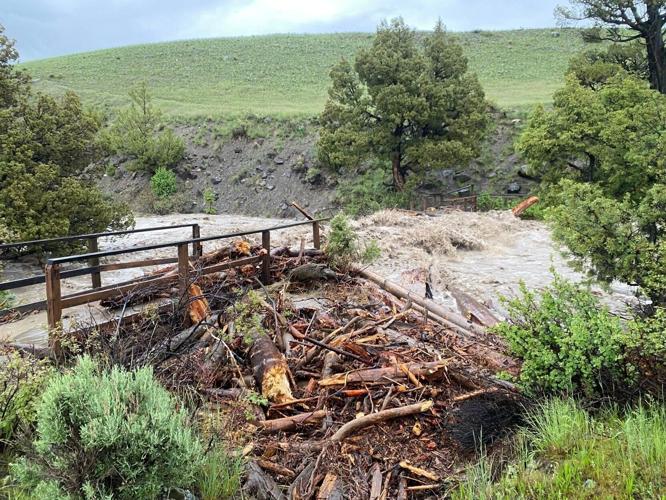
The swollen Rescue Creek flows over a washed-out bridge in Yellowstone National Park.
Gateway towns
Cody — located about 50 miles from Yellowstone’s east entrance — is one of several gateway towns tourists travel through to get to the park.
Right now, the city’s preoccupied with finding marooned visitors places to stay, said Tina Hoebelheinrich, chief executive officer of the city’s chamber of commerce.
The city’s calling up area hotels to see who has space for unexpected guests, she said. As of 1 p.m. Monday, two of Cody’s 100-odd hotels were booked full, she said.
The Shoshone River, which originates in Yellowstone, flanks Cody’s northwest corner. It’s not close enough to town to pose any problems, Hoebelheinrich said. But she’s worried about all the guest ranches outside the city. She heard anecdotally that one had flooded and evacuated its guests.
Shoshone National Forest — located about 25 miles west of Cody — is also experiencing high waters. As of Monday afternoon, two campgrounds at the park, Big Game and Wapiti, were closed because the Shoshone River was swelling.
Aerial video taken from a helicopter of a paved road, eroded and washed out in several places due to high water levels in adjacent river.
Hoebelheinrich said she and others visited the campgrounds Sunday night to check in on the conditions.
“I just remember very plainly that Wapiti was at the top of the bank,” she said.
Dubois — a smaller city located about a hundred miles southeast of Yellowstone — wasn’t seeing as much traffic Monday.
“So far, I don’t think there’s been a huge difference,” she said.
Most people passing through Dubois that afternoon were leaving the national park, said Julie Gerona, executive director of the Headwaters Arts and Conference Center.
They might get more visitors Monday evening or on Tuesday, she guessed.
Dubois’ busy season is July through September, Gerona said, so Yellowstone-bound vacationers looking for a plan B can probably find room to stay at the town’s hotels and short-term rentals.
“We have plenty of things to do,” she said.

The swollen Gardner River damages North Entrance Road in Yellowstone National Park.
Widespread destruction
Flooding and related damage shut down at least 20 roads in Wyoming and Montana on Monday.
Cody Beers, a spokesman for the Wyoming Department of Transportation, said the agency is keeping a particularly close eye on highway bridges that cross the rising waterways.
Two major bridges — one on Highway 120 and one on Highway 296 — stick out as problem areas, Beers said. Both cross the Clarks Fork of the Yellowstone River, which was so high on Monday that it touched the bottom of the bridges.
The water level was causing debris to get caught and pile up on the bridges’ upriver sides.
Accumulated debris can “cause water to run around the bridge and potentially damage the bridge and the roadway,” Beers said. He said WYDOT personnel will likely have to go in and remove it all.
And WYDOT will have to put off other road improvement projects to repair destruction wrought by the floods, he said.
Damage from the flooding will be felt all across Wyoming, Beers said. Tourism is one of Wyoming’s biggest industries — not least because of Yellowstone, Grand Teton and other recreational hotspots nearby.
Wyoming pulled in $258 million in tax revenue from outside visitors in 2021, according to a report commissioned by the state’s tourism office. That represented a 60% increase from 2020, the report said.
Yellowstone enjoyed record attendance that year, with 4.8 million visitors, up from 3.8 million in 2020. Officials expect 2022 to be another busy year.

The swollen Rescue Creek flows over a washed-out bridge in Yellowstone National Park.
The Montana side
Patrick Gorman and his family traveled to Yellowstone from Marion, Iowa, on a Western camping trip that also included a stop at Mount Rushmore.
“Rain won’t stop us from enjoying our vacation,” Gorman tweeted Sunday, alongside a photo of his umbrella-wielding kids.
But by Monday, the Gormans and roughly 20 others were stranded at a campsite in Gardiner, Montana, just outside the north entrance to the park, after the overflowing Yellowstone River washed out the only roads into town.
“The river right now has overtaken half of the tent camping,” Gorman told the Star-Tribune on Monday afternoon via Twitter.
People with campers and RVs — Gorman included — were safe, he said. They still had power and internet, but hadn’t received word from officials on when they might be able to leave.
The floodwaters also left Red Lodge, a city of about 2,200 near the park’s northeast entrance, similarly isolated.
Michelle Owen Camper and her family, who live between Roberts and Joliet, Montana, were visiting the city Monday morning when the flood hit. She took a video of waters rushing past houses on its south end.
Owen Camper runs a painting business in the area. She’s been checking in with her customers to see how they’re doing. A few people have already lost their homes to the flood, she said.
It’s the second natural disaster the community’s grappled with in less than a year — about 40 acres near Red Lodge burned in a wildfire last July.
“You didn’t see as much destruction at all,” Owen Camper said of the fires.
Now, water is rushing through Red Lodge’s streets. Several key bridges are gone. Residents are piling up sandbags to save as much as they can.
“I don't think it's ever it's never been this bad,” said Sherry Weamer, director of the Red Lodge Area Chamber of Commerce.
But the world outside the storm is still catching up.
“Travelers don't know,” Weamer said. “So they're calling here as they usually do, just to, you know, get information and then we're sharing what we know and trying to divert.”


 101 homes to be built on NW Tucson corner