Hackers first made contact on April 8 — two days before they apparently made good on a swatting threat that led deputies to smash through a Tucson home's windows and shoot Axeel Melendez, leaving him paralyzed from the chest down.
It all started when Melendez was playing Rust, a multiplayer survival video game, on an online server.
Someone in the game server asked if they could check Melendez's computer to verify he wasn't cheating.
Confused but not alarmed, Melendez obliged.
He hadn't heard of it before, but it seemed normal.
Shortly after, he began receiving notifications that several of his accounts were being logged into.
Trying to get ahead of it, he set out to change all his accounts and passwords.
It was too late, though. Hackers had already accessed his email account, revealing a trove of his personal information.
They demanded money from the then 23-year-old under threat of making fake calls to law enforcement to get officers to raid his house, a common tactic used by hackers known as swatting.
Worried, Melendez called 911 to report the hacking and threats.
“They said that they were going to call the police station and say that I have a bomb so that FBI shows up at my house so I could get swatted,” Melendez told a 911 operator, a recording of the call shows. “They knew my ethnicity, so they said that they were going to call ICE to show up at my house and get my whole family deported. We’re all citizens, so it’s okay.”
People are also reading…

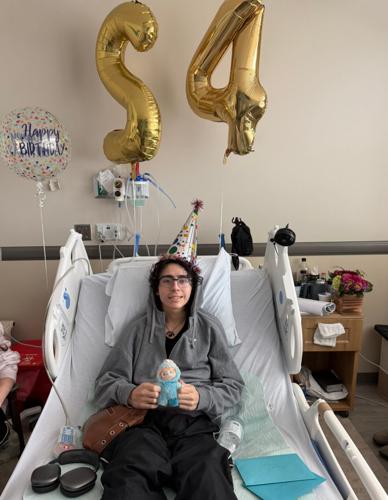
Axeel Melendez was shot and wounded by deputies responding to a bogus shooting call two days after he reported concerns to the Pima County Sheriff's Department about being a target of swatting. He turned 24 years old at the hospital.
“They can’t just call the SWAT on you,” the operator assured him. “That’s not how it works.”
“Nothing is going to happen,” the operator said. “They just have your personal information.”
Melendez apologized and said he was hoping for guidance on how to handle the situation.
Later that day, a Pima County sheriff's deputy showed up at Melendez’s house to talk to him.
Melendez explained the situation. The deputy told Melendez that he didn't need to worry because he let the department know about the potential for fake emergency calls ahead of time, the deputy’s report says.
If any emergency calls were made in reference to his address, the deputy told Melendez, he would be contacted and would just have to tell responding deputies about being hacked.
Melendez still felt unsettled with the situation, though, the report says.
While the deputy was at his house, a false call came in to Tucson police and was transferred to the Pima County Sheriff's Department, the report notes. The caller, who said their name was Sam, claimed Melendez was “harassing a lot of people and abusing females.”
The deputy “advised Axeel of the report just made, and told him that it was all right, and it did appear to be suspicious, and that more may come in like that, but that there was nothing to worry about.”
The deputy then let his supervisor know about Melendez’s situation, the report says.
A fake shooting reported to 311
About 5:40 a.m. April 10, two days after Melendez reported the swatting threats, someone with a Wisconsin area code phone number who was claiming to be him called 311, the non-emergency number for city services. Because it was outside of city's jurisdiction, the call was transferred to the Pima County 911 Communications Center, according to a report from Tucson police, who investigated the deputy-involved shooting.
The caller told them his father had just shot his sister and provided Melendez’s home address.
Shortly after, several deputies were at the Melendez home south of Tucson International Airport near South Nogales Highway, where he lives with his mother.
While on the way, a deputy advised over the radio that they could be responding to a swatting call, noting Melendez’s report from two days earlier, the police report says.
“They don’t know if there’s an active shooter or not,” said Dev Sethi, Melendez’s attorney. “They don’t know if it’s booby trapped. They don’t know if there’s chemicals in the house. The only thing they do know about the house — they only know one thing about the house — is the guy that lives in there is terrified because he is being extorted and has been threatened that he’s going to be swatted. That’s the one piece of information that they have, and they don’t take that information seriously.”

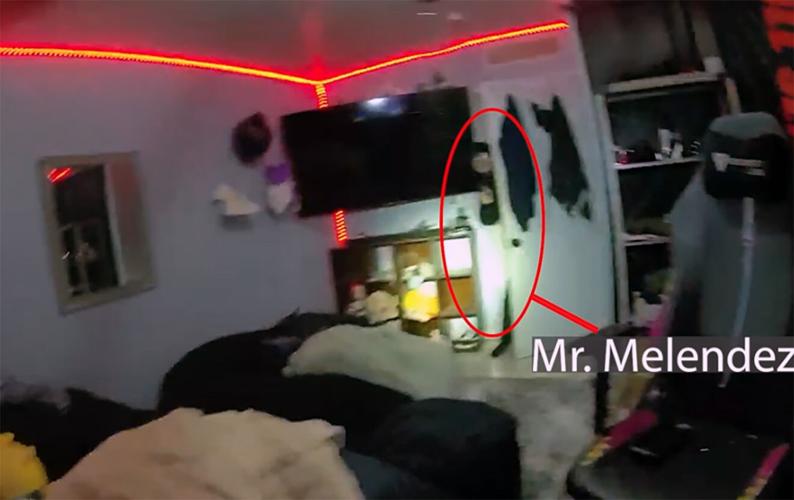
Video released last month showed the moments before the shooting of Axeel Melendez, 23, when Pima County Sheriff's deputies forced their way into his house while answering a fake emergency call about a shooting. Melendez, who was holding his mother's handgun, was shot and left paralyzed.
Melendez was wearing noise-canceling headphones while playing video games in his bedroom. His mother was asleep.
Deputies announced themselves from outside the house, Sethi said.
The Pima County Sheriff's Department’s patrol vehicles are outfitted with public address systems, said Angelica Carillo, a department spokesperson. The department also has specialized units that are better equipped than patrol to handle dynamic situations.
“They don’t use any of that,” Sethi said. "They don’t call in a canine team; they don’t call in a survey team or a SWAT team.”
The deputies, hearing nothing from inside the house, unsuccessfully tried to enter through a door.
They then went around to the back of the house.
Deputy Santiago Casillas-Velazquez, a 3-year-veteran, picked up a shovel and used it to smash open Melendez’s bedroom window.
“By this time, Axeel has heard the glass break,” Sethi said. “There’s a blackout curtain between him and the glass that’s broken, so he can’t see anything.”
Melendez ran to wake his mother, telling her to call 911, his lawyer said.
He then grabbed his mother’s handgun and went to see who was breaking into his house, Sethi said.
Deputy Andres Vasquez, a 2-year-veteran, had climbed through the shattered window into the bedroom.
Once inside, Vasquez spotted Melendez with a handgun standing behind the ajar interior bedroom door, the report says.
Vasquez and Casillas-Velazquez, who was standing outside the house, opened fire.
Melendez was shot in the right leg and shoulder.
A long recovery
At University Medical Center Tucson, Melendez underwent emergency surgery for gunshot wounds and a possible spinal injury, the report says.
In the time since the shooting, Melendez has remained in serious medical condition.
He is paralyzed from the mid-chest down and will need to use a wheelchair for the rest of his life, his attorney said.
For a large portion of the time since the shooting, Melendez has remained in the hospital. On May 19, he celebrated his 24th birthday from a hospital bed.
“Every minute is so tough,” Melendez said in a statement to the Star. “I don’t think anybody understands how hard this is to deal with. Emotionally and physically. I have had a lot taken from me. I am just trying to figure out what it means to be paralyzed and how to make a new life.”
After graduating from Desert View High School, Melendez went to Wyoming to attend an auto trade school.
“My goal was to get some experience working on highline cars and then more advanced education in automotive engineering,” he said. “I really wanted to work on an F1 engineering team.”
In addition to being an avid video gamer, he has a deep love of cars. He built a custom short-bed truck himself.
“I love soccer, and I enjoy reading and board games," he said. "I liked to be active and do stuff outside.”
Guidelines for potential swatting calls
In a guide designed to help public safety telecommunicators be equipped to handle swatting incidents, the Department of Homeland Security said swatters often call non-emergency lines to hide the caller’s true location. They also note that if only one call is made during an emergency, such as an active shooting in a populated area, they should consider the possibility of it being a swatting.
DHS recommends that if swatting indicators are present, call takers should check to see if the location is susceptible to swatting and directly contact the reported location.
Pima County Sheriff Chris Nanos told the Star he believes that the report that came on the morning of April 10 was a false report with the intent to harm Melendez. Nanos, however, would not comment on any specific aspects of the incident.
Nanos noted the possibility that there were missteps by his department but said he is waiting for the independent investigation to wrap up before an internal probe begins.

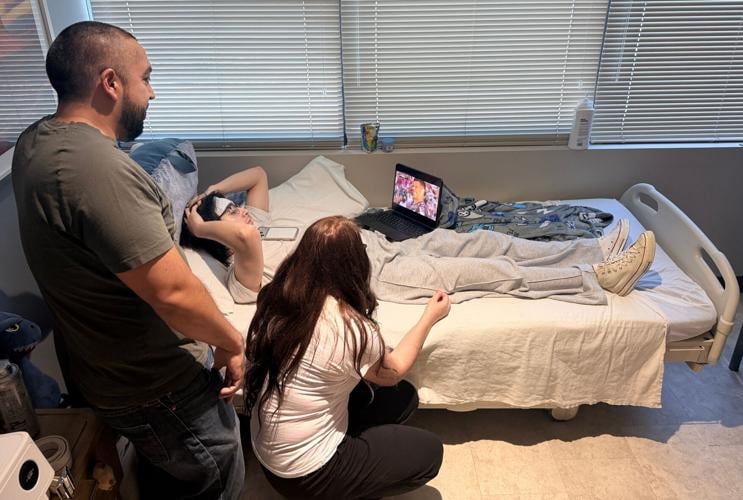
Family members join Axeel Melendez in watching a soccer match from his hospital bed.
“Were policies followed? Do we need to adjust policies because we were wrong? I don’t know,” Nanos said. “We’ll see.”
Typically, for reports of shootings, responding deputies gather information and use any available tools to approach the situation intelligently, said PCSD Sgt. Aaron Cross, president of Pima County Deputy’s Organization, the union that represents deputies.
“While we’re enroute, other units would be doing research on the call history of the house, which is available to every deputy,” Cross said. “We would look to see the call history and look into their interactions.”
Prior to being placed on administrative leave in October 2024 in what he said was a retaliatory move by Nanos, Cross was the patrol sergeant for the division and shift in which the shooting occurred.
“That would have been my squad,” he said. “That would have been my call had I not been moved out of patrol.”
He was placed on leave for holding a sign that read “Deputies don’t want Nanos” near the road while donning tan cargo pants, tan boots, a gray T-shirt, a holstered handgun and a magazine pouch with handcuffs, PCSD said in a news release.
Attorney: Nanos 'has a lot of questions to answer'
In 2016, another swatting incident involving PCSD wound up in the U.S. District Court.
On May 23, 2013, deputies responded to a reported altercation with gunfire at a residence, according to Star archives.
The couple, who were asleep at the time, were awoken by deputies banging on their door. When they answered, the two were put in handcuffs and detained while deputies searched their house.
After a search through the PCSD’s database showed the caller had a history of making false 911 calls, the couple was freed.
The couple sued the PCSD, and the department was ultimately ordered to pay them $1.25 million.
“We should’ve done our due diligence to figure out that was not a legit call,” Cross said about the 2013 incident. “These are just some of the awful things that can happen when you don’t have a lot of experience out on patrol.”
The PCSD would not comment on any policy change stemming from the incident or the requisite lawsuit.
As of February, 101 of the 195 deputies assigned to patrol had probationary status, meaning they were still in their first 18 months on the job, Cross said.
The PCSD would not answer the Star’s questions about the current number of deputies with probationary status assigned to patrol in time for the deadline.
After Nanos’ 2024 reelection, there was a wave of deputies leaving the PCSD, Cross said. The lack of experience and unpreparedness of those who remained leads to tragedy like what happened to Melendez, he added.
Casillas-Velazquez, the deputy who opened fire from outside the house, did not graduate from his first PCSD academy. He eventually graduated during his second attempt, a report from the Arizona Peace Officer Standards and Training Board says.
“It appears that poor communication and a poor understanding of appropriate policies and procedures led to a situation where Axeel was promised safety and reassured that his early reporting of extortion threats would protect him,” Sethi said. “It looks like some combination of recklessness and incompetence created this tragedy.”
“Sheriff Nanos certainly has a lot of questions to answer,” Sethi said. “And we are very curious to learn his explanation.”
“I don’t know the Melendez family at all,” Nanos said in response to the idea that the shooting was a misstep by his deputies due to being underprepared. “They could be right, but we’ll see. We’ll look at it.”





 Nancy Guthrie's Tucson neighbors: Life with streamers 'unbearable'