

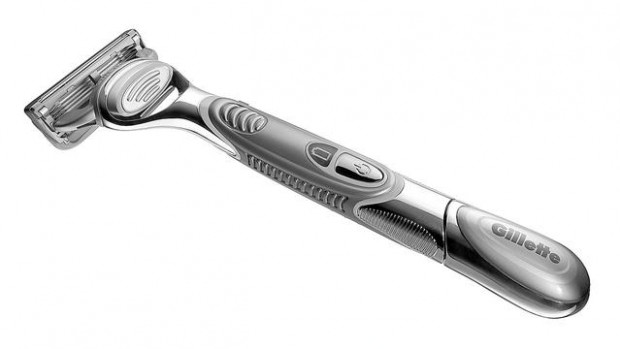
The new weapon in the perpetual war against male facial hair is a five-bladed razor called Fusion, which Gillette will debut early next year.
Yes, five blades, one razor.
It's the latest milestone in shaving innovation. The first double-bladed razor, the Trac II, appeared in 1971, and the three-blade Mach3, both from Gillette, in 1998. The four-blade Schick Quattro arrived in 2003.
"Razors have indeed improved, probably any man will tell you that," said Wallace Pinfold, author of "A Closer Shave: Man's Daily Search for Perfection."
But five blades? "That's just, 'My dog's better than yours,' " said Charles Kirkpatrick of Arkadelphia, Ark., head of the National Association of Barber Boards of America.
Some are poking fun at the blade race. Philips, which owns Gillette competitor Norelco, is running a parody ad in Britain featuring a lather-laden gentleman gazing dubiously at "The Quintippio," a fictional razor with "not 14, but 15 blades!" that's an "unstoppable cutting machine!"
People are also reading…
But more blades really are better, according to tribologists. They should know. They're the physicists, engineers and researchers who study tribology, the science dealing with friction, wear and lubrication of interacting surfaces in motion.
"It's a way of looking at any two items in contact, be it tires on a road surface or a ballpoint pen on paper," said Michael D. Bryant, a mechanical engineering professor at the University of Texas-Austin and editor of The Journal of Tribology.
He explained multiblade performance this way:
"The forces generated by the cutting action can cause the (whiskers) to bend or deflect away from the tool, reducing blade-to-whisker interaction.
"With a single blade," Bryant said, "multiple passes are required to compensate for this loss. To avoid multiple passes, other blades following the original blade effectively produce multiple passes with the same stroke."
There's a caveat. Add more and more blades, and "the razor starts getting very wide," Bryant said. Fuzzy faces and legs have contours and corners, "which you can't navigate with a wide razor. So there's the efficiency issue vs. navigation."
Thus, the wider the razor, the trickier to control.
Paul Lukas, a New York City writer, was curious about that when he did a test-shave with the Fusion in September. Gillette invited him to a fancy hotel suite to give it a try.
Lukas likened it to his usual razor, a three-blade. "It was the same width," he said. "They just crammed five blades into the same space, closer together."
So shaving with the Fusion felt almost like shaving with a solid surface, he said. He couldn't say whether it shaved better than his three-blade, as he wasn't allowed to do a comparison shave with both.
Al Medrano remains leery. He recently went from three blades to two, and said he's "getting a slightly better shave. I guess less is more."
Medrano, of Simpsonville, S.C., became a bit of a shaving legend when he published a 48-page paper after testing dozens of razors, electric shavers, preshave creams and oils, and after-shave products.
His thoughts on a five-blade razor: "I don't see it taking off much, especially when people see the sticker shock on the cartridges."
According to Gillette, the Fusion will retail for $9.99; a four-pack of refill cartridges will cost $12 to $13.