

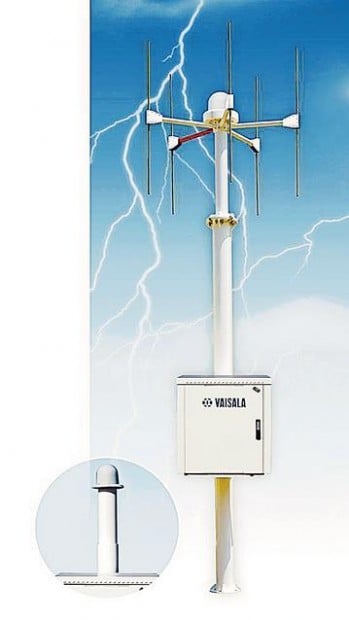
Tucson researchers have developed a lightning-detection system that is twice as accurate as its existing system, offering more precise reporting of lightning strikes.
Vaisala Inc., which operates the Tucson-based National Lightning Detection Network, has developed a new system that can determine where lightning hits within 250 meters (820 feet) or less, an improvement from the previous range of 500 meters.
The new system, dubbed Total Lightning Processor, was developed in Tucson and is a location algorithm that analyzes lightning data taken from sensors.
Vaisala is showcasing its new system this week in Phoenix at the annual American Meteorological Society meetings.
"A lot of people are excited about it at the conference," said Nikki Hembury, product manager of thunderstorm systems at Vaisala. "Our system is here and it has already been validated."
People are also reading…
Hembury said the systems cost between $100,000 to $200,000 depending on customer requirements.
Lightning causes 15,000 structure fires and burns around 2 million acres of forest each year in the United States, according to the National Oceanic and Atmospheric Administration.
Also, an average of four people are killed by lightning in Arizona each year, the NOAA said.
The detection network was started by three UA researchers, including Philip Krider, a professor of atmospheric sciences, in the mid-1970s. It detects 20 million to 25 million cloud-to-ground strikes that happen every year.
There are a number of steps to pinpoint where lightning strikes.
First a 50,000-degree Fahrenheit lightning bolt strikes and is detected by one of the company's 200 sensors in North America.
Within seconds, the information is sent to the Total Lightning Processor where the information is analyzed and sent to customers via the Internet.
The new system can save up to 80 percent of the customer's time in analyzing lightning detection sensor data because of new Web-based tools that are an improvement over the previous system, Hembury said.
The company is also preparing to improve its ground sensors, which will boost lightning detection to 150 meters, Hembury said.
A number of government and private institutions are using Vaisala's network. For example, NASA uses lightning-detection information when it launches its space shuttle.
Eric Betterton, head of the UA's department of atmospheric sciences, said the system is invaluable for understanding lightning and can be used to curtail lightning-related accidents like the collapse of the Sago Mine in West Virginia in 2006.
"Using this system to prevent lightning-caused catastrophes is huge benefit," Betterton said.
But Vaisala isn't the only company showcasing a lightning-detection system at this year's American Meteorological Society conference. A competitor, WeatherBug, announced Tuesday its own Total Lightning Network.
Did you know
Vaisala has been in business since 1938, operates all over the world and is headquartered in Finland.
Vaisala has 1,000 employees worldwide, 250 of whom are in North America. The company has 75 employees in Tucson.
Vaisala's sales were about $300 million in 2007.