

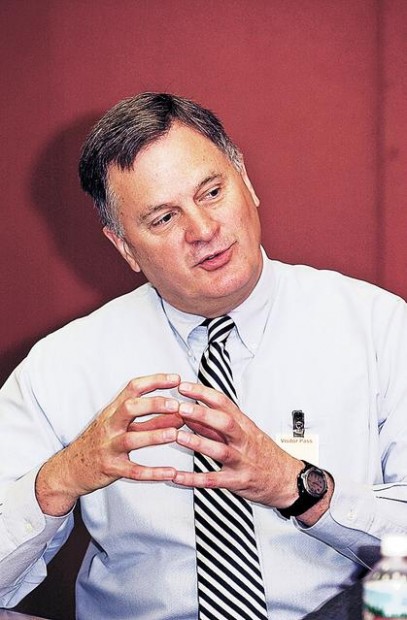
Growing the local economy has been Bruce Wright's focus for 20 years.
Wright serves as the University of Arizona's associate vice president for economic development, and he is the founder of the Arizona Center for Innovation, the local high-tech business incubator at the UA's Science and Technology Park.
Wright is working on plans to build a new 65-acre biotech park at East 36th Street and South Kino Parkway, and he is hoping the project will break ground by late 2009 or early 2010.
He spoke about the UA's economic development efforts in an interview Friday. Here are excerpts:
Q: Why do you think it's necessary for the University of Arizona to have a hand in developing the local economy?
A: I think the university plays a very significant role in several different ways. First of all, we're one of the largest employers in the Tucson metropolitan area. . . . We contribute about $2 billion a year annually to the local economy through our employees. . . . Secondly, it seems to me that we are a primary source of skilled labor for the community. . . . And then finally, as a research university we are a source of new technology that gets translated or transferred into the marketplace in the form of new products and services.
People are also reading…
Q: How has the UA's Science and Technology Park changed since the university took over in 1994, and which of those changes do you count as the biggest accomplishments?
A: The university acquired the Science and Technology Park from IBM in 1994, and, at that time, there were about 700 employees working at the facility. Today, we're approaching 8,000 employees and 30-plus companies in our organization at the tech park, so it's become more of a major employment center in Pima County. . . . So the park really has played a significant role I think in helping to advance Tucson's high-tech economy and it annually contributes about $1.5 billion to the local economy. . . .
Q: Do you know how much taxpayer money will be spent on developing the new Arizona Bioscience Park?
A: I don't. I think our principal approach to that is to partner up with the private sector to do the majority of the development of the park. . . . At this point, we have no commitment of state or local taxpayer funds for park development. We acquired the land for the park by exchanging land at the Science and Technology Park of the 65 acres we've acquired at 36th and Kino. So, to date, there has not been any formal cash or outlay on the part of the taxpayers in support of the park.
Q: Why is there a need for a second biotech park? Is this an effort to make Southern Arizona a leading player in the biotech industry?
A: The state of Arizona — Phoenix, Tucson and Flagstaff — is really focused on trying to be part of the emerging life sciences, biotech world. . . . So, we feel like we have an opportunity to play as a community in the rapidly growing field of biotechnology. One of the problems, though, is that we lack sufficient commercial bioscience space. . . . Tucson is particularly deficient in the ability to provide high-quality commercial laboratory and research space for commercial enterprises. So, one of the motivations of the park is to address that need.
Find the latest local economic-development news at AzStarBiz.com.