

Pima County’s already high property tax bills could go up another $27 for the average homeowner if supervisors approve County Administrator Chuck Huckelberry’s recommended budget, unveiled Thursday.
Package that with a proposed $20 hike in city of Tucson property taxes and yet-to-be-determined increases by the different school districts, and homeowners could be looking at a significantly elevated bottom line on their next tax bill.
Despite the recommended 18-cent combined property tax hike, Huckelberry is recommending the county spend significantly less next year.
His proposed budget for fiscal 2016 totals $1.16 billion, which is $23.5 million less than this year.
Of that total, nearly $134 million would go for construction of such things as roads, buildings and other infrastructure improvements. That’s about $98 million less than the county budgeted for construction this year. The remainder is for operating costs.
People are also reading…
The recommendation includes no significant service cuts, nor does it offer any new or expanded services.
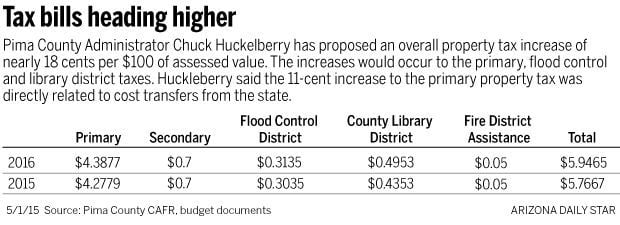
Huckelberry’s recommendation calls for an almost 11-cent increase per $100 assessed value in the primary property tax rate, which goes toward operating costs. The library district tax would go up by 6 cents and the flood control district by 1 cent, making the overall increase in the property tax rate just under 18 cents per $100 of assessed value.
Huckelberry bemoaned the fact the county already has a high property tax, but said there were few alternatives “because we have no other source of revenue.”
Pima County does not charge a sales tax, making property taxes its primary local revenue source.
If supervisors approve, the new combined rate would be $5.95 per $100 of assessed value.
“We just can’t afford it,” Supervisor Ally Miller said, asserting the county needs to find alternatives.
She suggested selling off land the county acquired in the past to preserve the Sonoran Desert, or to stop paying the University of Arizona and Banner Healthcare $15 million per year to support graduate medical education.
“Taxpayers are not responsible for educating doctors,” Miller said.
Huckelberry said the county payment to Banner next year has been reduced to $12.5 million, but he warned against cutting ties altogether.
“We’d be crazy to do that, because we’d get our hospital back,” Huckelberry said. “It’s pretty well proven we’re incapable of running a hospital.”
The county entered an operating agreement with University Physicians Healthcare and the University of Arizona to run what was then called Kino Hospital, which had proven financially disastrous for the county.
Huckelberry said part of the agreement includes support for graduate medical education. If the county broke that agreement, the cost to run the hospital would fall directly on the county.
In 2004, the last year the county was in charge, hospital costs were more than $34 million per year.
Supervisor Sharon Bronson agreed reductions of service or a closure of the hospital “would put a tremendous burden on other hospitals in the region.”
Bronson blamed the state Legislature for the need to increase taxes, saying state lawmakers have forced millions of dollars of costs onto the county this year.
“That trend is continuing and escalating at an alarming rate,” she said.
Huckelberry said the 11-cent proposed increase to the primary property tax was a direct response to the state’s cost shifts, particularly a mandate for counties to pay overages associated with school district taxes the state has paid since 1980.
State law limits the amount a homeowner must pay in combined primary property taxes to 1 percent of their full cash value. Amounts over that associated with schools, the state has paid.
“I don’t think the state constitution planned for the counties to pay for education aid to the state,” Huckelberry said.
Miller said the state and governor were right to stop paying the difference, which in Pima County has been estimated between $8 million and $18 million per year.
“(Gov.) Doug Ducey is being responsible,” Miller said. “We were being subsidized.”
Supervisor Richard Elías said the Legislature forced the county to seek more revenue.
“They created a huge amount of uncertainty,” Elías said.
He noted the county is considering a lawsuit against the state over the cost shifts, but said the county has to be prepared to pay those costs in the meantime.
Huckelberry proposed three alternatives to the increased property tax, including convincing the state to stop pushing costs down on the county, adopting a half-cent countywide sales tax and approving a jail excise tax.
But the state Legislature has deflected criticism over cost shifts, a sales tax would require a unanimous board vote, which it has not been able to get, and a jail tax requires a public vote, so it would not help the upcoming year’s budget.