

Tucson Medical Center announced a much improved financial status and plans for a 24-hour children's emergency room.
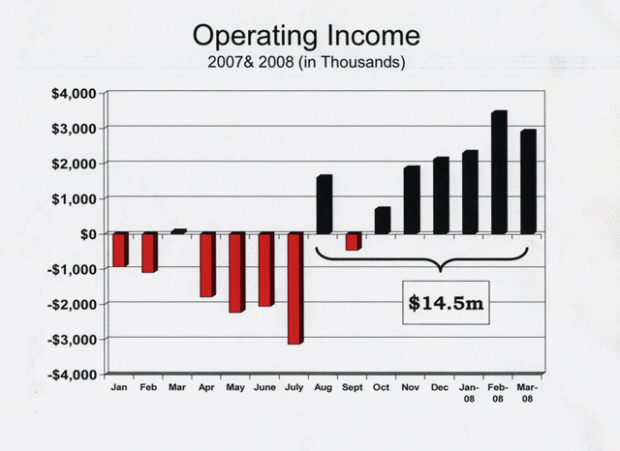
In a major turnaround, the hospital has made money in seven of the past eight months after years of losses, said Judy Rich, executive vice president and hospital administrator.
Tucson Medical Center was nearly $11 million in the red in the first half of 2007, when CEO Frank Alvarez resigned in June.
The hospital's operating income in the first three months of the year was $8.7 million, for an operating margin of 8 percent, chief financial officer Walter Yokobosky said. In the same period last year, the hospital posted a loss of $1.9 million from regular hospital operations.
The non-profit hospital got back on track by cutting 480 full-time-equivalent jobs in the past 12 months, and renegotiating supply costs for more than $2 million in savings. It also saved money by restructuring some debt, allowing it to borrow $10 million a year for three years to invest in capital projects, Yokobosky said.
People are also reading…
The hospital also was helped by a record patient volume, due in part to a bad flu season.
A raise for staff nurses
A year ago, the hospital announced layoffs of 100 workers and cut 50 vacant jobs.
In the second half of 2007, the company cut another 330 full-time-equivalent jobs from its budget, including a lot of contract nurses.
The hospital was overstaffed from absorbing workers after El Dorado Hospital closed, Rich said.
When it cut those expensive positions from the books, hospital executives came up with $4 million to give its staff nurses a raise. Most received $3 to $5 extra per hour.
Rich said she has started regular conversations with the company's staff. It would have been easy to send a "take it or leave it" message about changes at the company, she said, but she took a different approach.
"The message in all those meetings was: 'It's a new day and we don't have all the answers. We want to listen,' " she said.
She also held a series of town hall-style staff meetings and hosts monthly breakfast meetings with the staff.
Rich also shelved the "new model of care" concept that Tucson Medical Center had been developing for a few years. It was too resource- intensive, Rich said, causing the staff to give it too much attention and taking focus away from what was happening in the here and now.
The head of TMC's board of trustees said the management changes, new focus areas and strategic review of capital needs paid off.
"The board couldn't be more pleased with the progress made," said the board's chairwoman, Susan Ernsky, who is senior vice president with Mission Management & Trust Co. in Tucson.
"The management team was given very clear marching orders" to improve the quality of care and the hospital's bottom line, Ernsky said, "and they did just what we asked them to."
Capital projects
Tucson Medical Center is investing $32 million this year in capital projects, including equipment and computer upgrades and developing roads and utilities at the site of the future Rincon Community Hospital at Civano.
The hospital executives announced several new goals on Tuesday.
For one, it plans to make its children's emergency room a 24-hour operation in September. Infrastructure and jobs will be added before the expansion.
Tucson Medical Center has the second-busiest emergency room in Arizona, with 88,000 visits a year. The extra hours will add capacity.
Still on hold is a replacement facility for Tucson Medical Center, 5301 E. Grant Road. The hospital needs to record three years of solid financial performance before it can seek bonds to build the new hospital, Yokobosky said.
Additionally, the hospital and its board will decide by September whether it wants to get back into the business of trauma care, Rich said.
Although it is early in discussions, Rich said the hospital already is seeing a lot of Level 2 trauma patients and already is paying for physician on-call coverage.
On-call coverage was a factor in the closing of Tucson Medical Center's Level 1 trauma center in 2003. When it closed, the center had lost $20 million over five years. The closure of the hospital's trauma operation left University Medical Center as the only Level 1 trauma center in the area.
Tucson Medical Center also has more plans for the old El Dorado Hospital, which it bought in 2004 and closed in 2006.
El Dorado has since been turned into an outpatient health care campus, which includes a bustling senior center, an urgent-care center and a skilled nursing facility.
TMC plans to move several outpatient centers out of the hospital to El Dorado.
Rich said the hospital also hopes to open a long-term acute-care facility at El Dorado in a joint venture with Regency Hospital of Tucson LLC. Federal regulations have stalled progress for the facility, she said.