

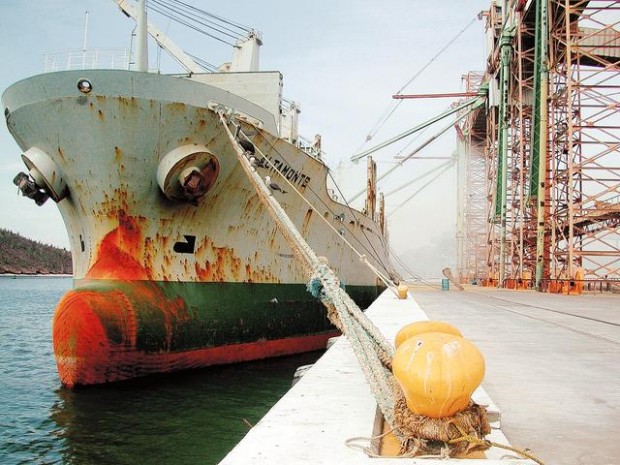
GUAYMAS, Sonora — The semi-annual meeting of officials from Arizona and Sonora often spawns hopeful statements about the little Sonoran port that thinks it can.
But the recent history of the underused Port of Guaymas, 320 miles south of Tucson, is of a port that couldn't.
That history is littered with pledges and plans to develop it into a significant gateway for international trade that serves as Arizona's seaport. Those plans never seem to pan out, and traffic at the port dwindles.
This week, two ships are scheduled to arrive at the port, one of them a passenger ferry.
But now, conditions are different, say officials at the Port Authority of Guay-mas. Now there is an extreme backlog of ships at the port of Long Beach, Calif., an unprecedented flood of imports from China, record-high copper prices and a post-drought revival of Mexican agriculture.
People are also reading…
The possibilities impressed Arizona Gov. Janet Napolitano, who toured the port with Sonoran Gov. Eduardo Bours last weekend as part of an Arizona-Mexico Commission meeting.
"As you drive around the area, there is construction and economic activity aplenty," Napolitano said. Arizona and Sonora "are hot right now … in terms of energy and vitality, and as the commission makes clear, there is a great deal of momentum for creating the Arizona-Sonora region as an economic entity and partners to the world."
Guaymas, she said, could be the region's portal to the world. And if the port assumes that role, the resulting increase in shipping could give Tucson big economic benefits. Goods headed both ways along roads and rails from Guaymas could mean more local jobs in warehousing, logistics and manufacturing.
Seek Long Beach overflow
During the tour, port spokesman Guillermo Von Borstel noted that container ships currently wait 14 to 21 days to unload at Long Beach.
Guaymas could well serve as one of several "reliever ports" for Long Beach, particularly for shipments that are time sensitive, he said. The proper investments in infrastructure and equipment could transform Guaymas from a "hinterlands" port that primarily moves bulk materials — oil, cement, copper and crops — to a port that handles a variety of goods in containers, Von Borstel said.
"Our major focus at the port for our development this year is a container terminal that would be built and operated by a private company and the corridor for trucking that would move those containers," Von Borstel said.
At present, Guaymas' port lacks the depth of water, necessary access roads, and cranes to move containers. If the port gains the capacity to handle them, port officials estimate they'd move 100,000 containers in the first year and be capable of moving three times that in future years, Von Borstel said.
But the Tucson man who built, owns and operates his own local inland port said container business at Guaymas is still something of a pipe dream.
"At the end of the day, economics will make or break things," said Alan Levin, owner of the Port of Tucson, an industrial park and "intermodal" center near South Wilmot Road and Interstate 10 that moves containers between railroad cars and trucks. "The economics of unloading a supercontainer (ship) in Long Beach will far outweigh unloading a smaller container (ship) in Guaymas."
Levin said he respects the efforts of those who want to increase business at the port and along the corridor from Guaymas to Tucson. In fact, his business would benefit. But the reality is that other ports are already in a better position to handle Long Beach's backlog, he said.
"There are other ports along the West Coast like Vancouver, and there are other ports in Mexico, and there is Houston for ships that can fit in the Panama Canal," he said.
ASU feasibility study due
The lures of increased cargo at Guaymas and its spinoff benefits to Arizona were attractive enough for the state to fund an extensive study by Arizona State University of the port's potential and the condition of the infrastructure along the Tucson-Guaymas corridor that would support it, said Augustine Garcia, director of the Tucson-Mexico Trade Office.
The results of the study, expected to be released in February, could have a profound impact on investments in the port and the corridor, Garcia said.
Colby Bower, policy coordinator for the Phoenix-based Border Trade Alliance, expects an improved outlook for Arizona and Guaymas.
"With Long Beach the way it is and along with some other things, it sounds like the numbers may really be lining up a little bit better, and that's why the study is what everybody is waiting for," Bower said. "The initial indications are that Guaymas could take significant pressure off of Long Beach if it were developed into a deep-water port."
Bower said the development of "e-seals" — electronic security seals — could also be a major boon to ports like Guaymas. Such seals allow customs officials to track shipments at all times and be apprised if a seal on a container is broken, he said. U.S. Customs officials could apply such seals at Guaymas, he said.
"More than anything it shows you that a container hasn't been compromised," Bower said. "The idea is, if we know what's going into the container once the electric seal is on there, why should it have to be stopped?"
Sealed containers could then whiz through international border crossings like the Mariposa Port of Entry in Nogales without waiting for Customs officials or being inspected there. Under current conditions, it's not unusual to see U.S.-bound trucks at Mariposa lined up for several miles, and trains are also subject to inspections and long waits, Bower said.
Long Beach offers crane
The ability to handle container ships at Guaymas would require dredging at least part of the port to make it deep enough to handle ships that carry about 4,500 containers, A crane being offered by officials at Long Beach, which is currently re-tooling to handle the next generation of ships known as "supercontainers," would lift the containers off the ships at Guaymas and onto rail cars or trucks. Access roads leading to the port would also have to be improved, Von Borstel said.
Estimates on how much those improvements would cost and how they would be paid for by added commerce are part of the ASU study, Garcia said.
What would be considered an insignificant number of containers to Long Beach would make a big difference for Guaymas, which has operated at less than 20 percent of its capacity in recent years, Garcia said.
Long Beach moved more than 5 million containers last year.
"The overflow at Long Beach is so great that everybody is looking for a piece of it," Garcia said. "Even if you get only a tiny fraction of the action, that would have a huge impact here."
The initial indications are that Guaymas could take significant pressure off Long Beach if it were developed into a deep-water port.
Colby Bower
Phoenix-based Border Trade Alliance policy coordinator
World trade negotiations resume this week in Hong Kong, but disagreements could doom them. Page D7.
● This week's two arrivals at the Port of Guaymas
1. Ship: Santa Rosalia
Nationality: Mexican
Arrival day: Monday
Coming from: Santa Rosalia, Baja California Sur
Cargo: Passengers and vehicles
Departure day: Monday
2. Ship: Ranunculo
Nationality: Panamanian
Arrival day: Monday
Coming from: Kenai, Alaska
Cargo: fertilizer
Departure day: Wednesday