


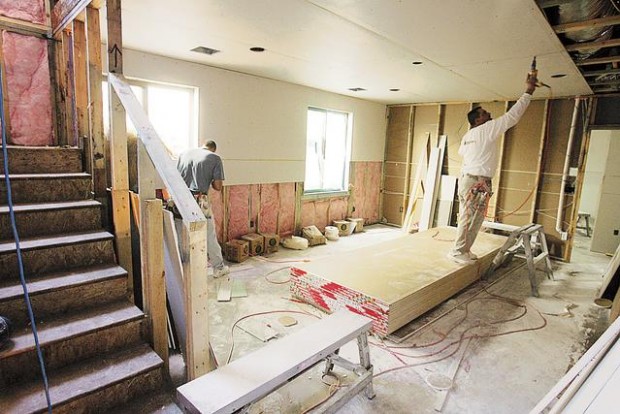
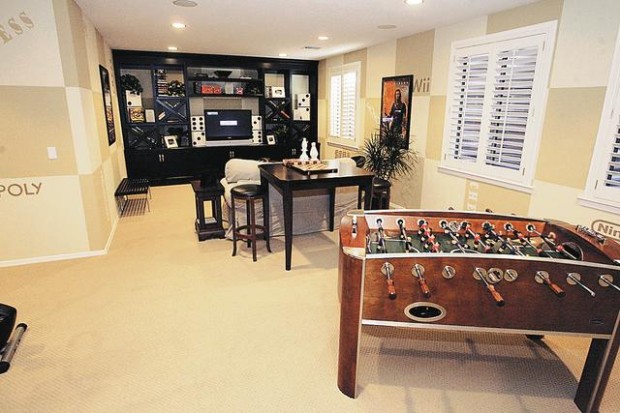
Basements are something of an anomaly in desert dwellings. But amid a slowing housing market, one Tucson-area home builder is banking on rising consumer interest in subterranean space.
Scottsdale-based Maracay Homes has been building houses with basements in the Phoenix area for about four years and started offering them in Rancho Sahuarita about a year ago.
The buyers often are transplants from the Midwest or the Northeast, where basements are generally standard, said Dave Bessey, Maracay's president.
"What we found from research with our buyers is people, especially from the Northern climates, were asking about basements and why we weren't doing them," he said.
In subdivisions where the company offers basements, typically about a third of the home buyers choose that option, Bessey said. That may be a sizable number considering the cost: about $80,000 to $100,000 on top of the sticker price for a typically sized basement, which come fully finished and with windows.
People are also reading…
The extra cost seemed reasonable to Sarah Hughes and her husband, Derrick, who bought a basement-equipped home in Rancho Sahuarita in April.
Sarah Hughes said she and her husband are both from states where basements are common. They were interested in a basement partly because they think it will help to reduce energy bills in the summer, she said.
"I was surprised when I moved to Arizona that very few people had basements," she said. "I thought of all the states in the whole country, people should have basements (in Arizona), where it's so hot."
Maracay is bucking a national trend, which is showing a move away from basement building, according to the National Association of Home Builders.
About 29 percent of homes built in the United States in 2006 had full or partial basements, compared with about 37 percent in 2000, the association says. Meanwhile, about 56 percent of homes built in 2006 had slab foundations, compared with 46 percent in 2000, the association says.
The likelihood of finding a basement varies by region, depending on the type of soil, consumer preference and the expense of putting living space underground, said an e-mail from Stephen Melman, director of economic services for the National Association of Home Builders.
Bessey, of Maracay, said basements generally are found in colder climates, where the ground typically freezes. Setting the foundation below ground helps protect it from temperature extremes, he said.
"By the time you dig deep enough, you might as well put in a basement," he said.
In Arizona, dense bedrock can make adding basements expensive and difficult, although they have become somewhat popular in Phoenix, industry members said.
"Up in the (Catalina) Foothills, I doubt you'd find very many basements at all, because that probably would require blasting," said Roger Yohem, a spokesman for the Southern Arizona Home Builders Association.
Yohem added, however, that an "outdoor lifestyle" may be the biggest factor dictating the lack of basements in the state.
Interest in basements has ebbed and flowed over the years in Arizona, but they've never really taken hold, Yohem said. But that may change as land becomes more expensive, he said.
"In the future, 25 years down the road, in this Tucson market you'll be seeing a lot more two-story houses," Yohem said. "That might be a traditional two-story home or a regular home with a basement."